
At GeoBusiness 2017 in London, Hugh Boyes, a Cyber Security specialist outlined some of the security risks of digital engineering and the importance of cybersecurity for engineering projects. BIM models, floorplans and 3D LiDAR scans of sensitive buildings and infrastructure can often be found on the web. He mentioned the floorplan of a major police station, a BIM model of a young offenders facility, and a BIM model of the Victoria Underground station. All of these could potentially be very useful to anyone interested in disrupting infrastructure. It is well-known that mapping underground infrastructure reduces risk during construction and also during disasters, natural and man-made. However, it can also provide information about sensitive infrastructure. Hugh mentioned substations as particularly sensitive elements of the energy grid. With traditional centralized generation, substations are critical elements of the grid and are particularly vulnerable. In many countries disrupting a small number of large substations can leave significant parts of the country without power. (An advantage of a decentralized grid comprised of many microgrids with their own generating and storage facilities is that it is much less vulnerable.)
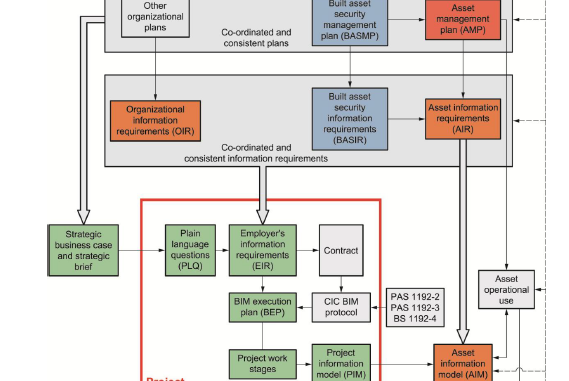
For people who are designing and building sensitive infrastructure using BIM, he recommended following the PAS1192-5 guidelines and incorporating security into the design from the start. PAS 1192-5 specifies processes which will assist organizations in identifying and implementing measures to reduce the risk of loss or disclosure of information which could impact the safety and security of personnel and users of infrastructure or the built infrastructure itself. PAS 1192-5 is applicable to any built asset or portfolio of assets which is deemed sensitive. It is for use by asset owners and organizations involved in the design, construction, maintenance and management of built assets, especially those who wish to protect their commercial information and/or intellectual property. Hugh is the joint technical author of BS PAS1192-5 – Specification for security-minded building information modelling, digital built environments and smart asset management.

Be the first to comment