
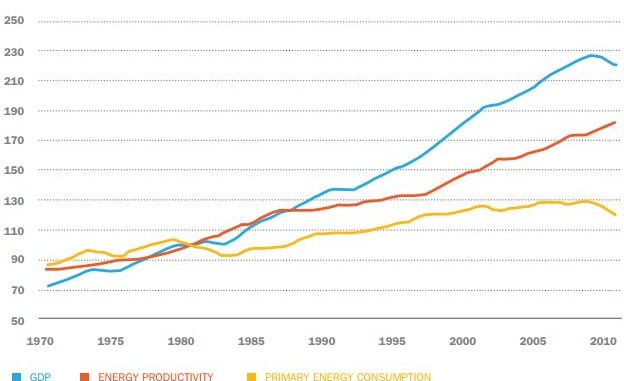
The Department of Energy’s (DoE) Quadrennial Technology Review 2011 has some very interesting statistics about energy use by buildings and DoE’s priorities in meeting the Adminstration’s goal of improving the energy efficiency of commercial and residential buildings by 20% within a decade.
The energy productivity of the United States has increased by more than 85% during the paat three decades. Energy productivity, often called energy intensity, is the gross domestic product divided by the total energy consumed and is a measure of how much energy is required to produce a dollar of GDP. Developong countries like China, whose per capita emissions are much less than the U.S., prefer energy intensity as a measure of their contribution to emissions reduction.
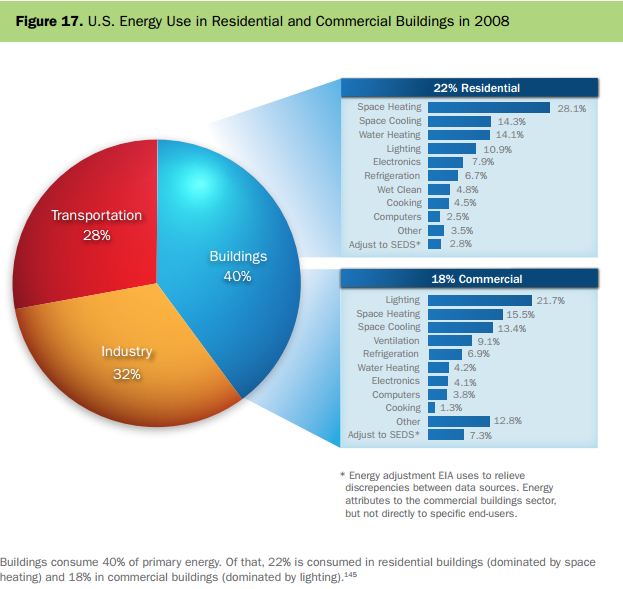 In the U.S. 40% of primary energy consumption and 72% of electricity is used by commercial and residential buildings. HVAC, lighting, water heating, and electronics account for about three-fourths of primary energy demand for buildings. Energy usage in commercial buildings is dominated by lighting. In residentail buildings most of the energy is used for heating. Electricity accounts for 40% and 53% of site energy use in residential and commercial buildings, respectively. Fuels for heating and cooking account for 60% and 47% of energy usage in residential and commercial buildings.
Approximately 60% of the commercial floor space and 75% of the homes that will be occupied in 2030 have already been built.
Department of Energy priorities
Many of the cost-effective energy efficiency measures available today for buildings and industry are not implemented because non-technological barriers, such as split incentives, inhibit their deployment.. It is estimated that technologies already available or soon to be available could reduce building-related energy consumption by 25% to 45%. It has been deomnstrated that an integrated approach to building design, construction and operation can cost-effectively yield energy savings exceeding 50% in new builds.
For existing buildings energy savings of more than 40% savings have been demonstrated in retrofits in a variety of climates, including more than 20% savings over the current minimum (building code) requirement.
According to DoE key enablers for deploying these technologies include
- calibrated data through distributed sensors
- validated modeling
- real-time control of a building’s components and their interactions with the electrical grid.

Be the first to comment