
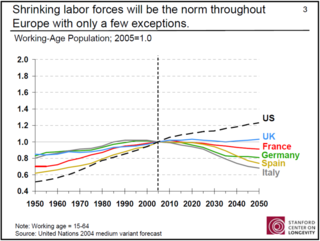
I have blogged about the shrinking workforce in countries around the world like Japan and Germany, but also in other West European countries. The shrinking workforce is acting as a brake on the German economy. The German Chamber of Industry and Commerce
DIHK estimates that German economic growth has
been reduced by one percent by the labour shortage and that the problem
is getting worse.
The Bundestag recently adopted a bill to implement the 2009 EU directive on highly qualified employment.
The “Blue Card” is intended as a new, unbureaucratic way for graduates
and people with similar qualifications from outside the EU to enter
Germany’s labour market. Austria and Gernmany have also opened the door to skilled immigrants from the east European countries tha t joined the EU in 2004. As a result last year the population of Germany increased for the first time since 2003.
North America and Australia would be facing the same demographics if it
weren’t for immigration. Canada and Australia allow more immigrants in
annually on a per capita basis than any other major countries. For the
past seven years Canadian immigration levels have been at about 240,000
to 265,000 new permanent residents annually..
Many countries are now competing for highly educated and skilled international workers.
 As an example, in a recent interview Steven Harper, the Prime Minister of Canada, said that Canada is changing its immigration to shift the immigration system away from accepting people on a first-come, first-serve basis to one where potential immigrants are chosen according to how they can benefit Canada. The old system operated on receiving applications and processing them in order. The new system is designed to prioritize potential immigrants depending on the skills that the Canadina economy needs.
For example, the Canadian Experience Class program is designed to attract people who have already proven they can integrate into Canadian society and meet its labour-market needs. This program fast-tracks permanent residency applications for skilled foreign workers and graduate students who have already spent time in Canada on temporary permits or student visas and can demonstrate they are proficient in either English or French. Before it was created, highly skilled outsiders could not apply to become permanent residents from within Canada. Under the new program, applicants can apply from within Canada and expect a quick decision, normally within one year. The top three countries of origin under this program are China, India and the Philippines
and the program is the fastest-growing category of newcomers to Canada.

Be the first to comment