
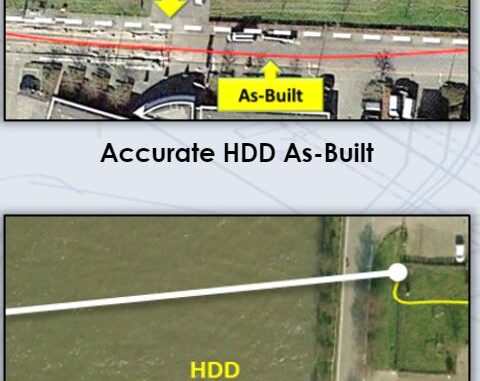
Currently best practices for recording the location of new underground infrastructure is to survey it after installation and before covering the trench. Appropriate survey tools are total stations, RTK, and LiDAR. However, trenchless technology is increasingly being used with the result that crossbores have become a major problem in many jurisdictions. A technology that is being increasingly applied to locating pipe networks installed this way is inertial locating. Using this technology it is possible to map networks of pipes with diameters ranging from 29-34mm to 90-1500mm for distances of up to 2 km with a precision of up to 15 cm in XYZ. The output of such a system is a 3D model.
Knowing where things are underground has become important enough that in several countries around the world; France, the Netherlands, Belgium, Singapore, U,K. and the U.S., initiatives to create national digital twins of below-ground infrastructure are already underway. Recently there have been important technical advances in several technological areas that are have brought the feasibility of cost-effective mapping of underground infrastructure within reach. The most accurate way to detect the location of underground infrastructure is to (carefully) dig a hole to expose it and then bring in a survey team to survey the location. But this is time consuming and expensive – it is estimated that the average cost of a pothole is $30,000. Depending on the technology used to dig the hole it can also he hazardous. Excavation technologies such as hydraulic and vacuum excavation are safer but also expensive.
Currently best practice for locating underground infrastructure is walking the site or right of way with electromagnetic wands (EMI) or ground penetrating radar (GPR) pushcarts. There are reports of successful applications in which a rig with GPR arrays collected data at roadway speeds of up to 130 kilometers per hour. This is a major advance because of safety and efficiency – no boots on the pavement and rapid data acquisition. Reality capture technology is being used commercially to capture the depth and location of new pipelines during construction. After the pipe has been placed in the trench and before covering it, it is scanned using a rig equipped with a mobile laser-scanner and photo cameras. However, locating pipe networks installed with horizontal drilling (trenchless digging) remains a challenge. In many jurisdictions crossbores are a major problem with potentially disastrous consequences.
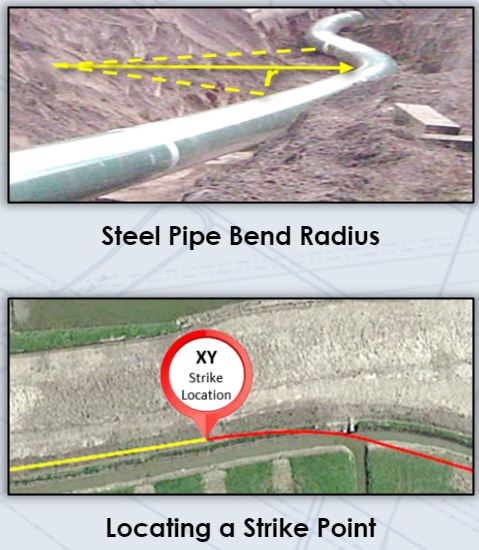 The Reduct DuctRunner inertial mapping technology is composed of an Orientation Measurement Unit (OMU) that contains inertial sensors. The OMU is battery powered and the data logged is stored internally during a measurement run. Unlike other technologies for tracking trenchless digging does not need to be traced from above ground as it moves through a pipe. The device also contains odometers recording the the speed of travel. After a run that can stretch up to 2 km, Reduct’s software converts the data recorded by the OMU and odometers to an accurate 3-dimensional line that can be exported in several formats (.csv, 3D AutoCAD, or Google Earth KML file).
Be the first to comment