
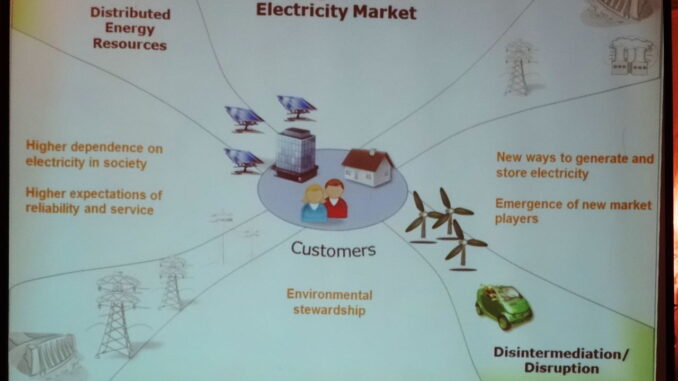
I’ve blogged previously about the challenges that solar PV and companies like Solar City pose for the traditional asset-based utility business model. For the first time in 100 years companies like SolarCity are providing consumers with a competitive alternative to the local power company. This is disruptive for the traditional utility business model.
Regulators are very concerned about this trend. The National Association of Regulatory Utility Commissioners (NARUC) and FERC periodically meet for what they call a Sunday Morning Collaborative to discuss common burning issues. As a measure of the level of concern, at a recent SGIP meeting FERC Commissioner Norris said that the burning issue currently being discussed at these meetings is new utility business models. Jon Wellinghof, outgoing chairman of FERC, has said
“Advances in technology and the desire we are seeing at the consumer level to have control and the ability to know that they can ensure the reliability of their system within their home, business, microgrid or their community. People are going to continue to drive towards having these kinds of technologies available to them. And once that happens through the technologies and the entrepreneurial spirit we are seeing with these companies coming in, I just don’t see how we can continue with the same model we have had for the last 100 or 150 years.”
A recent study of decoupling suggests that providing energy services may be one of the important future options for utiltiies. Some utilities have come to a similar conclusion.
At the Second Annual Summit on Data Analytics for Utilities in Toronto, Bradley Wasson, Project Director at NB Power did not pull any punches when he said that the traditional utility business model based on a return on investment in assets has come to an end. He emphasized that we are in the midst of an inflection point for utilities.
Ductless mini-splits and disintermediation
The immediate driver for this in New Brunswick is not solar PV, but heat pumps known as ductless mini-splits, which improve energy efficiency for heating and cooling (reducing demand for power) and of which there are about 20 000 in New Brunswick. The threat is disintermediation, when a third party comes between the utility and its customer. As another example, Microsoft Hohm and Google Powermeter were perceived as threats because utilities found the idea of a Microsoft or Google insinuating itself between the utility and its customers unattractive.
Future utility business model
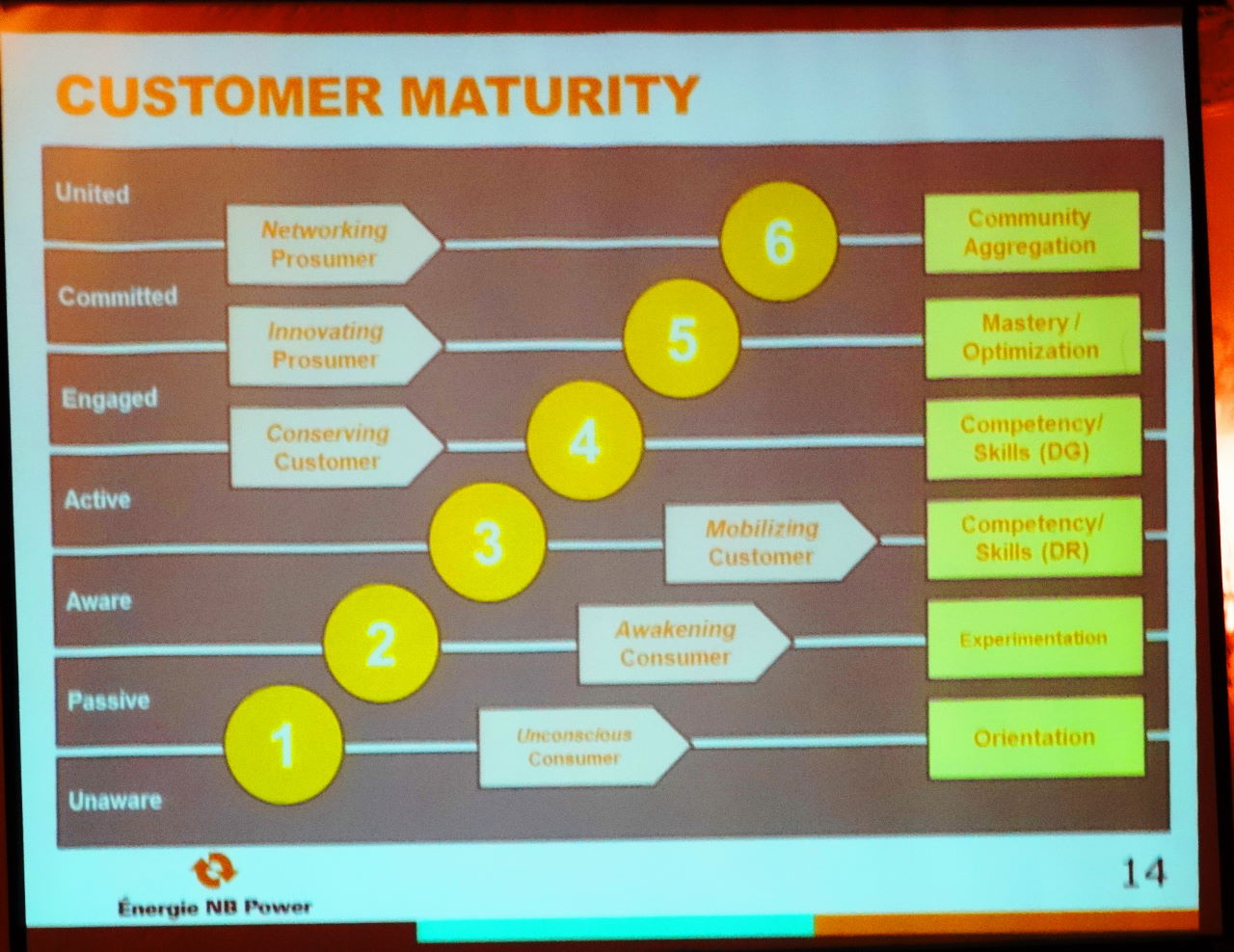 This led Brad to the conclusion that utilities need to understand their customers better. He outlined some of the things that NB Power is doing to improve communications with its customers including developing a customer maturity model.
He sees the utility business model evolving to providing energy products and services. Other utilities have come to a similar conclusion.

Be the first to comment