
I spent most of last week at the Geospatial World Forum 2013 (GWF 2013) in Rotterdam, which was an amazing event, because of its focus on monetizing geospatial value in vertical industries, Industries for which there were symposia at GWF 2013 include construction and infrastructure, electic power and gas, mining and exploration, water as a resource, water distribution management, and agriculture in addition to more traditional sectors such as land management, photogrammetry and the environment.
I spent most of my time in Construction and Infrastructure sessions. There were many absolutely fascinating pesentation on the applicaton of geospatial technology in this sector. Among the most far-reaching in terms of potential impacts were three or four talks that explicitly addressed the challenge of finding a practical way to integrate geospatial into construction processes.
Value of geospatial information
To put this in context, there is a strong drive in the Netherlands to integrate geospatial information into govenrment organizations. Geonovum is leading the charge in this area. By way of motivation there is a very
interesting cost-benefit analysis in the context of the European INSPIRE
initiaive by Ecorys and Grontmij in November 2009. The scope of study
was the cost and benefits of the collection, maintenance and
dissimilation of geographic information, but just within governmental
organizations in the Netherlands. The study did not attempt to
estimate the value of geospatial information to society as a whole. It concluded that over 15 years, the total net benefit to government organizations in the Netherlands would be € 34 million (Ralf Duinmeijer, Joulz ICT private communication).
Cost of poor interoperability
To put this in the context of interoperability and what poor interoperability costs the economy and individual firms, in 2004 in a remarkable study
the U.S. National Institute of Standards and Technology (NIST)
attempted to identify and estimate the efficiency losses in the U.S.
capital facilities industry resulting from inadequate interoperability.
The NIST study focussed on interoperability problems attributed to the
highly fragmented nature of the industry, the industry’s continued
paperbased business practices, a lack of standardization, and
inconsistent technology adoption among stakeholders. It concluded that inadequate interoperability cost the U.S. capital
facilities industry $15.8 billion in annually in 2002, but qualified the
conclusion by saying that this is likely a conservative figure because
there were additional significant inefficiency and lost opportunity
costs associated with interoperability problems that were beyond the
scope of NIST analysis.
At GWF 2013 it was reported that Rijkswaterstaat, responsible for public works and water management as part of the Dutch Ministry of Infrastructure, has estimated that poor interoperability costs it € 800 million per year.
Barriers to integrating BIM and geospatial
Bram Mommers, who is with ARCADIS Netherlands, set the stage by looking at what the barriers are
that are hindering the integration of geospatial into the constrcution process. (ARCADIS is a large
international company that provides consultancy, design, engineering and
management services in the fields of infrastructure, water, environment
and buildings.)
Traditionally the challenge has been that civil engineering on one hand and geospatial on the other have been different cultures. The way Carl Steinitz put is that they work at different scales. Geospatial scientists deal with the universal, engineers with the very specific.
Bram gave some examples of these parallel worlds. Geospatial folks make maps, engineers and architects make drawings. Engineers and architects use CAD or BIM design tools. Geospatial folks use GIS. The geospatial standard for buildings and infrastructure is CityGML. The AEC standard for BIM models is Industry Foundation Classes (IFC).
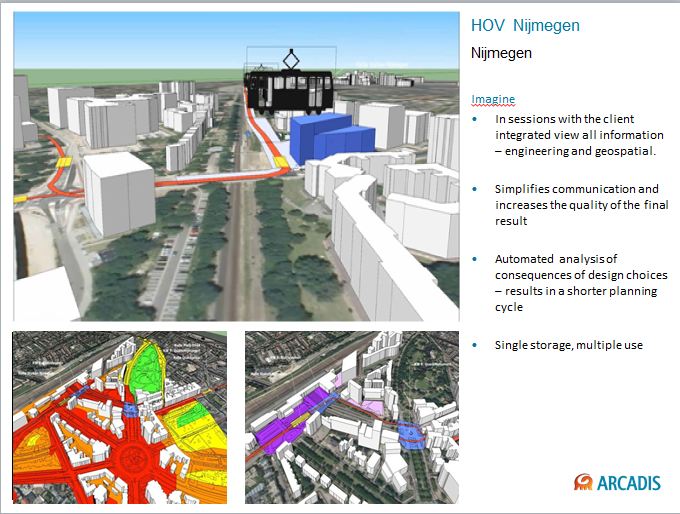 ARCADIS has been involved in projects that integrated geospatial into the desing process. On the HOV Nijmegen project it was found that integrating geospatial and engineering design in a single database resulted in a single copy of each data element and multiple use. It simplified communication and increased the quality of the final design. It also enabled automated analysis of the consequences of design choices with the result that the planning cycle was shorter. Bram mentioned several other projects that benefitted from the integration of geospatial with the construction process.
Based on their experience with these projects, Bram and his colleagues concluded that there are three main barriers to the integration of civll engineering and geospatial.
- Semantics – for example, different terms used for the me things by geospatial analysts and civil engineers and designers
- Different topology – examples, (1) geospatial uses point, lines, and polygons; CAD/BIM uses splines, nurbs, and other parametric curves and treats polygons in a different way from geospatial topology; (2) features with location vs objects with location as an attribute
- Data formats – for example, geospatial data is stored in shape files, GML, an
 d CityCML; CAD/BIM uses DWG, DGN, RVT files, and IFC
Mapping semantics
To address the first issue of semantics, a Dutch initiative called Concept Library (CB-NL) sponsored by the Dutch Council on Building Information (BIR), a joint government and industry initiative, has been created with the objective of developed an open, on-line system to map between the terminologies used in different domains. The goal is a single integrated model for construction (buildings and infrastructure) that would allow design, construction, maintenance and operations to share the same data. The concept library would be extended to include geospatial. The overall goal as Bram stated it is
- Ontology for the build environment – multiple sets of domain terminologies mapped on to it
- One language
- Combines geospatial and construction
 The impacts of this appproach that Bram sees are
- Store once, use multiple times – avoid redundant data
- Integrated information management – based on data custodians
- Geolocation as a property of an object – in additon to features
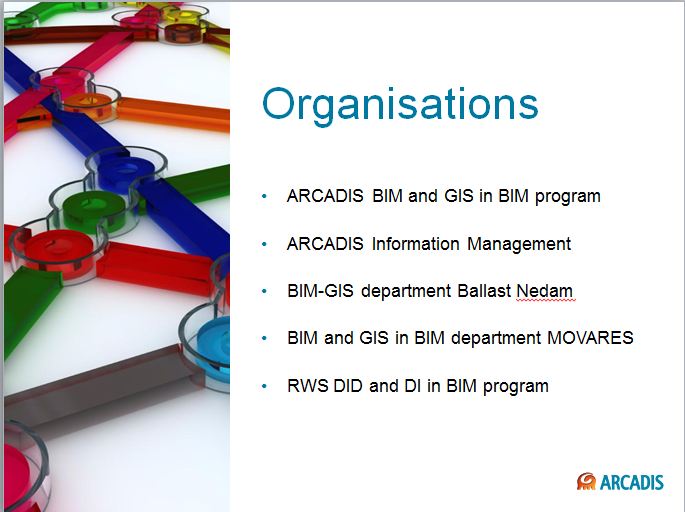
Bram listed a number of organizations in the private construction sector that are supporting this initiative.

Be the first to comment