
Geospatial World has just published the results of a survey of 650 of its readers conducted between November 2014 and January 2015 targeted on their geospatial technology and data usage.
Geospatial softwarion
One of the questions asked in the survey was
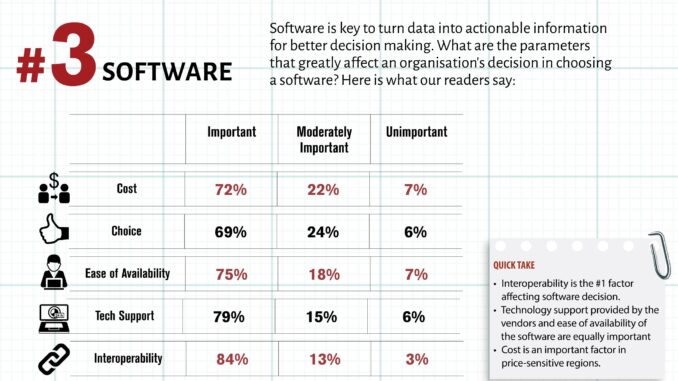
What factors are most important in determining your organization’s buying decisions when procuring geospatial software ?
The choices were cost, choice, ease of availability, level of technical support, and interoperability. I found it very interesting that interoperability came out on top. Nearly all (97%) of respondents found it an important factor.
 This supports the effort over many years that many in the geospatial sector have put into developing geospatial standards to enable geospatial interoperability, especially the Open Geospatial Consortium (OGC) standards. The next challenge is multi-disciplinary interoperability in vertical domains such as construction and utilities.
 There are a number of initiatives underway to develop standards and best practices to support interoperability in construction. The OGC, buildingSMART, and ISO have agreed to work together on developing common standards. The first result of this collaboration is a common data model for alignments (important in transportation modeling) that is shared by the building and information modeling (BIM) and geospatial sectors.
 Similarly in the utility sector the Smart Grid Interoperability Panel (SGIP) and the OGC have signed a memorandum of understanding to work together on integrating geospatial with smart grid standards in the electric power sector. For example, the MultiSpeak standard which was developed for electricity distribution utilities incorporates the OGC Geography Markup Language (GML) 2.1.2 standard for geospatial location.
Recently the OGC and the World Wide Web (C3C) signed an agreement to improve interoperability and integration of spatial data intended to make geospatial a fundamental component of the Web.

Be the first to comment