

The Special Report on Managing the Risks of Extreme Events and Disasters to Advance Climate Change Adaptation, which was just released at the Intergovernmental Panel on Climate Change (IPCC) 34th Session being held in Kampala, Uganda, assesses how exposure and vulnerability to weather and climate events determine impacts and the likelihood of disasters. It evaluates the influence of natural climate variability and anthropogenic climate change on climate extremes that can contribute to disasters, as well as the exposure and vulnerability of human society and natural ecosystems. In assessing the impact of climate change on different phenomena, the report is very careful to assign a probability using the following terms:
- Virtually certain 99-100% probability
- Very likely 90-100% probability
- Likely 66-100% probability
- About as likely as not 33 to 66% probability
- Unlikely 0-33% probability
- Very unlikely 0-10% probability
- Exceptionally unlikely 0-1% probability
Some interesting conclusions
There is evidence that some extremes have changed as a result of anthropogenic influences, including increases in atmospheric concentrations of greenhouse gases.
- It is likely that anthropogenic influences have led to warming of extreme daily minimum and maximum temperatures on the global scale.
- There is medium confidence that anthropogenic influences have contributed to intensification of extreme precipitation on the global scale.
- It is likely that there has been an anthropogenic influence on increasing extreme coastal high water due to increase in mean sea level.
Economic losses from weather- and climate-related disasters have increased, but with large spatial and interannual variability (high confidence).
 Models project substantial warming in temperature extremes by the end of the 21st century.
- It is virtually certain that increases in the frequency and magnitude of warm daily temperature extremes and decreases in cold extremes will occur in the 21st century on the global scale.
- It is very likely that the length, frequency and/or intensity of warm spells, or heat waves, will increase over most land areas.
- The 1-in-20 year extreme daily maximum temperature (i.e., a value that was exceeded on average only once during the period 1981–2000) will likely increase by about 1°C to 3°C by mid-21st century and by about 2°C to 5°C by late-21st century, depending on the region and emissions scenario.
It is likely that the frequency of heavy precipitation or the proportion of total rainfall from heavy falls will increase in the 21st century over many areas of the globe.
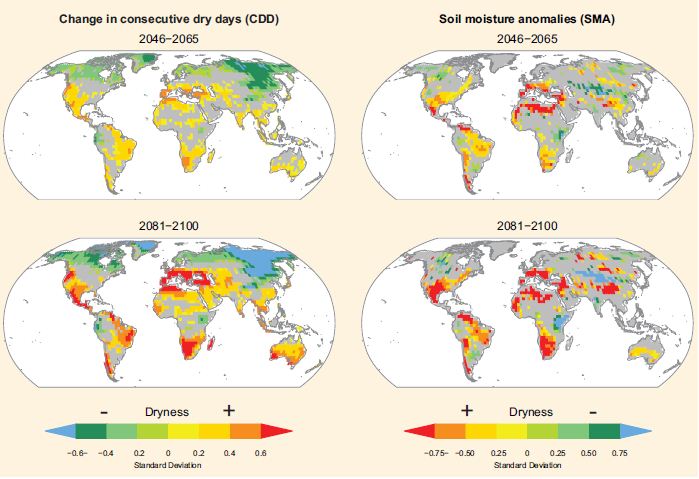
There is medium confidence that droughts will intensify in the 21st century in some seasons and areas, due to reduced precipitation and/or increased evapotranspiration.
It is very likely that mean sea level rise will contribute to upward trends in extreme coastal high water levels in the future.
- There is high confidence that locations currently experiencing adverse impacts such as coastal erosion and inundation will continue to do so in the future due to increasing sea levels, all other contributing factors being equal.
- The very likely contribution of mean sea level rise to increased extreme coastal high water levels, coupled with the likely increase in tropical cyclone maximum wind speed, is a specific issue for tropical small island states.
There is high confidence that changes in heat waves, glacial retreat and/or permafrost degradation will affect high mountain phenomena such as slope instabilities, movements of mass, and glacial lake outburst floods.
There is also high confidence that changes in heavy precipitation will affect landslides in some regions.

Be the first to comment