
I blogged previously about a presentation that, Rod Nikula, VP Power Supply at Wright-Hennepin Cooperative Electric Assn (WH)
in Minnesota, gave at a NRECA conference that hit on a very sensitive topic among power utilties. Companies like SolarCity,
a full service solar PV energy company, offer a financially attractive
solar package once the
power rate from the local utility reachs 14 cents/kWh or above. SolarCity offers a unique leasing plan that requires no money down.
It offers a flat rate for 20 years, and payments are made against
savings from the monthly utility bill.
This is an example of what a recent Edison Electric Institute (EEI) report refers to as disruptive challenges that threaten to force electric power utilities to change or adapt the business model that has been in place since the first half of the 20th century, These disruptive challenges have arisen due to number of factors incluiding the:falling costs of distributed generation such as solar PV, demand-side management technologies (DSM), government programs to incentivize solar PV and other technologies; and the very low price of natural gas. EEI sees these forces as potential game changers to the U.S. electric utility industry. They are seen as likely to dramatically impact customers, employees, investors, and the availability of capital to fund future investment. The EEI does not attempt to predict the timing of this potential industry transformation, but argues that the potential for a transformation of the electric power industry must be taken seriously.
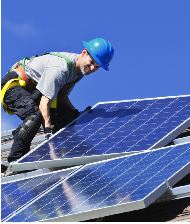 By 2022 it is projected, assuming continued decreases in the cost of
solar panels, that solar power will deliver power more cheaply for 10%
of residential demand in 49 states, the only exception being Washington
State which has the lowest power rates in the United States. Furthermore according to another report,
solar PV installed by businesses is projected to be competitive with at
least 10% of commercial power demand in the United States by 2022.
The financial risks created by these disruptive challenges include declining utility revenues, increasing costs, and lower profitability. As DER and DSM programs become broadly adopted, utility revenues will tend to declline. The higher costs to integrate and subsidize DER and DSM could squeeze profitability, which will affect investor returns. As a result the availability of capital for the electric utility industry could be adversely impacted. Ultimately this could result in upward pressure on consumer electric power rates.
The current level of lost load nationwide from DER is estimated to be less than 1 %. At this point investors are not seeing this as an immediate threat. However, EEI believes that this will change as the pace of change accelerates.
The EEI report recommends revising utility tariff structures to mitigate or eliminate subsidies and provide real customer price signals. It also recommends that the electric utility sector should proactively plan to address these disruptive challenges. Specifically it needs to ensure that thirty year investments are recoverable in the future in a timely manner.
But while the paper does not propose new business models to address these disruptive challenges by protecting investors in order to retain access to capital, it does consider the expectations and objectives of investors, which it is suggested could lead to a transformation of the traditional utiltiy business model.

Be the first to comment