
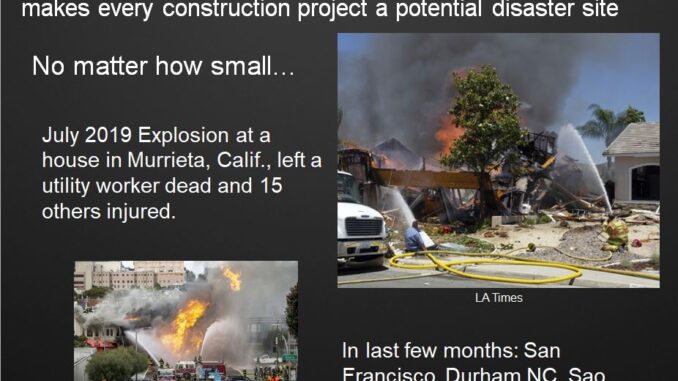
This is a readable version of a video that I submitted to the EthicalGEO site.
Without accurate maps of where underground infrastructure is located, every construction project has the potential to become a disaster site. Unlike the aviation industry where reliable data is collected and is accessible to investigators to prevent disasters from happening in the future, there is limited access to data about the location of underground infrastructure and what data is accessible is often inaccurate, out-of-date and incomplete with the result that serious incidents during construction with injuries and fatalities occur again and again.
Just about every month the news carries reports of explosions caused by damage to underground utilities during construction excavation. In the last few months of this year there have been explosions in Murrieta, California (July) where a utility worker was killed and 15 others injured, downtown San Francisco (February), Durham, North Carolina (May), and I could go on. These incidents are more frequent than many people realize.
This is not an impossible problem. A number of cities, regions and countries around the world have recognized the importance of accurate information about the location of underground infrastructure and implemented processes to reduce the risk of these events. For example, comparing the United States and Japan reveals a startling difference in the number of incidents of underground utility damage during construction. The number of incidents in the U.S. is about 400,000 per year (roughly one every minute). For all of Japan the number of incidents in 2016 was 137. Clearly something can be done to reduce the risk for construction workers and the public.
Returning to the comparison with the aviation industry, when major airplane crashes occur, such as the recent Boeing 737 Max 8 incidents, there is highly accurate data accessible to investigators to determine the cause and implement measures to prevent similar crashes in the future. Annual statistics show that fatalities per passenger mile in the airline industry have dropped dramatically from its high in 1929 and continues to drop. In contrast in the case of underground infrastructure there is limited access to location information and the data that is available is often inaccurate, out-of-date, and incomplete. The number of incidents of underground utility damage is not decreasing.
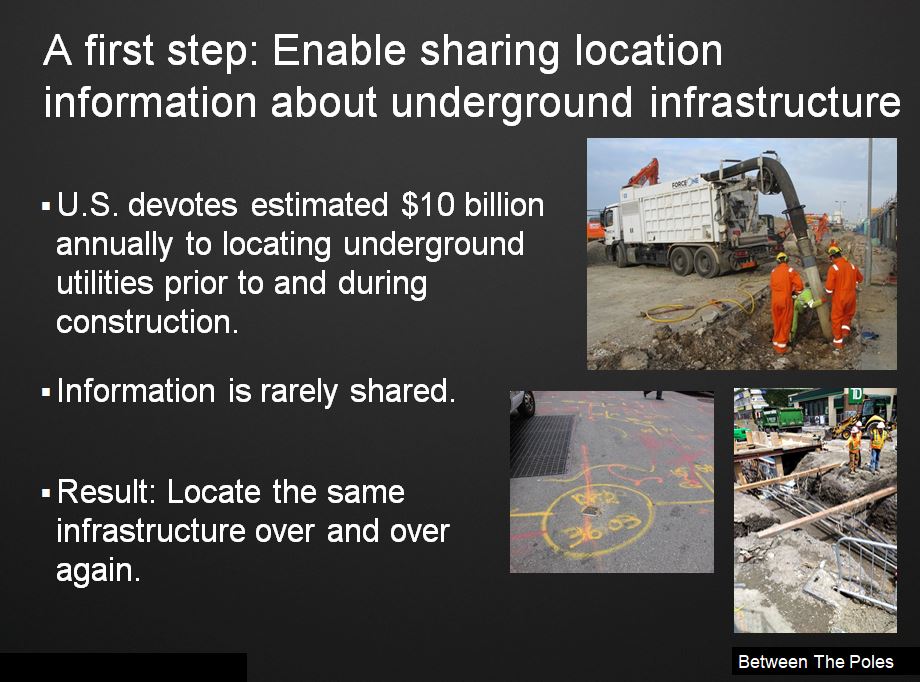 How do we begin to address this issue cost-effectively ? It is estimated that in the U.S. about $10 billion is devoted annually to locating underground infrastructure prior to and during construction. But this location information is rarely shared, with the result that the same underground utilities are located over and over again. If policies, organizational structures and technologies were applied to capturing and sharing the location of utilities and other infrastructure exposed during construction, this could be a cost-effective way to begin the process of incrementally creating accurate maps of underground infrastructure and making it possible to share this information with the people who need it most, planners, designers, excavators and construction contractors.
Over the years I have personally compiled information on 25 jurisdictions in the Americas, Europe, and Asia Pacific that have implemented various policies and organizational structures for sharing information about the location of underground infrastructure. These range from government mandated measures to private companies, industry associations, and voluntary consortia.
The concept I am proposing is to develop a community to share information about alternative policies, organizational structures, and technologies for sharing the information about the underground infrastructure that is exposed prior to and during construction. Based on the premise that one size does not fit all, this community would share information about what they have done to enable sharing of information about the location of underground infrastructure. Governments, private companies, consortia, industry associations, airports, universities, and others who are concerned about improving the accessibility and quality of location data for underground infrastructure would be invited to participate. The ultimate objective would be to begin making a dent in the number of incidents of underground utility damage and the attendant casualties.
If you agree with the premise that it is unethical to bury dangerous infrastructure in the public right-of-way without accurate maps, I encourage you to go to EthicalGEO site, watch my video and then make sure you rate it – not based on its quality, it’s my first video – but on its content. This will contribute to raising the profile of this very serious issue in North America.

Be the first to comment