
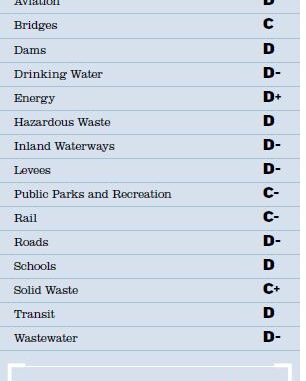
In 2009 Blaine Leonard, of the Utah Department of Transportation and the then President-elect of the American Society of Civil Engineers (ASCE), gave the opening keynote at GITA 2009. His talk focussed on the 2009 ASCE Scorecard on American infrastructure
and what the stimulus means for addressing some of the infrastructure
challenges that the ASCE has successfully attracted public attention to.
the ASCE believes is going to infrastructure, something over $70
billion, and then discussed the short fall for several of the items.
The
key takeway I left with is that the stimulus is making a significant
dent, but by itself it is insufficient to resolve the problem. Of the
$2.2 trillion the ASCE estimates is required to bring American
infrastructure up to an acceptable level, meaning B- or C+, the money
currently allocated by all levels of government is about 45% of what is
necessary.
 In 2010 a bipartisan report was released that calls for “a fundamental overhaul of America’s
transportation policies and programs. The report estimates a federal
shortfall of up to $194 billion a year in infrastructure spending on
roads, rail, and air transportation through 2035. Given the poor state
of current US transportation infrastructure, as described in the ASCE’s Infrastructure Report Card,
it is estimated that an investment of $262 billion per year will be
required to actually improve the US transportation network. The report
cites lack of a vision and underinvestment as compromising US
productivity and its ability to compete internationally. The report
says that it is time to “rethink existing systems for the 21st century
and create an agenda for enacting change.”
Deteriorating infrastructure and private capital
Last year President Obama in his State of the Union speech specifically called out infrastructure
as requiring significant investment. He said that “our infrastructure
used to be the best”, and mentioned countries such as Russia, China,
South Korea, and several European countries that are ahead of the US in many sectors of infrastructure. He also referred to the American Society
of Civil Engineers’ Intrastructure Scorecard that assigned a grade of “D” to American infrastructure.
He said that the Administration is proposiing to redouble the
rebuilding efforts that were initiated over the past two years and
identified attracting private funding as important for this effort.
UK National Infrastructure Plan based on private capital
Last year at the Global Infrastructure Leadership Forum, Geoffrey Spence, who heads up Infrastructure UK,
the Treasury body that oversees the UK’s infrastructure plan, gave an
overview of the National Infrastructure Plan of the UK. The fact that
Geofffrey Spence was a personal economic adviser to Chancellor Alistair
Darling during the last banking crisis, gives some indication of how
seiously the UK Government is treating infrastructure.
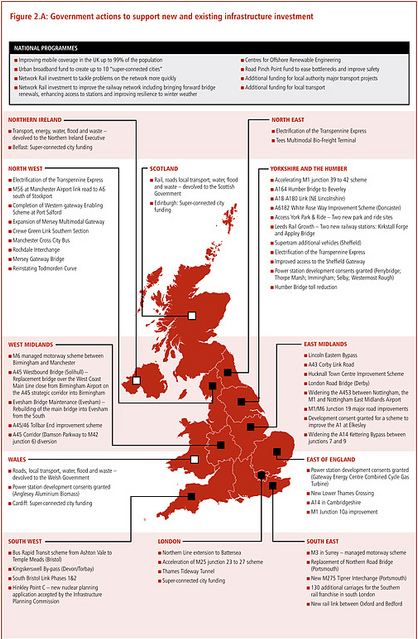 In 2011 the Government released its National Infrastructure Plan,
which outlines a plan to invest about £250 billion in the next five yrs
and £ 400 billion in the 10 yrs on infrastructure including high speed
rail, energy (especially nuclear and wind), aviation, water and
wastewater, roads and highways, and high speed broadband. This is a
considerably higher spend than in the past and signals a change in focus
from social infrastructure such as hospitals and government facilities
to economic infrastructure.
The most revolutionary aspect of
this plan is the intention that 70% of the funding will come from the
private sector.
The Institution of Civil Engineers
(ICE) has said that it supports the vision as expressed in the Plan and
that it believes that it would enable the UK to compete in the global
economy. It specifically recommended that HM Government assign a senior
minister with responsibility for monitoring performance against Plan,
create a simple set of performance measures for infrastructure that are
independently assessed, and develop a two year pipeline of
infrastructure projects to help the private sector to improve
efficiency. The ICE also suggested ways to asist the Government to
attract private investment.
Geoffrey Spense said that the Government wants full transparency for
the infrastructure effort, so that business will know where they should
focus its efforts over the next ten years. It intends to maintain an
open pipeline of projects for the next several years so that, for
example, companies specializing in tunneling will be able to see for all
tunneling projects in one place, whether they are for rail, sewers, or
nuclear power plants. He said that there is a multi-ministry
subcommittee that meets regularly to identify where blockages are
occurring between ministries and to work colaboratively to streamline
infrastructure projects where multiple ministries are involved.
The challenge of construction productivity
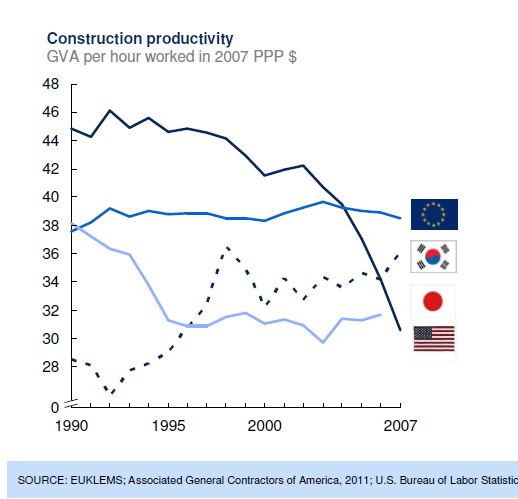 McKinsey says that construction productivity has stagnated or
declined in many countries and gave historical construction productivity
data for the European Union, Korea, Japan, and the U.S.
McKinsey
suggested that governments and infrastructure investors could reduce
risks and increase returns by focussing on three areas,
- Improving priductivity of existing and new assets
For example, by tuning the regulatory and market structure to improve efficiency and expand capacity.
- Making the economic model more attractive to investors
By being smarter about matching capacity expansions to demand and finding additional sources of revenue.
- Reducing cost and risk by improving project delivery
By allowing more competition, pushing more risk on to contractors,
and encouraging engineering, procurement and construction (EPC)
companies to increase their build capabilities.
Several speakers
reiterated that one of the major problem in the infrastructure sector is
the lack of data for comparing efficiency of construction and operation
across projects.
McKinsey suggested that more private sector
involvement in infrastructure projects could result in an estimated 30%
improvement in construction productivity over 5-10 years, resulting from
the combination of 5-15% reduction in the cost of design and planning,
5-10% in engineeering, 5-10% in materials purchase and sub-contracting,
3-5% in construction, and 3-5% from organizational enablers. They
estimate that this would translate into a 20% reduction in overall
infrastructure spend.

Be the first to comment