
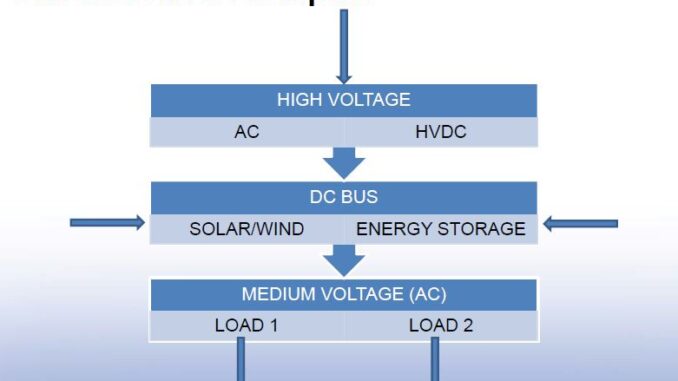
In the late 1880’s when electricity was just beginning to be introduced primarily for lighting and for running motors, there were two alternative incompatible technologies that were being promoted as the basis for the electic grid. Direct current (DC), associated with Thomas Edison, took an early lead because the first practical electric motors used direct current. DC had a major disadvantage in that because there was no way to convert between high and low voltages, the latter typically used by the consumer, it could not be transmitted over long distances efficiently. Alternating current, associated with Nicola Tesla and George Westinghouse, had a significant advantage in that it was possible to transform between high and low voltages which made it possible to transmit electricity efficiently at high voltages over long distances. Ultimately AC won out and is the basis for our current electric grid.
But this might be changing. Most of the digital equipment we typically use such as computers, gaming devices, televisions, control and sensing devices use DC. If I remember, something like 40% of the power in the U.S. goes to chip devices, and this is expected to rise to 60% in the not very distant future. Many renewable energy sources such as solar PV generate DC. High voltage direct current (HVDC) transmission is significantly more efficient than AC transmission over long distances. A significant breakthrough in high voltage DC technology was announced recently by ABB, which has developed a practical high voltage DC circuit breaker. The fastest way to charge an electric vehicle is DC.
 Solid state batteries
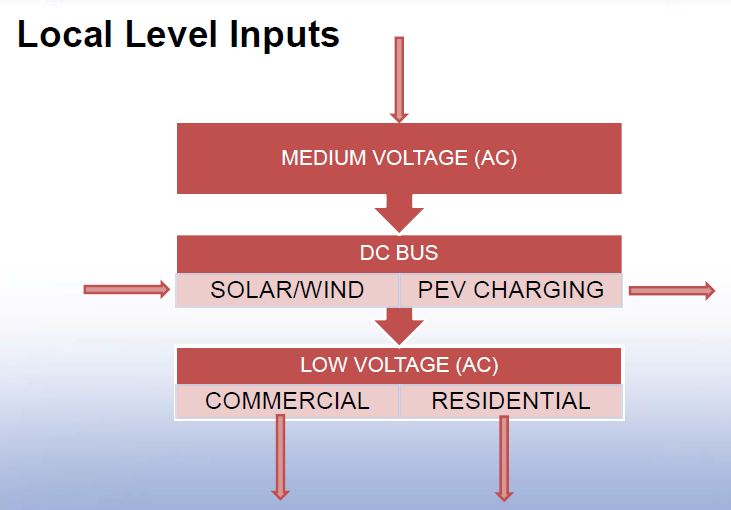
But perhaps the device that may dramatically change how consumers use power in the world of smart grid and distributed generation is the solid state transformer (SST). The breakthrough that has enabled this to happen is silicon carbide (SiC) MOSFET transistors that can handle high frequency, high voltage transformation. Transformers using this technology are 1% the size and weight of a traditional iron core transformer. They are capable of higher efficiencies than iron core, can handle different voltage inputs and both DC and AC, and support bi-directional power flow. All of which makes them highly suitable for a distributed generation environment.
According to the market research report “Solid State Transformer Market – Global Forecast & Analysis (2012 – 2020)” published by MarketsandMarkets, the total solid state transformers applications market is expected to reach $ 5 billion by 2020, growing at a CAGR of 82.3% from 2012 to 2020.
Be the first to comment