
Itron has published its first annual Itron Resourcefulness Index. It is a study based on a survey of utility executives from the gas, water and electricity industries as well as utility consumers. 800 informed consumers and 600 utility executives in 14 countries were asked to respond to questions about the state for the global utility industry.
Concern about the current state of the utility industry
Respondents indicated that there is a significant level of concern about the state of the utility industry. 60 percent of utility executives and 70 percent of customers believe that utility operations are not efficient. 70 % of utility customers and 40 % of utility executives agreed that operational inefficiency lowers customer satisfaction. The discrepancy between the utility executives and consumers points to another problem identified in this study.
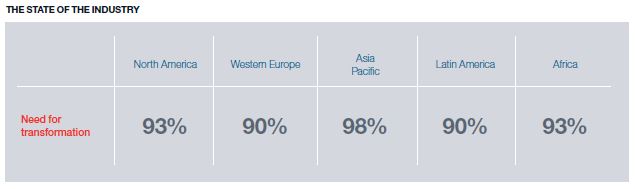
94 percent of utility executives surveyed agreed that transformation of operations was essential to improve efficiency. The concern was greatest in the developing countries, especially Ch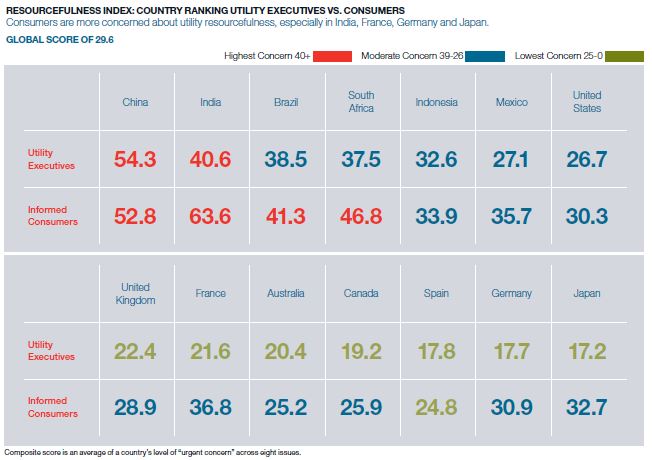 ina and India. Developed countries, in particular Spain, Australia and Canada, had the lowest overall concern among both consumers and executives.
Noteworthy is the gap between the level of concern expressed by utility executives and consumers. In every country consumers expressed greater concern about the state of the utility industry than utility executives.
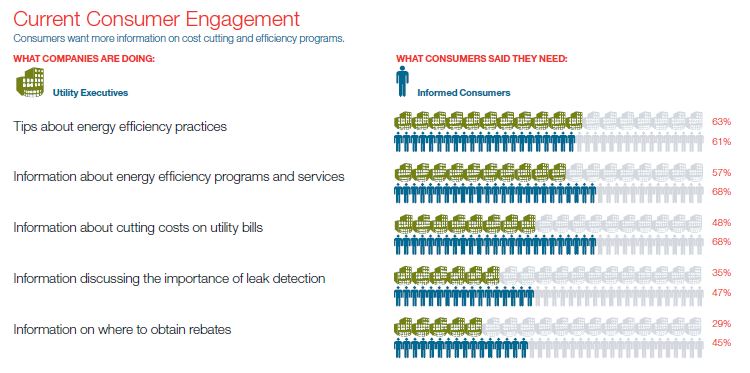
Eight out of 10 consumers said they do not receive enough information from their utilities today, and seven out of 10 said they want to know more.
 The survey also asked executives in the event that they lost 10% of their current budget, what would they cut. Nearly six out of 10 executives said they would cut consumer education if budgets were reduced. This points to a serious lack of communication between utility executives and consumers.
If utility executives had to deduct 10 percent from their budget, what would they reduce
- 23% Energy Efficiency / Water Conservation
- 26% Staff / Employees
- 20% Infrastructure
- 21% Upgrading Our Technology
- 33% Consumer/educational programs
Barriers to change
94 percent of utility executives identify government policy and uncertainty about regulations in the future as the most important barrier to infrastructure investment. Consumers also seem to agree that government or a lack of policy is hindering infrastructure investment.
Which if the following do you believe are barriers to infrastructure investment ?
- 54% Government regulation that delays investment
- 45% Lack of clarity of government regulation
- 40% Uncertainties about the future of the industry
- 34% Difficulties with prioritizing where to invest
- 32% Lack of public funding
- 25% Lack of private funding
- 19% Need more time
Role of technology
Utility executives were also asked in the event that their budget was increased by 10%, where would they spend the money, More than half of utility executives said that the very first thing they would do with more budget is spend it on technology. Of these 68 % said they would invest in IT services and 58 % would invest in the sensor web often termed the “Internet of Things.”
If Utility executives had an extra 10 percent in their budget, what would they spend it on ?
- 51% Upgrading Our Technology
- 43% Infrastructure
- 41% Staff / Employees
- 39% Energy Efficiency / Water Conservation
- 25% Consumer / Educational Programs
Big data and analytics
A large proportion (74 %) of utility executives feel big data analytics is going to be central to infrastructure modernization efforts. Six out of 10 consumers also believe big data drives utility operational efficiency.
According to this survey 46 percent of utility executive respondents feel prepared for big data analytics today. ( This is surprising. A similar recent Oracle survey found that utilities are more prepared to manage the huge volumes of data that smart grids are capable of generating in 2013 than they were one year ago, but the majority still say they are unprepared. In 2013 17 % of respondents said they are completely prepared compared to 9 % in 2012.) Consumers are very concerned about big data readiness, with only two out of 10 responding that utilities are prepared to take advantage of big data analytics today.
Utility executives liekly to invest in technology would choose
- 68% IT services (programs, software, hardware, etc.)
- 58% Internet of things (i.e. embedding sensors in physical objects)
- 45% Sensors
- 38% Meters
In summary
The Itron study found that there was near unanimity among utility executive and consumer respondents that the industry needs to transform itself. It found that consumers want help from utilities to better manage their resources and that policy and regulation are perceived as critical, but they are seen by both utility executives and consumers as a barrier to progress. Communications between utilities and consumers needs to improve. Most of respondents see technology as the key to the transformation the utility industry needs to go through.
Be the first to comment