
Landbase evolution
One of the problems that just about every organization responsible for managing network infrastructure has to face is the evolution of its landbase. By the landbase I mean maps of the roads, water bodies, public buildings, and other features that appear on maps produced by TeleAtlas,
NAVTEQ, US Census TIGER, the Ordnance Survey in the UK, BAKOSURTANAL in Indonesia, and other private and public mapping agencies. Utilities, telcos, and municipalities capture the location of their infrastructure against a landbase. But a landbase is a moving target because landbases evolve over time, and I’m not referring to continental drift. The accuracy of the maps is continually being improved, maps are becoming more detailed, roads get widened and straightened, and waterbodies get filled in and created. For example, as a result of the availability of global positioning (GPS) data there is currently an ongoing effort called positional accuracy improvement (PAI), which is creating a new generation of maps. The Ordnance Survey in the UK and the US Census are two organizations that have ongoing PAI projects.
Dependency of Infrastructure Networks on a Landbase
Organizations responsible for maintaining network infrastructure adopt a specific landbase and
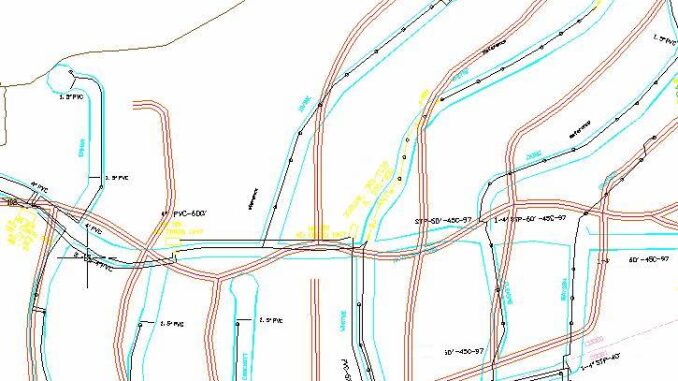
capture the location of their facilities against this landbase. When the organization decides to adopt a new landbase, which can happen for several reasons such as improved accuracy or because it decides to buy a landbase from TeleAtlas or NAVTEQ rather than maintaining its own, it finds that the locations of its facilities relative to recognizable geographic features such as road centrelines change. In the example I’ve included, the old landbase is blue, facilities are black, and the landbase is red. In many cases facilities, which typically run under or alongside roads, are no longer on or even near the correct road. In a nutshell the problem is that the productivity of field staff is diminished, because, somewhat paradoxically, although the accuracy of the landbase improves, it becomes more difficult to locate facilities.
Traditional Solutions
The traditional approach to this problem is to use a technique called conflation, which involves identifying control points, features that are recognizable in both the “old” and the “new” landbases. A least-squares algorithm is used to compute a “best-fit” mathematical transformation which it is hoped will move the facilities closer to the relative position they had when displayed against the original landbase. But this approach is frequently unsuccessful in producing the quality of maps that organizations require to maintain the productivity of their field staffs.
When the traditional approach is unsuccessful, organizations are known to resort to simply re-digitizing their entire network against the new landbase. Needless to say, this can be expensive and emphasizes how serious a problem landbase evolution is. Secondly, landbases will continue to evolve, and with each new landbase organizations are faced with a similar problem. Do they move to a more accurate landbase, which they know will diminish the reliability of their facilities maps.
Relative and Absolute Location
An alternative approach that Serguei Sokolov and I have encouraged people to consider is based on the recognition that the relative location of facilities objects is what is important to field staff and not the absolute location, which is typically what is captured in spatial databases. For example, a linesman is not really interested that a transformer is located at 45.4234 N, -75.6789 W, but that it is on the east side of Bank St., 27.5 m south of the intersection with Catherine St. The key point is that if you capture the location of facilities relative to recognizable features in the landbase such as centrelines and intersections, then your landbase can evolve without diminishing the usefulness of your facilities maps.

Be the first to comment