
The primary objective of interventions such as one-call centres, pipeline safety and other regulations, and national programs such as ROADIC in Japan is the reduction of damage to underground infrastructure during excavation. Collecting reliable statistics make it possible to assess the effectiveness of policies, technologies and changes in business practices aimed at preventing and reducing the severity of underground utility damage incidents.
Background
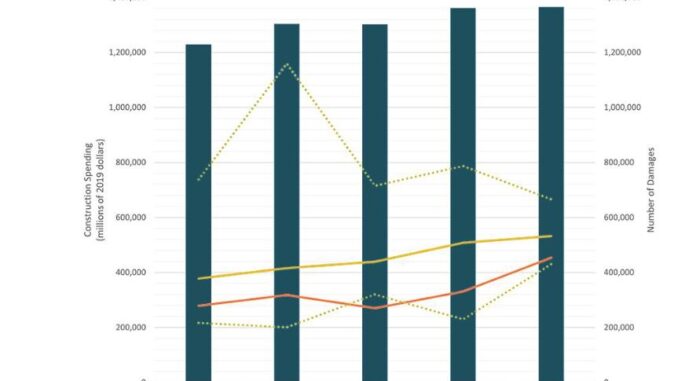
While many jurisdictions have attempted to address the problem of damage to underground infrastructure during construction, reliable statistics remains a challenge for many jurisdictions. In North America the Common Ground Alliance (CGA) has been collecting voluntarily submitted statistics on underground utility damage in North America since 2003. For trends over time the Common Ground Alliance (CGA) breaks out incidents that are reported by “consistently reporting sources” which are sources that have reported incidents over multiple years. The ratio of this metric to a proxy for the annual amount of construction activity has revealed that number of incidents of damages per million dollars of construction spending (in 2017 constant dollars) has been increasing.
With respect to federally regulated gas and hazardous fluid pipelines In the U.S. it is mandatory to report incidents of pipeline damage to the Pipeline and Hazardous Materials Safety Adinistration (PHMSA). PHMSA has implemented policies and regulations to improve pipeline safety. PHMSA’s statistics have not revealed a trend toward a reduction in pipeline incidents including those attributed to excavation damage.
Common Ground Alliance 2019 DIRT Report
The CGA has just released the 2019 DIRT Report. The report found that damages to underground infrastructure during excavation are on the rise.The number of damage reports entered in the CGA’s DIRT system reached an all-time high at 534,151. The estimate of total damages in the U.S. increased 4.5% year-over-year to 532,000. A key metric relied on by the CGA to track temporal trends is ratio of damages to construction spending. The overall trend in this metric has been upward since 2015. In 2019 estimated damages were up 4.5% compared to 2018. It is suggested that the rise in damages may correlate with an increase in overall pressure on the damage prevention process.
For 2019 alone, the CGA has estimated that the societal costs of damages to buried utilities in the U.S. is $30 billion.This estimate accounts for direct costs (facility repair) and indirect costs (property damage, medical bills, businesses unable to operate, etc.).
Ontario Regional Common Ground Alliance 2019 DIRT Report
The Ontario Regional Common Ground Alliance (ORCGA) has been collecting voluntarily submitted data on underground damage incidents since 2005. While some would argue that this represents only 50% of actual incidents, this is the best compilation of data on underground utility damage in Ontario. It is relied on by Ontario One Call for measuring performance toward its legislated goal of reducing underground utility damage. Recently the ORCGA released the 2019 DIRT report for Ontario.
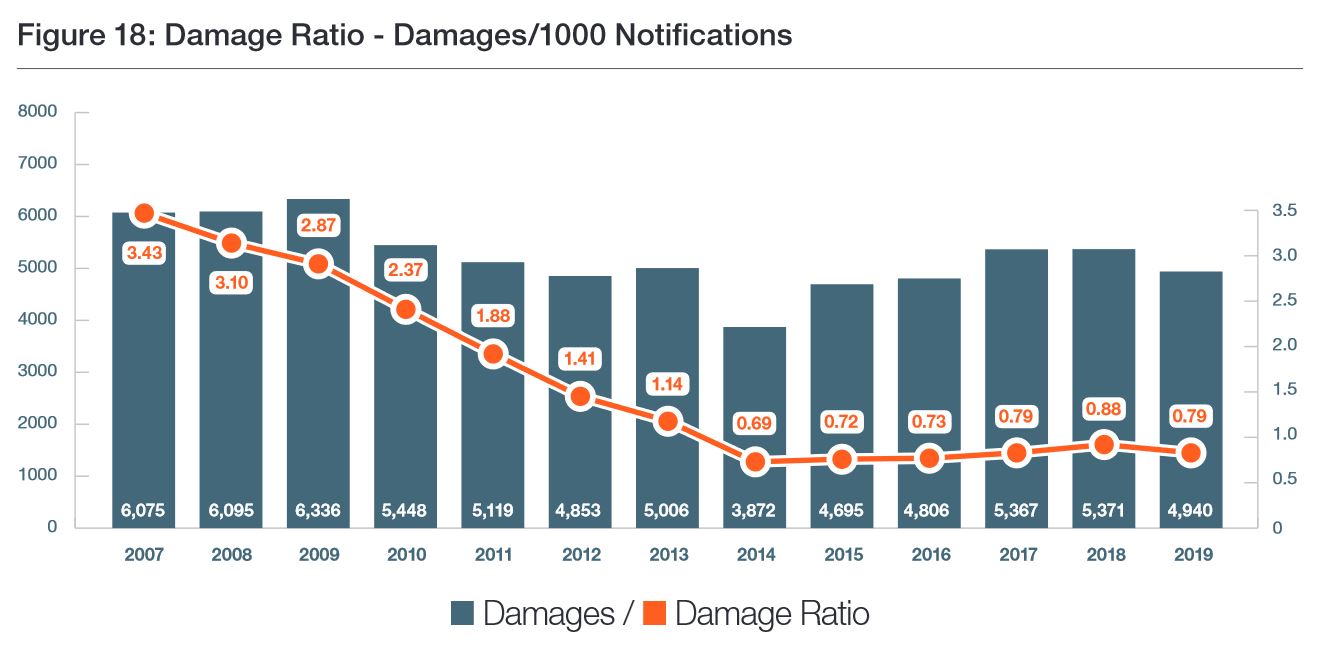 In Ontario industry practice is to measure damage prevention performance by the damage ratio metric which represents the number of damage incidents per thousand notifications. Notifications are tickets transmitted from Ontario One Call to underground infrastructure owners in response to a request from an excavator for locating underground facilities. Since 2014 the damage ratio has been gradually increasing. Due to a change in the Ontario One Call process in 2018, notifications in 2019 decreased which affected the damage ratio.
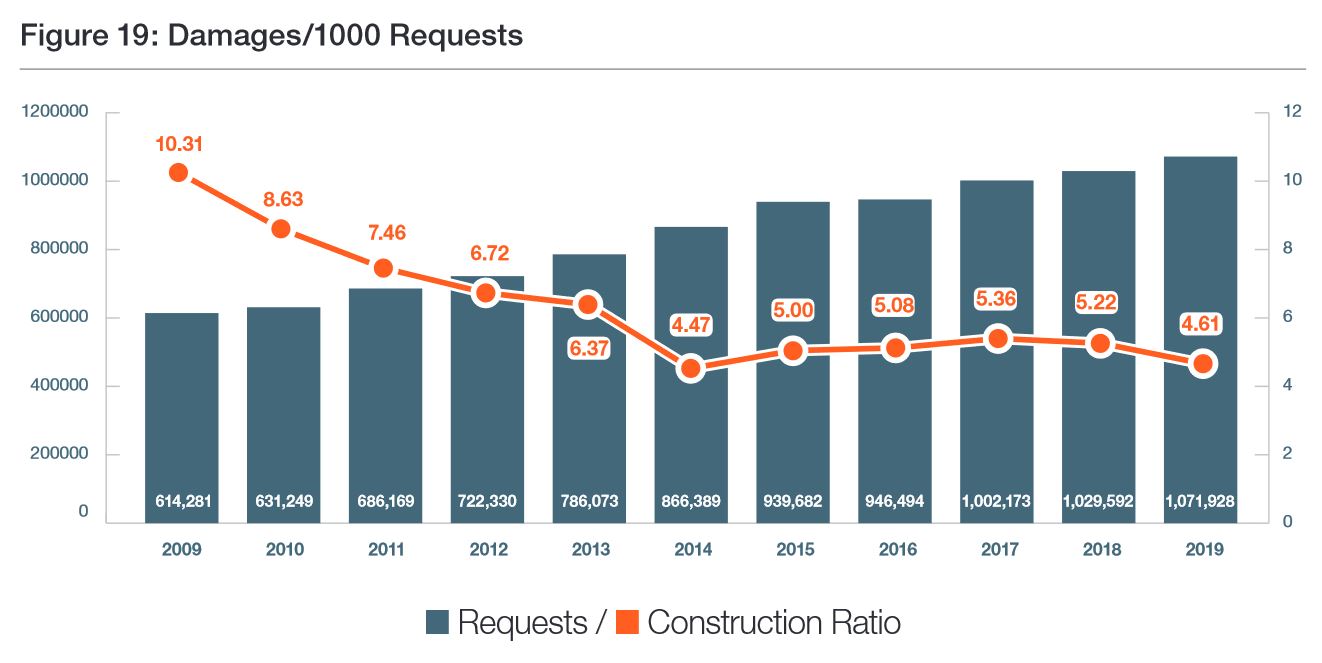 In response to the Ontario One Call process changes, a chart was created to show a new metric, the damage to request ratio, which shows the number of damage incidents per 1000 requests. A request is a communication from an excavator, typically via Ontario One Call, for locating underground facilities. Since 2018 this ratio has slowly decreased.
KLIC system in the Netherlands
The Netherlands has had what in North America is called a one call system since 1967. The objective of the KLIC system is to prevent damages to the utility network and to ensure the safety of excavators during excavations. In 2010 the Netherlands switched to an online digital information system (KLIC-Online) that reduced the turnaround time for locate requests to less than 24 hours.
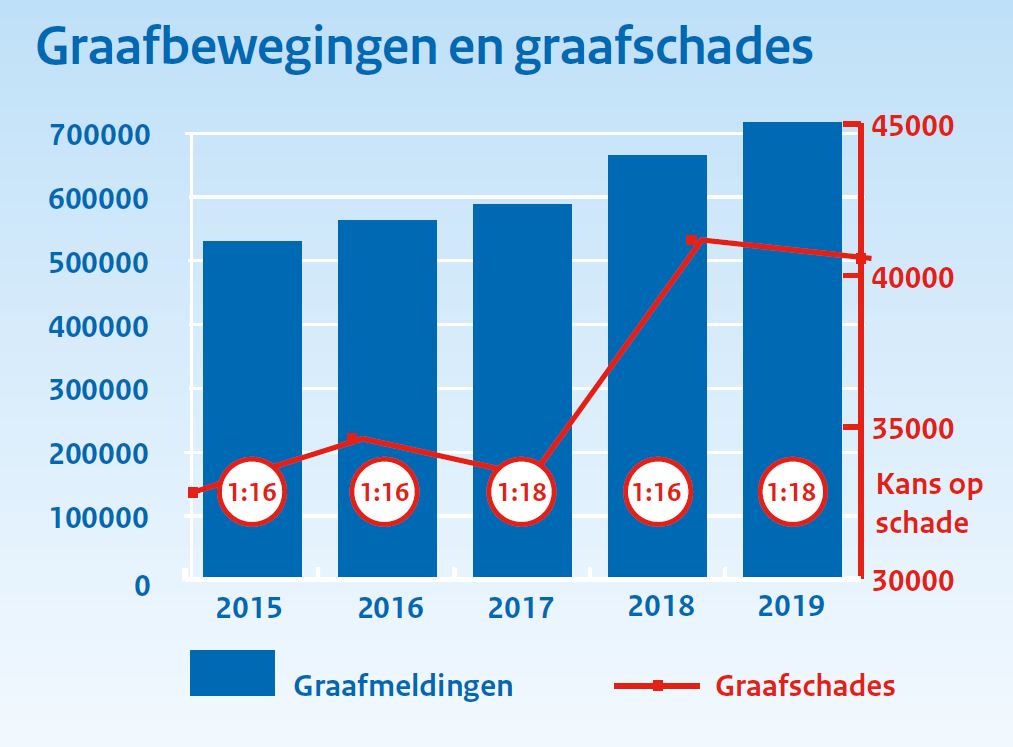 In the Netherlands network operators are required to report all incidents of damage to their infrastructure including location, cause and other information. Based on this and other information the Dutch Telecom Agency (Agentschap Telecom) issues an annual report with statistics on underground utility damage in the Netherlands. The metric comparing the number of requests for location information from excavators (blue bars) to the number of incidents of damage during excavation (red line) shows that this ratio has remained constant since 2015.
Conclusion
The latest statistics from the CGA, ORCGA and the KLIC system confirm what has been seen in previous years. The trend in damage to underground infrastructure prorated to construction activity is flat or even increasing. The CGA’s estimate of the impact of underground damage on the U.S. economy of $30 billion annually makes it clear what the economic benefits of a more comprehensive approach to reducing damage to underground infrastructure could be.

Be the first to comment