
I remember visiting a company in the business of digital aerial image acquisition, orthophotography, and stereo imagery. Using the stereo imagery they extracted 3D buildings and other objects to build 3D city models. To do this they used a traditional 3D approach, a semi-automated process that involved manually linking features in the stereo images. It required special 3D hardware and trained technicians. It was not for the untrained novice, especially because they were extracting tens of thousands of features.
At the PCI Geomatics Reseller Meeting in Ottawa I heard a very interesting presentation by Brad Grinstead, who is with IAVO Research and Scientific. IAVO-RS and PCI have developed a product that does not require special 3D hardware and which can be learned in a few minutes. 3D FeatureXtract is lightweight, designed to be used with low-cost PC hardware and no special stereo hardware requirements and by people with little or no training.
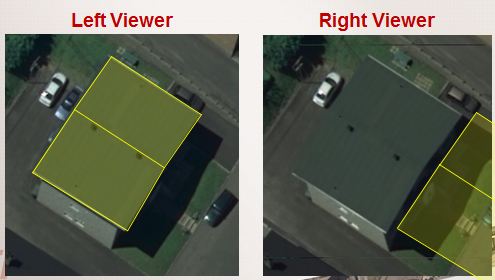
 Basically is is comprised of two side-by-side mono viewers, sophisticated 2D drawing/editing tools for digitizing complex objects including complex roof and outline styles, It supports polygon extrusion onto a digital elevation model (DEM and texturing. Another big advantage is that all it requires is overlapping immagery, which is typically delivered from aerial overflights and is often available in satellite imagery. People who want to create 3D urban models and have access to municipal imagery vey likely already have the raw data that they need to create 3D models using 3D FeatureXtract.
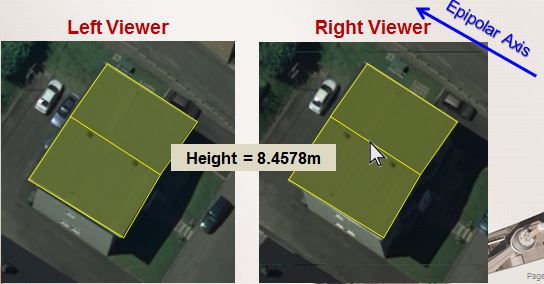
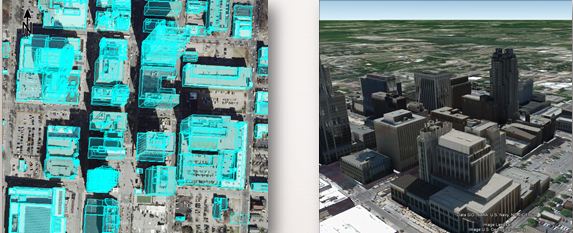 The process involves tracing and digitizing a 2D object such as a roof in the left-hand mono view. The digitized object will be shown in the right-hand view but will not be aligned with the image of the object. You drag the polygon along the epipolar axis until it lines up with object in the image. At this point the 3d coordinates of the object such as the height and other dimensions of the object can be triangulated. The result is highly accurate 3D vectors for the object. You can then complete digitizing the 3D object, for example, by automatically extruding the object down to the DEM. Ypu can also add textures from the underlying imagery, rather than generic textures from libraries which is what many 3D applications do. The objects can be exported in several formats for import into applications such as Google Earth and 3D GIs.
The application is not just for buildings but can be used for power poles, street light standards, manhole covers, bridges, hydrological structures such as dams and levees, and forestry.
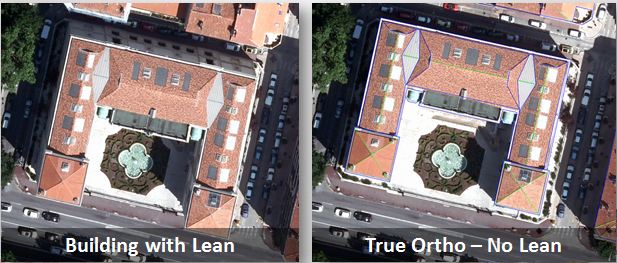 A specialized application of 3D FeatureXtract is to what is referred to as “true ortho”. These are orthorectified images that have gone through an additional processing step to remove building lean which can obscure some features and incorrectly geolocate the rooves of buildings and other elevated objects. Correcting for lean requires a 3D model of the object that is being corrected and 3D FeattureXtract can be used to create these.

Be the first to comment