
In the U.S. and the U.K. statistics reveal that about a quarter of underground utility damage and strikes is attributable to locating issues including inaccurate maps, missing data and problems with underground locating equipment.
There are over 10,000 works (construction projects) taking place every day across the UK with tens of thousands of incidents of underground utility damage during excavation occurring annually. But there are no reliable statistics on this important safety and economic issue. A very important initiative in the UK is the the Utility Strike Avoidance Group (USAG) which has begun collecting information about underground utility strikes during construction. USAG has just released the 2017 & 18 Utility Strike Damages Report. For this biennial report USAG analyzed reports on 3000 incidents of underground utility damage or strikes submitted by 34 USAG members. The information submitted on each incident includes when the strike occurred, where the strike occurred, how the asset was damaged (equipment type), what the damage was, type of asset damaged, type of construction project, and what caused the damage.
In the U.S. the Common Ground Alliance (CGA) has been collecting voluntarily submitted statistics on underground utility damage since 2003. The latest CGA DIRT report for 2018 concluded that progress in the U.S. in reducing damages has plateaued. Total damages in the U.S. increased from 439,000 in 2017 to 509,000 in 2018, representing a 16% increase. Damages per 1,000 one call information requests increased by 11%, from 1.87 to 2.08, and damages per million dollars of construction spending (2017 constant dollars) went from 0.359 to 0.392.
Cause of underground strikes
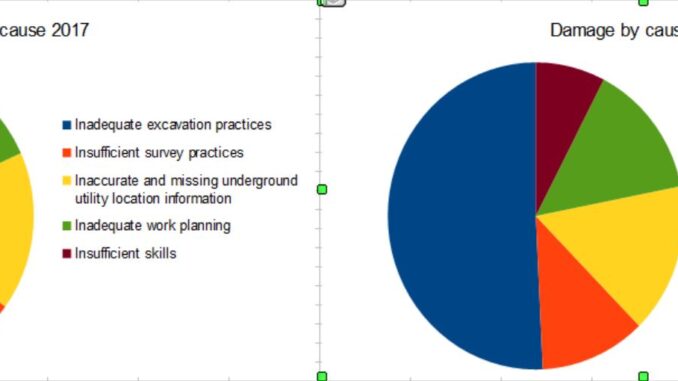
One of the interesting analyses in the USAG report is the cause of underground utility strikes. Respondents are requested to identify the cause of the damage from a list of over 15 possible sources.
I have simplified the number of categories to five;
- Inadequate excavation procedures (Inattention/lack of awareness, Not following procedure, No protective systems, Clearance not maintained, Misuse of tools/equipment, Lack of supervision, Excavation practices not sufficient, Service markup not maintained,)
- Insufficient survey practices (Insufficient survey practices (use of locating equipment), Inadequate survey)
- Inaccurate and missing underground utility location information (Inaccuracy of plans, Assets not on relevant plans)
- Inadequate work planning (Inadequate assessment of works, Insufficient time allowed)
- Insufficient skills (Insufficient competency, Insufficient gang skills)
Since most of these incidents were reported by contractors, I would expect that their perspective would be reflected in the cause profile. Over 50 % of the causes identified are related to excavation practices. The next highest cause is missing or inaccurate location information followed by insufficient survey practices. Together these locate issues represent the second largest reported cause of strikes in both 2017 and 2018.
Comparison with Common Ground Alliance DIRT 2018 Report
For comparison the Common Ground Alliance, which collects data on underground utility damage incidents (strikes), includes analysis of 440,749 damages and near miss events submitted for 2018 in the latest DIRT report.
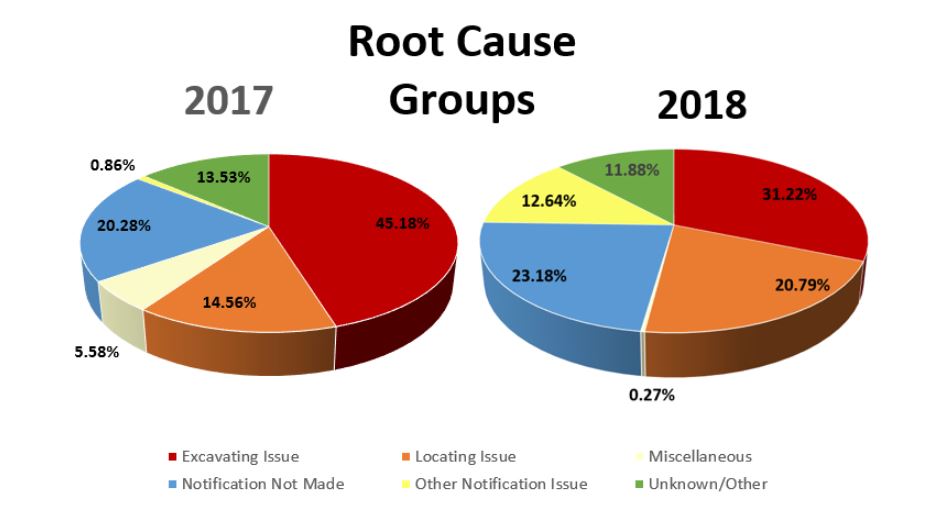 CGA damage report submissions includes cause. The submission form offers 25 options which the CGA groups into six root cause groupings. In 2018 the most frequent reported causes were excavating issues 31.22%, locating issues 20.79%, and notification not made 23.18%. Excluding incidents where 811 was not notified, damages attributed to locate issues was the second most reported cause similar to the USAG findings.
| Locate issues as a proportion of all incidents | Locate issues (%) |
| USAG 2018 | 27 |
| USAG 2017 | 28 |
| CGA DIRT 2018 | 27* |
| CGA DIRT 2017 | 18* |
* Excluding damages where 811 was not notified
The profile of the stakeholder type reporting these incidents to CGA; 64% locator, 8% excavator, 17% natural gas operator, 8% telecom operator, and 4% other is quite different from the USAG report where about 90% of reports are by contractor/excavators.
Cost of excavation damage
I have blogged previously about a study at the University of Birmingham to estimate the average cost of underground utility damage which concluded that each incident entails an estimated direct cost of £3600 per strike. Indirect costs are estimated to amount to 29 X the direct cost which results in an estimated average true cost of each utility strike of over £100,000. Statistics for the total number of incidents of underground utility damage have not reached the level of North America where the Common Ground Alliance collects data on at least 50% of all incidents, and it is estimated that there are roughly 400,000 to 800,000 incidents per year. There is apparently an (unsourced) estimate that the total number of incidents in the U.K. is 60,000 per annum which suggests that incidents per capita are less frequent than in North America. Based on this estimate the total annual cost of underground utility damage is the U.K. could reach £6 billion.

Be the first to comment