
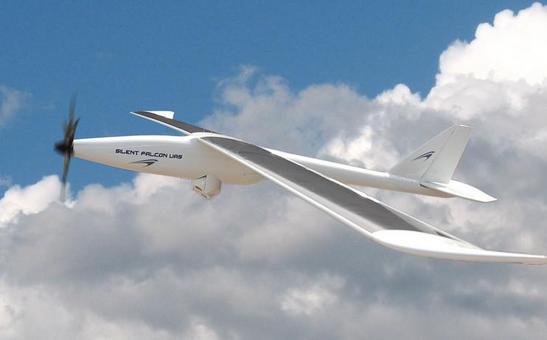
In the last year or so I have come across a number of UAVs at the various conferences I have attended. They range from hexacopters to fixed wing aircraft, but all of them suffer from a serious constraint – limited flight time, typically 40-50 minutes maximum. Under adverse weather conditions flight time is less than that. This limits the usefulness of these UAVs for long range missions, for example transmission line monitoring, which typically involves LiDAR mounted on a helicopter and is expensive.
I have just come across a UAV that promises much longer flight times. The Silent Falcon is a solar/electric, all composite, modular small Unmanned Aircraft System (sUAS) designed for commercial, civil, public safety and Intelligence, surveillance and reconnaissance (ISR) applications. It has a solar/electric propulsion system and is made from carbon fiber composite materials similar to many of today’s large scale commercial aircraft. It has three interchangeable wing configurations for different flight profiles. It is silent, claiming to be undetectable at less than 200’ above ground (AGL).
It claims it is the first sUAS capable of meeting long endurance mission profiles typical of many commercial, civil, public safety, and other operations. Its daytime endurance is estimated to be 5 to 12 hours depending on wing configuration, weather, and flight profile. Night-time endurance is estimated at 3 to 5 hours. For example, equipped with LiDAR this could be used for transmission line monitoring for vegetation management at a much lower cost than a manned helicopter.
It uses thin film photo voltaic (TFPV) solar energy collection and Lithium polymer (LiPo) batteries for energy storage. It has an HD electro-optical camera and an infrared sensor as standard vision sensors, but also supports medium-wavelength infrared (MWIR), Hyperspectral Imager, and LIDAR devices.
Thanks to Kim Tofin for pointing me to this.

Be the first to comment