
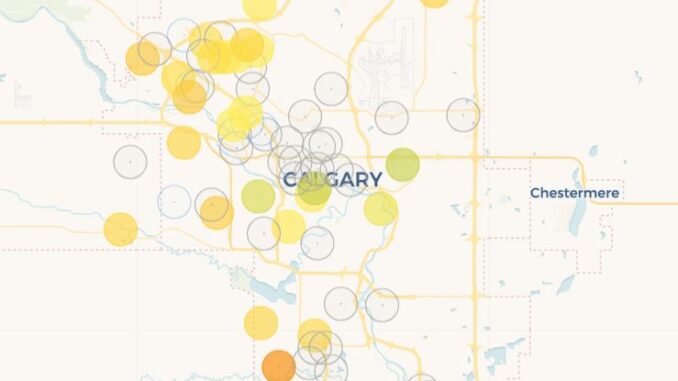
The World Health Organization (WHO) estimates that more than seven million deaths every year are linked to air pollution exposure from household and ambient (outdoor) air pollution. But in spite of these statistics the average city has only one or two air quality monitoring devices which are very expensive costing about $1.5 million each. At this year’s FOSS4GNA (Free and Open Source Software for Geospatial North America) get together in St Louis Steve Liang, a professor at the University of Calagary and CEO of SensorUp, described a way that citizen scientists can contribute to measuring air pollution using a low cost board and CPU and share via open source geospatial web software to map the resulting measured air pollution in real time.
Based on the latest results from WHO air pollution is now the world’s largest single environmental health risk, linked to 12% of all global deaths. Around 4.3 million deaths every year are attributed to exposure to household (indoor) air pollution, from heating, cooking and lighting using solid fuels. Around 3.7 million deaths every year are linked to outdoor air pollution , including exposure to fine particulate matter from fuel combustion from vehicles and from power plants, industry and biomass burning.
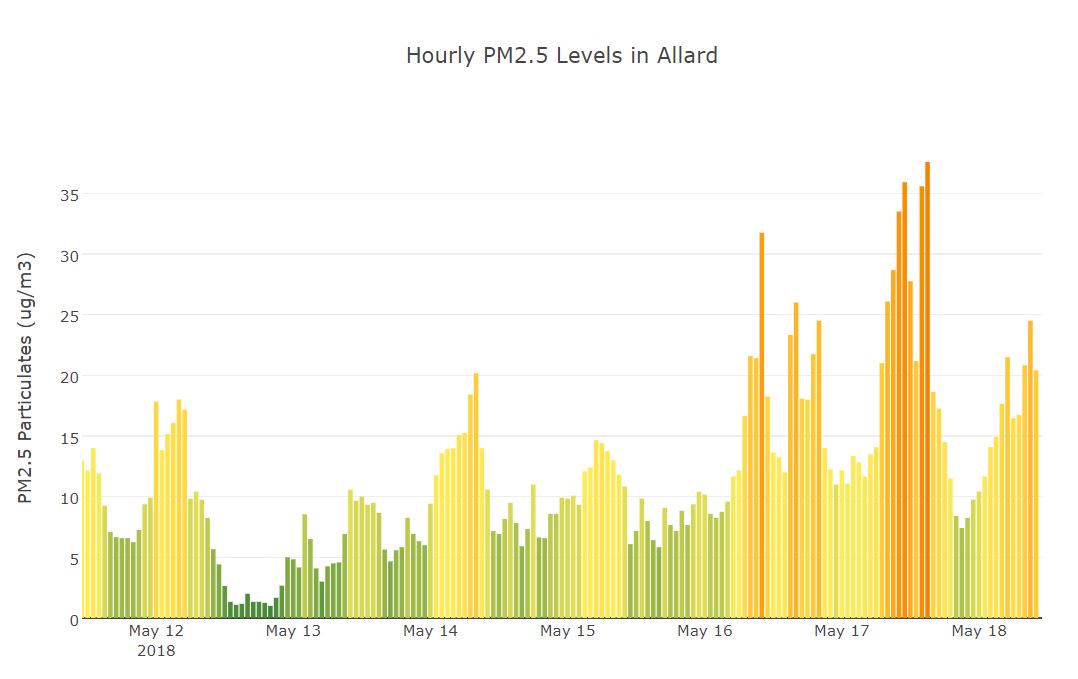 Steve described the sensors, which are typically built by interested people in workshops led by staff from SensorUp, a startup that Steve leads. The devices consist of a sensor that measures PM2.5 (particles less than 2.5 microns in size), temperature and humidity, a CPU and Wifi. Each device costs less than $100. After building the device, each participant in the workshop brings it home and installs it outside within wifi range of their internet router. The sensor reports ambient PM2.5, temperature and humidity every 5 minutes to a central server maintained by SensorUp. It uses the Open Geospatial Consortium (OGC) standard SensorThings API which provides an open and unified way to interconnect Internet of Things (IoT) devices, data, and applications over the Web. SensorUp SensorThings platform is the most advanced OGC SensorThings API implementation.
A web application built on the open source geospatial software Leaflet allows users to view the data on a map in real time, investigate air pollution historically and compare different cities. The data is open and accessible to anyone. To date about 500 people across Canada have built their own devices and are sharing measured PM2.5. The real-time feed from these devices is mapped here.

Be the first to comment