
The Semantic Web is an effort of the World Wide Web Consortium (W3C). The idea of the Semantic Web is to provide a common framework that allows data to be shared and reused across application, enterprise, and community boundaries, or put another way a web of data that can be processed directly and indirectly by machines. Converting the existing web to a semantic web has turned out to be a major challenge and it remains largely unrealized.
However, as a first step ways are being found to add some level of semantic content to existing data and services. As an important example, the OGC has announced the adoption of “Semantic annotations in OGC standards” as an OGC Best Practice. Annotation of Web Services (or data) compliant to OGC standards such as WMS, WFS and GML refers to attaching meaningful (semantic) descriptions to the service.
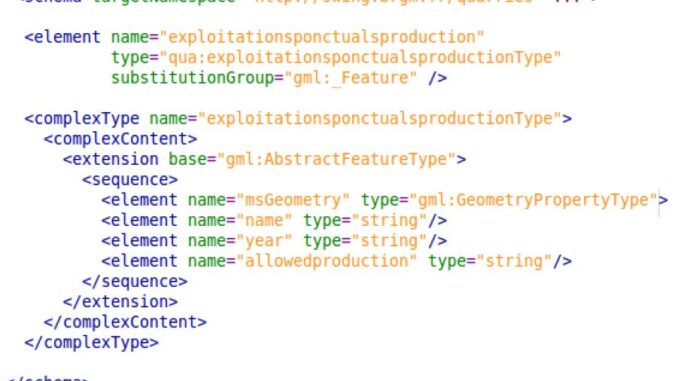
The authors give an example from a GML document of an XML schema that defines a class or feature type exploitationsponctualsproduction. They point out that from the information in this schema you can’t tell what the data described by this schema represents. The name is confusing and the attributes don’t provide any additional information. Whose name is the value of name, what does the attribute year refer to, and how is the allowedproduction measured?
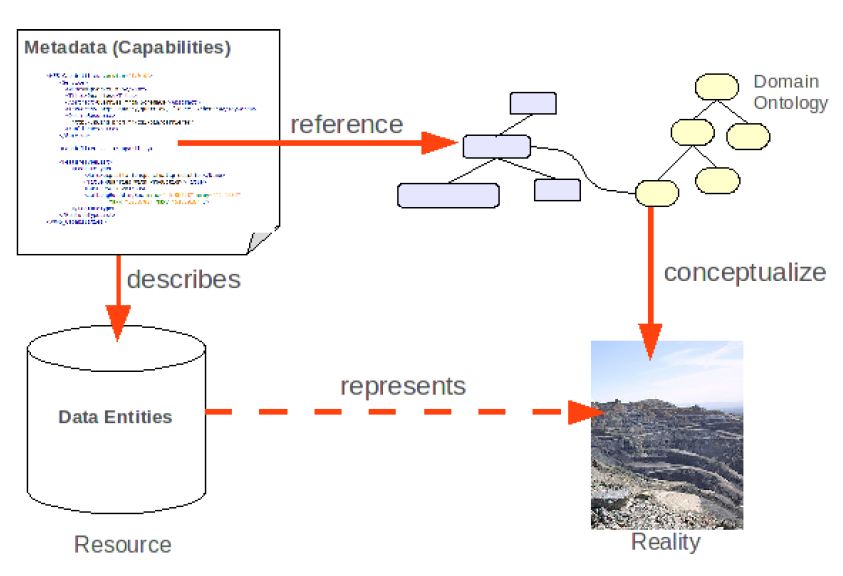 An OGC Best Practice means a recommended way to add semantic content to OGC web services based on existing standards. The authors discuss how to do this using not only OGC standards but also standards from the W3C and ISO/TC211.
OGC standards cover the functional dimension of a web service, but they don’t tell us much about what the data represents in the real world. For example, in the case of WMS or WFS the application knows how to load and visualize the data on a map, but provides very little information to a user in a specific domain such as engineering or construction about how to read the displayed map.
Put another way, semantic annotations can convert geospatial data into infrastructure data. Semantic annotations are a way for data providers to connect geospatial data to real world domain models, to provide information about data and web services that is meaningful to an engineer or construction contractor. Semantic annotations not only make data meaningful to a much broader audience of consumers, but make it discoverable by a much broader audience through standard web search engines.

Be the first to comment