
Open data has been gathering momentum among governments. First enunciated in the United States, the principle that citizens should not be required to pay twice for government data, free and open access to government geospatial data has been adopted by many governments including US Federal, Canada, Japan, South Africa, Brazil, California state and counties, and by the City of Vancouver and other cities. In 2013 G8 leaders (Canada, France, Germany, Italy, Japan, Russia, United Kingdom, United States, and the European Union) signed a charter on open data. The Ordnance Survey in the UK began releasing some of its data with open licensing as part of its OpenData initiative in 2010, but it wasn’t until 2018 that the OS Mastermap was made openly available for the public and businesses to use. But being able to access prepared maps and other derived material is just a first step, governments need to provide access to raw geospatial data in commonly used Web-friendly formats. In the U.S. Data.gov was launched in late 2009. In 2013, President Obama issued an Executive Order making open and machine readable the new default for federal government information in the United States.
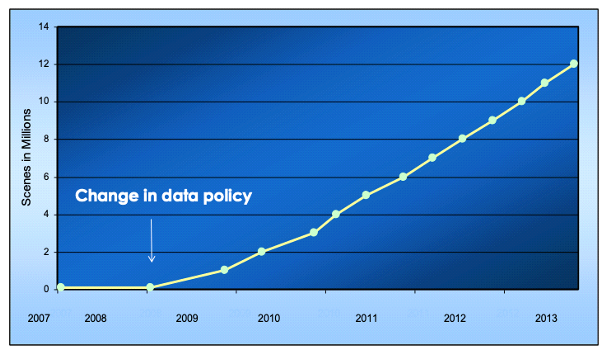
A key transition occurred in 2008 when the U.S. Geological Survey announced a policy of open data. Prior to this Landsat images were made available on a cost recovery basis, costing hundreds to thousands of dollars per scene. But in January 2008 Barbara Ryan, the Associate Director for Geography at the U.S. Geological Survey, and Michael Freilich, NASA’s Director of the Earth Science Division, signed off on a Landsat Data Distribution Policy that made Landsat images free to the public. The USGS announced the free-and-open data policy on April 21, 2008. In a recent talk at the Geospatial Knowledge Infrastructure Summit Barbara Ryan described the impact of that decision. Landsat downloads jumped from 53 scenes per day to 5,700 scenes per day. The economic benefit derived from the Landsat data was estimated at US $1.7 billion domestically, $400 million internationally for a global total of $2.1 billion In 2011.

Be the first to comment