
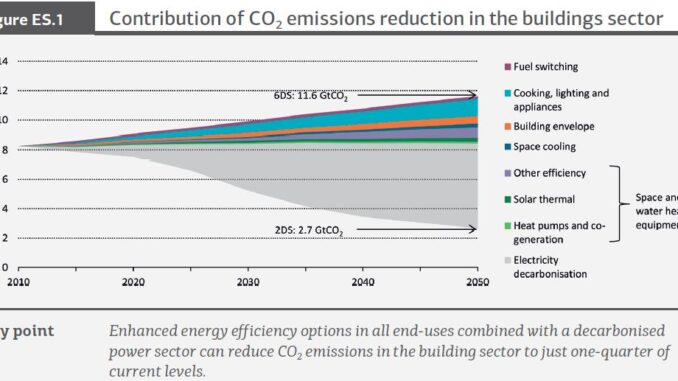
The energy demand of buildings is expected to rise by 50% by 2050. It is driven by rapid growth in the number of households, residential and services floor area, higher ownership rates for existing electricity-consuming devices and increasing demand for new products.
According to the International Energy Agency (IEA), this growth could be limited to just over 10% without changing comfort levels or requiring households to reduce their purchases of appliances and other electronic equipment.
The IEA has estimates that limiting global temperature rise to2°C would require a 77% reduction in total CO2 emissions by buildings by 2050 compared to today’s level. To achieve this will require energy demand reduction, increased use of renewables and decarbonised electric power generation.
It has been estimated that 40 exajoules (EJ), could be saved in the buildings sector in 2050 with existing technologies such as high-performance windows, optimal levels of insulation, reflective surfaces, sealants, heat pumps, solar thermal heating, co-generation, energy efficient appliances and equipment, efficient cook stoves and solid-state lighting (SSL).
The IEA estimates that a combination of efficiency standards, greater use of heat pumps, solar thermal and co-generation with waste heat and renewables could reduce growth in electricity demand by 2 000 terawatt-hours (TWh) in 2050. This would be realized by avoided capacity expansion of 330 gigawatts (GW) of coal-fired capacity or 460 GW of gas-fired capacity and savings of between US$ 170 billion and US$ 150 billion in new generation capacity.
Regional priorities
Energy trends in buildings vary from country to country depending on climate, population, income, economic development and household sizes. The IEA has examined nine countries/regions in detail and has identified priorities and made policy recommendations for each.
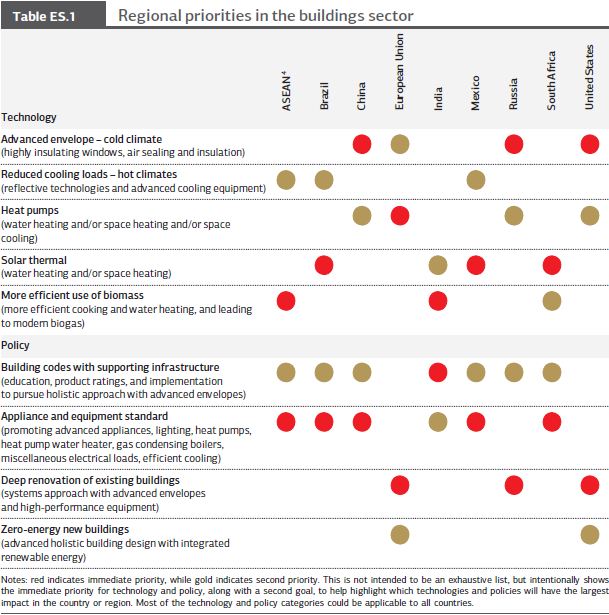 Energy reduction for buildings involves technology and policy.
Technology
- Advanced envelope for cold climates – highly insulating windows, air sealing and insulation
- Reduced cooling loads for hot climates – reflective technologies and advanced cooling equipment
- Heat pumps – water heating and/or space heating and/or space cooling
- Solar thermal – water heating and/or space heating
- More efficient use of biomass – more efficient cooking and water heating, and leading to modern biogas
Policy
- Building codes with supporting infrastructure – education, product ratings, and implementation to pursue holistic approach with advanced envelopes
- Appliance and equipment standard – promoting advanced appliances, lighting, heat pumps, heat pump water heater, gas condensing boilers, miscellaneous electrical loads, efficient cooling
- Deep renovation of existing buildings – systems approach with advanced envelopes and high-performance equipment
- Zero-energy new buildings – advanced holistic building design with integrated renewable energy
The first priority in improving the global building stock is to establish and enforce building codes that include minimum energy performance for new and refurbished buildings. Policies are required to ensure that high-performance building envelopes rapidly become the standard for all new construction globally. Priority should also be given to refurbishing existing buildings, particularly in the European Union, Russia and the United States, where it is estimated that 60% of existing buildings will still be in use in 2050.
It is estimated that space heating and cooling and water heating account for nearly 60% of global energy consumption in buildings. Heat pumps, solar thermal and co-generation for space heating and cooling as well as hot water should be prioritized.
Lighting has significant potential for energy efficiency improvements. With better use of natural lighting and adoption of highly efficient lamp technologies, buildings energy consumption for lighting could be reduced by 40% in 2050 compared to current levels.
In many countries, appliances and other electrical equipment represent the fastest-growing end-use for energy in buildings as household wealth rises in major economies such as China, India and South Africa. The deployment of best available technology and continued improvements in appliance and equipment efficiency could reduce the growth in electricity demand to 40% of current levels in a low-carbon scenario compared to a near doubling under a business-as-usual scenario.
Recommendations
Rigorous building codes will need to be implemented in all countries. New buildings in cold climates should be subject to progressively tighter regulatory standards, to between 15 kilowatt-hours per square metre per year (kWh/m2/year) and 30 kWh/m2/year for heating purposes. In hot climates, the cooling energy demand intensity should be reduced by around one-third compared with current levels. In fast-growing economies with rapid new-build rates, the implementation of effective building codes should be the priority.
In OECD countries and non-OECD Europe and Eurasia, large-scale refurbishment of residential buildings should be the priority. Approximately three-quarters of all buildings in these countries will still be standing in 2050 and hence will need to be upgraded to a low-energy standard.
Efficient district heating systems can benefit from thermal energy storage coupled with waste heat and renewables. Integrate building end-use equipment into smart grids and smart metering should be promoted, to help reduce peak load and bring other economic benefits.

Be the first to comment