
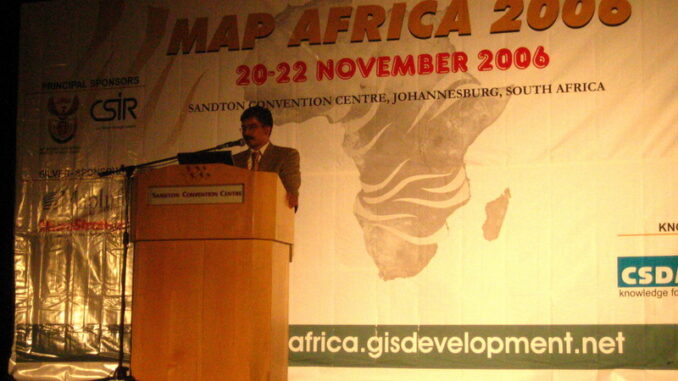
I’ve just spent a few days at Map Africa and this has been a very interesting conference. First of all it
has not been a traditional GIS conference. There has been a strong focus on capacity building, specifically in Africa as you would expect. I found two particularly interesting things about this conference.
Open Source Geospatial
At the end of the first day there was a panel discussion on Interoperability and Open Source. The panelists were Andrew Terhorst from the Meraka Institute in South Africa, Professor Dasgupta from India, and myself. Andrew provided a uniquely African perspective on open source. He was vocifereous in arguing that open source is good for South Africa becaue open source creates an opportunity for the development of human capital in South Africa. He also reiterated what I think is generally recognized that security is not a reason to not use OSS, but he did allow that OSS needs to improve its usabality and that this is the primary barrier to its adoption. He encouraged people to be more adventurous and to use open source because it’s a way to help Africa to develop its human capital. As he pointed out himself, he has an academic perspective and he needs to be able to see code to undertand the algorithms used. For example, he likes GRASS because he can see how things work. In
this context I found it interesting that he sees open source as not
only providing a way for people to collaborate but as a new form of
peer review.
My perspective is that both open source and closed source have necessary roles in the software industry. For example, I believe that the state of web mapping servers is analogous to web (HTTP) servers in the late 90’s, and that this area of the geospatial industry is ripe for commoditization and open source. Desktop geospatial applications is another matter – there is still lots of room for closed source vendors to differentiate themselves in this software segment.
I detected a serious interest in open source geospatial among the South African participants at this conference. What was most interesting to me from what I heard from a number of people with whom I chatted at the conference is that in South Africa cost is one of the most important reasons motivating this interest. There is what appears to be a widespread perception in South Africa that traditonal GIS is too expensive. Part of this is no doubt due to the fact that in the developing world, if you express the cost of software in terms of the local per capita income, the cost of software is much higher than in North America. For example, I remember seeing some time ago that in Bangladesh Windows98 cost the equivalent of three years’ income for the average Bangladeshi. But South Africa is quite different from Bangladesh. For example, Gauteng province, which includes Johannesburg and Pretoria, represents 37% of the African economy. So I think this is only part of the reason.
Free Digital Spatial Data
One of the remarkable things I discovered about South Africa is that data collected by the national government, mainly by the Department of Land Affairs: Surveys and mapping, is free in digital form. This is remarkable. The country where spatial data was first made available at no cost was the US where the Federal Government’s guiding principle is that if taxpayers paid to collect data, the government can’t charge them again. Many people believe that one of the reasons that the US is such a major force in the geospatial industry, both in the areas of software applications and data providers, is because of the availablility of low cost data. I think this means that great things are in store for the South African geospatial industry.

Be the first to comment