
Since Monday I’ve been at Map Middle East 2006 in Dubai. There are people here from several parts of the world, but primarily from the Middle East as you might expect. Some very interesting themes have been apparent in the talks I have attended. First of all, Google Earth is on everyone’s mind. Ed Parsons from the Ordnance Survey is taking bets that every speaker will mention Google Earth. So far he is ahead. What was most telling was speaker after speaker, who have been geospatial specialists for years, reporting that their children’s first (happy) experience with geospatial was Google Earth. Some people were surprised that Vanessa Lawrence from the OS mentioned Google Earth and perhaps she was motivated by Ed not wanting to lose his bet, but I think that Google Earth is a phenomenon that simply can’t be ignored.
Michael Jones, CTO of Google Earth, is here and presented to a full house. He spoke about Google Earth’s mission, which is to reach the 6 billion inhabitants of Earth that are not familiar with geospatial technology, not the 1 million who are. Another way to look at this is from the perspective of how to scale to billions,
Application Number of users
Expert 1
Expert -> experts 00’s
Expert -> users 000,000’s (Traditional GIS)
Users -> users billions (Google Earth)
This is interesting because it makes clear not only who Google Earth is going after, but also who they’re not. It also shows the power of user participation enabled by Web 2.0. When asked who does QA on Google Earth’s data he replied that the users QA it. He gave an example. Google Earth recently deployed a new high resolution database for Germany, and within 12 hours they were getting updates and corrections.
Michael also reported that new spatial content is added to Google Earth every second, which means that in the 50 or so minutes he was speaking, 3000 new features were added to Google Earth. As an example of the type of data people are loading into Google Earth, the location where every scene of Shakespeare’s plays occurs are available in Google Earth.
A few other themes recurred. Spatial data is ubiquitous and getting cheaper. Someone mentioned a terabyte of new data every day. Sam Bacharach of the OGC thought this was an underestimate. The challenge, which several speakers mentioned, is how to convert terabytes of data to megabytes of useful information and to provide user interactions to make this accessible to the average cell phone user. It was interesting that several speakers mentioned that maps are not the only or even the best way to present useful information derived from spatial data to users.
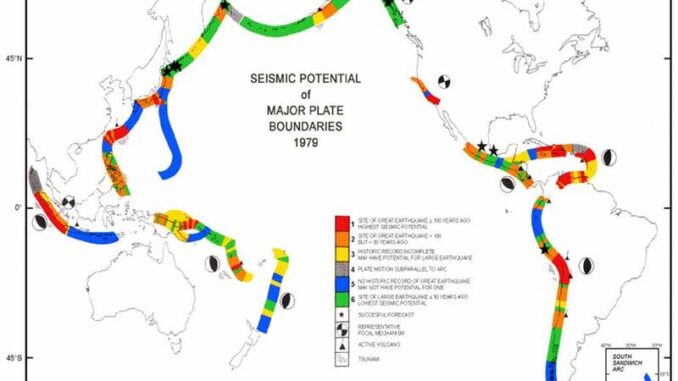
I’ll leave you with a fascinating bit of information that suggests that the tsunami that was
triggered by an earthquake near western Sumatra was not totally unexpected. The map to the right , which was published in 1979, identified using red through green the areas of highest probability of earthquake activity. I’ve included a subset of the map showing the west coast of Sumatra. Thanks to David Rhind of the City University of London for providing these slides. 

Be the first to comment