
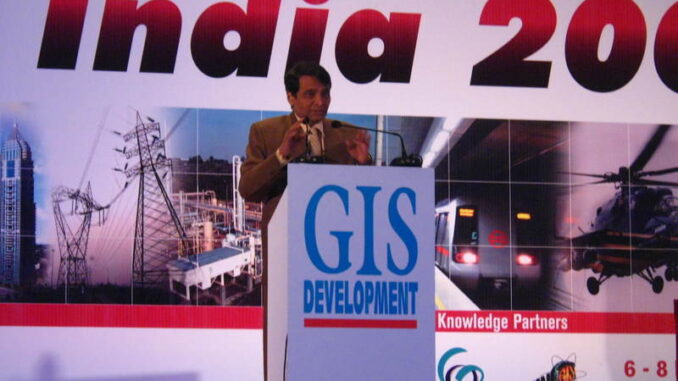
I just spent two days in Delhi at Map India 2008. I always enjoy attending and presenting at Map India because India is very advanced in geospatial technologies and I always come across different and interesting perspectives.
Economic Expansion
The conference took place this year in Noida, which is not in Delhi proper, but in Uttar Pradesh. What I found remarkable was the amount of construction going on in Greater Noida. I have been in Dubai a number of times in recent years, and the level of construction there is astounding. Something like 15% of the world’s construction cranes are in Dubai, which has a population of only several million. My impression of the level of construction in Greater Noida is that while not as frenetic as Dubai, it is still quite impressive. There was evidence of construction everywhere. Even in Delhi things are happening. For example, work has already started on a world class airport. I have heard that the same thing is happening to airports across India including Mumbai. THis is all being driven by an Indian economy that has been expanding at an annual rate of 9%.
Suresh Prabhu
One of the most interesting talks I heard was presented by Suresh Prabhu, currently an MP, but who has held several ministerial positions in the Union government in the past. His key point was that India cannot sustain the current level of growth without investing in infrastructure, which means that land currently devoted to agriculture will have to be repurposed. Also climate
change means that for sustainability, something like a third of the land in India will need be dedicated to forests, which leaves only 2/3 of Indian land resources available for agriculture and infrastructure. Another sustainability challenge is that 2/3 of Indian agriculture relies on ground water because surface water resources are drying up. Planning and managing natural resources in the context of these challenges is another example of the benefits of convergence and the ability to design and simulate built structures in their geospatial context.
Mobile
There were several talks on mobile which interestingly is more critical for the transportation sector in India than in other countries. There are about 3.75 million trucks on the road in India with an additional 200 000 being added each year. 80% of these vehicles are owned by companies with less than 5 vehicles. The challenge from a macroeconomic perspective is efficiency. In India logistics represent about 15% of GDP. For comparison in the US logistics is 8.7% of GDP. According to a speaker It is estimated that in India annually a staggering Rs200 000 crores (US$ 40B)are wasted because of inefficiencies in fleet management and warehousing.
Currently penetration of automated vehicle tracking is less than 1%. As a speaker explained the main business driver for automated vehicle tracking in India is that although most drivers have mobile phones the information obtained over a telephone from a truck driver is “99.9% unreliable.” This is why automated vehicle tracking is perceived to be more critical in India than the US and why penetration is expected to rise rapidly once some fundamental hurdles are overcome. One of the hurdles is the price of mobile solutions, but it appears that equally challenging is the mythology surrounding GPS technology among small business owners who represent the overwhelming majority of the transportation sector. GPS is perceived as an unproven technology or as too complicated for small businesses. I can’t help but think that this appears to be a classic technology adoption problem in the SMB sector, not that diffferent from what Autodesk experienced in its early years. The following excerpt is from The Autodesk File by John Walker .
The Autodesk Customer
He or she is probably
not an employee of a large, manufacturing-oriented company. Rather,
they are more likely to be a member of a small shop, or the manager of
a small independent business where the expenditure of even $3,000 is
significant.
When you pay for a product yourself, and see the checkbook balance
drop, you tend to have a different perspective than if someone bought
the system for you. It is more personal, and the commitment to that
product, and the company that produced it, is greater.

Be the first to comment