
I have blogged
numerous times about the challenge of accurately geolocating underground
utilties. Most recently I blogged about the estimated ROI for
investment in improving the geolocation and other information about
underground utilities and the project of the City of Las
Vegas to create a 3D model of its underground utilities
numerous times about the challenge of accurately geolocating underground
utilties. Most recently I blogged about the estimated ROI for
investment in improving the geolocation and other information about
underground utilities and the project of the City of Las
Vegas to create a 3D model of its underground utilities
.
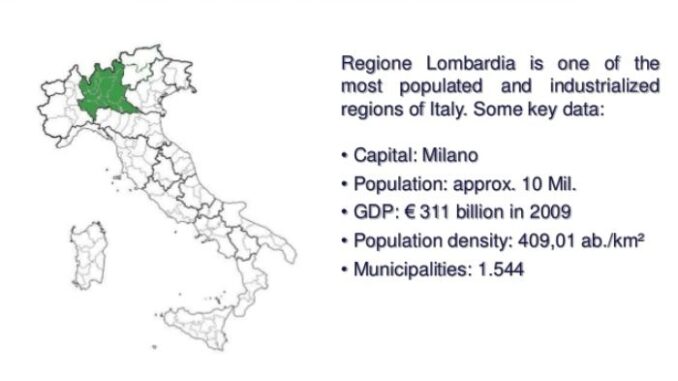
At the GI_Forum Symposium in Salzburg, Paolo Viskanic of R3 GIS gave a presentation about
a remarkable project that has been underway for the past ten years in the Region of
Lombardy in Northrn Italy.
a remarkable project that has been underway for the past ten years in the Region of
Lombardy in Northrn Italy.
.
A pilot project was carried out on the site of the Expo Milano 2015 event in Milan. The
total project area is about 230 000 square meters.
 All underground
infrastructure including electric power, water, sewers, gas, district
heating, street lighting, and telecommunication, were mapped both from historical records and using ground penetrating radar (GPR). GPR appears to work better in the EU for detecting underground infrastructure because the transmitter power is not s restricted as in the United States. A data model for underground infrastructure was developed for the different types of underground networks based on the Italian DigitPA and the INSPIRE US utility standards.
total project area is about 230 000 square meters.
All undergroundinfrastructure including electric power, water, sewers, gas, district
heating, street lighting, and telecommunication, were mapped both from historical records and using ground penetrating radar (GPR). GPR appears to work better in the EU for detecting underground infrastructure because the transmitter power is not s restricted as in the United States. A data model for underground infrastructure was developed for the different types of underground networks based on the Italian DigitPA and the INSPIRE US utility standards.
Most of the data is 2D, but some 3D data has been recorded and used to demonstrate 3D visualization.
.
Comparison
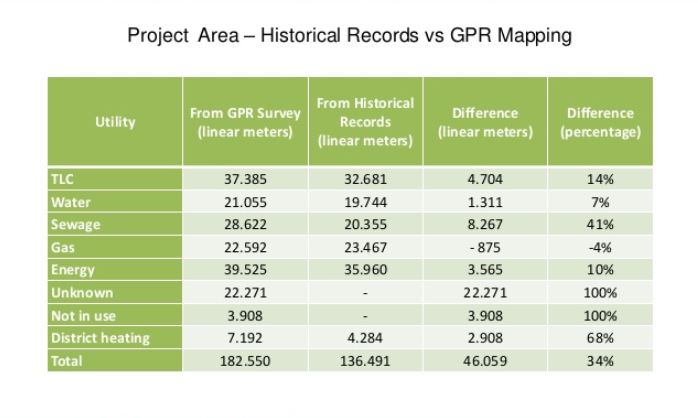
of the historical records with the results captured By GPR revealed
signicant discrepancies in the historic record including thousands of meters of unknown infrastructure.
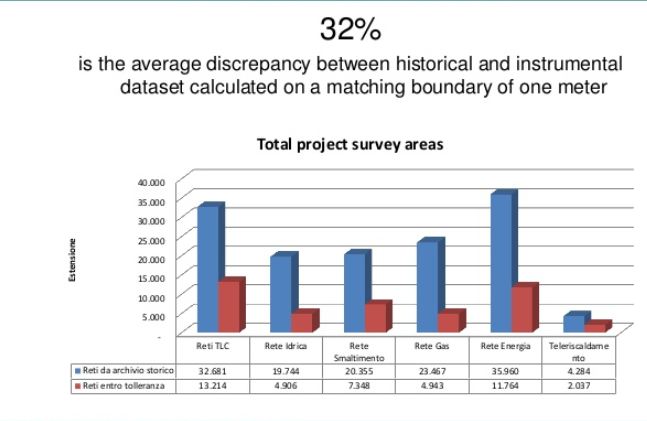 For the known infrastructure the average error in geolocation was about 30%, but much larger errors of up to 100% were also recorded. The conclusion is that even in Europe the record of underground infrastructure can be highly unreliable. That the exercise identifies underground infrastructure that had been previously unknown to the municipalities provides some financial motivation for municipalities because they tax utilties based on the total infrastructure the utilties manitain within city limits.
of the historical records with the results captured By GPR revealed
signicant discrepancies in the historic record including thousands of meters of unknown infrastructure.
For the known infrastructure the average error in geolocation was about 30%, but much larger errors of up to 100% were also recorded. The conclusion is that even in Europe the record of underground infrastructure can be highly unreliable. That the exercise identifies underground infrastructure that had been previously unknown to the municipalities provides some financial motivation for municipalities because they tax utilties based on the total infrastructure the utilties manitain within city limits..
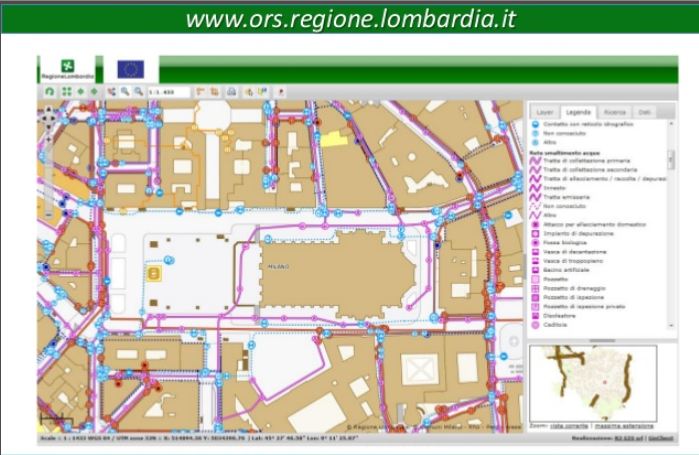
The data has been made available on the Web via OGC standard protocols and formats (WMS, WFS, KML). The web site has been implemented entirely using open source software.
.
Return-on-investment
An economic analysis of the data has been been carried out and the estimated return on investment is about €16 for every € invested in improving the reliability information of underground infrastructure. For comparison the ROI in the United States has been estimated to range from $3 to $21 for every dollar invested. Other benefits include improved safety for workers and the public and fewer traffic disruptions.
.
 Lessons learned
Paulo emephasized that there are several critical factors that are required to enable a project like this to be successufl. A clear legal framework is absolutely essential. In addition it is necesary to ensure that all stakeholders are involved. In the case of Lombardy this means EU, national, regional, provincial, and municipal governments.
.
Next steps
This is now mandatory for all municipalities in Lombardy, which means that the municipalities will need to map their underground infrastructure by the end of next year. To date about 200 of 1544 municipalities in Lombardy or about 10% have completed mapping their underground infrastructure.

Be the first to comment