
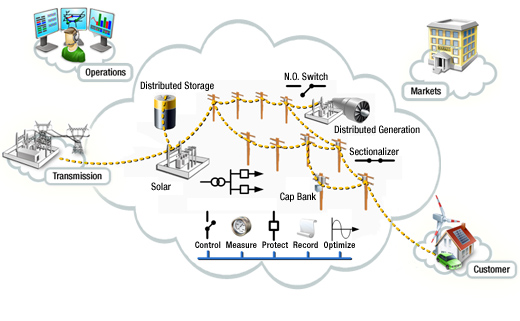
Massachusetts has not been among the states that have led the smart grid revolution in the United States. In September 2012 National Grid began a small smart grid pilot involving 5,000 meters in Worcester, Massachusetts. National Grid is expanding this to 15,000 customers to evaluate integrating home automation, dynamic pricing and distribution automation. At this point Massachusetts looks like a late adopter, but this is set to change. The Massachusetts Department of Public Utilities (DPU) has decided to aggressively accelerate the deployment of smart grid technologies in the state.
Background
DPU is responsible for ensuring that electric distribution companies provide safe and reliable electric service to customers and expand the deployment of clean energy technologies. As part of that mandate In October, 2012, the DPU issued a Notice of Investigation (“NOI”) into the modernization of the electric grid with the goal of developing policies to ensure that electric distribution companies adopt grid modernization technologies and practices. The expected benefits of grid modernization include improved reliability, reduced operating costs, reducing rate increases and volatility for customers, and empowering customers to better manage their use of electricity. The NOI also specifically mentions increasing the resiliency of the grid in response to “increasingly extreme weather”. Other benefits of grid modernization that the DPU foresees include providing support for energy efficiency, demand response, distributed generation, storage, electric vehicles (“EVs”), and renewable energy resources.
In November 2012, the DPU organized a workshop attended by over 125 stakeholders which resulted in the formation of a Working Group tasked with providing input to the DPU on approaches to grid modernization over the short, medium, and long terms and with helping the DPU in prioritizing grid modernization investments.
In July, 2013, the Working Group submitted a report to the Department covering on a wide array of grid modernization issues entitled “Report to the Department of Public Utilities from the Steering Committee”.
Enterprise systems required for smart grid include GIS
This report explicitly identifies what it calls network system enablers, enterprise systems that it considers essential for implementing a smart grid. These include GIS in addition to Distribution Management System (DMS)/SCADA, Outage Management System (OMS), Billing System, Metering System and Meter Data Management System (MDMS), and Communication Systems (Fiber, Microwave, Radio, etc.).
The report sees the role of GIS as the repository for asset information. It feeds system planning models, system operations models, outage management models and work-order/financial systems and can also
Electricity distribution companies required to prepare Grid Modernization Plans (GMP)
Based on the report the DPU established four grid modernization objectives; reduce the effects of outages; optimize demand (which includes reducing system and customer costs); integrate distributed resources, and improve workforce and asset management.
The DPU then proposed requiring each electric distribution company to develop and submit to the DPU a ten-year strategic grid modernization plan within six months. The GMPs must lay out plans to make measureable progress towards all of these grid modernization objectives.
Smart grid priorities
In its first GMP each power utility must include a comprehensive plan for advanced metering (CAMP). The DPU is prioritizing advanced metering because it sees AMI as a basic platform upon which grid modernization will be developed. It is being very aggressive in mandating completion of the rollout of AMI with three years of the DPU’s approval of each company’s GMP. To support this effort the DPU has already developed a regulatory framework specifically targeted on advanced metering.
The DPU has identified its next top priorities;
(1) time varying rates (time-of-use rates)
(2) cybersecurity, privacy, and access to meter data
(3) electric vehicles.

Be the first to comment