
The Massachusetts Department of Public Utilities (DPU) has decided to aggressively accelerate the deployment of smart grid technologies in the state. In July, 2013, the grid modernization Working Group submitted a report to the Department covering on a wide array of grid modernization issues entitled “Report to the Department of Public Utilities from the Steering Committee”.
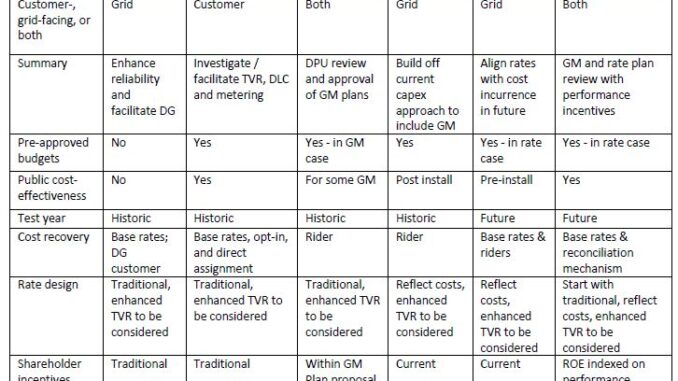
One of the most interesting parts of this report is that it presents recommendations for alternative regulatory frameworks that could be used for planning, reviewing and implementing grid modernization projects.
All of the utilities operating in Massachusetts with the exception of NSTAR operate under a regime that is based on fully decoupled base distribution rates. So there has been a recognition for some time in Massachusetts that the traditional approach to utility cost-recovery does not work in a modern environment where utilities are expected to encourage energy conservation, consumer deployment of solar PV, and other programs that actually reduce revenue.
The report discusses alternative regulatory frameworks that range from tweaking the existing framework to changing the fundamental groundrules.
Enhanced Regulatory Model
The Enhanced Regulatory Model provides a regulatory model that ensures maximum flexibility in addressing cost recovery for individual, targeted programs. It provides five submodels each of which is designed to facilitate recovery of costs associated with one of the five main initiatives of grid modernization, reliability, advanced metering, time-of-use rates, distributed generation, and direct load control.
Grid Modernization Expansion – Pre-approval Process
Distribution Companies would be permitted to request recovery of grid modernization investments through mechanisms outside of base rates, as determined by the DPU. Cost recovery could be enabled consistent with existing precedent regarding historic test-years (decoupling) but may also be modified to accommodate a future test-year approach.
Expansion of Investment Caps
This model would allow a utility with a capital investment recovery mechanism, such as National Grid’s annual mechanism for in-service capital investments up to $170 million made in a preceding calendar year, to request an increase to its capital investment budget cap outside of a base rate proceeding for additional investment for grid modernization.
Expansion of Investment Caps with a Multi-Year Plan
This model builds on the Expansion of Investment Caps model and additionally allows a utility to propose spending levels for a multi-year period instead of one year at a time.
Future Test Year Model
A forecasted rate year approach to cost of service provides utilities with greater incentive to invest in modernizing the grid because it aligns the cost of service with the time period in which the costs would be incurred so that revenues would be set to match expected costs in the year they are incurred instead of costs incurred two years earlier.
Future Test Year with Multi-Year Plan Model
This model takes the same form as the Future Test Year Model with a forecasted rate year. However, it would extend the plan for a number of years, usually three to five years. The benefit from multi-year plans is that the utility’s capital investment plan can be reviewed and approved for a number of years which allows the utility to plan several years in advance.
Utility of the Future, Today
Grid modernization promises to bring substantial net benefits to customers and society including improved reliability, reduced costs of service and customer bills, improved capacity utilization, reduced environmental costs, and increased customer choice. But since the incremental benefits of grid modernization investments tend to accrue to others such as customers and society in general and not the utility, the risk of disallowance under traditional ratemaking practices discourages utilities from pursuing grid modernization investments.
To address the fundamental shortcoming in the incentive structure of traditional utility ratemaking practice, it is proposed that a new regulatory model be adopted by the DPU – one that requires the utility to analyze grid modernization investments from a broader societal point of view, gives the utility a degree of certainty regarding cost-recovery before it makes investments, and evaluates and rewards good planning, implementation and performance. The regulatory model that it is suggested will encourage cost-effective grid modernization efforts includes pre-approval and performance-based ratemaking (PBR) elements.

Be the first to comment