
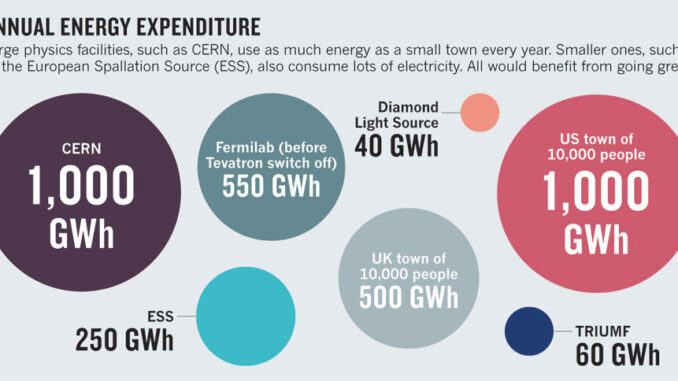
According to an article in Nature, international and national labs use massive amounts of power, 3 terawatt hours (TWh) per year in Europe and 4 TWh/yr in the United States, about the same as a small country. The European Spallation Source (ESS), a neutron source to be built in Lund, Sweden, intends to be the first sustainable national lab. It will use only renewable energy sources to power the accelerator and the lab and 70% of the energy that it consumes will be recovered as usable heat.
Most facilities waste heat. CERN, the European high-energy physics laboratory near Geneva which includes the Large Hadron Collider (LHC), generates waste heat that could be used for heating, but instead it has a separate source for heating. The spallation neutron source at Oak Ridge National Laboratory in Tennessee cools its equipment using a cooling tower, and then uses gas-fired boilers to heat its building.
The ESS will plug in to the city of Lund’s district heating system, which operates a network of hot-water pipes under the entire city and a neighbouring community 20 kilometres away. It is estimated that the ESS will produce 180 GWh of heat per year, of which about half will have a high enough temperature to go directly into the district heating system, and the rest will be heated so it can be used the same way.
A team at the TRIUMF particle accelerator at the University of British Columbia in Vancouver, Canada, is looking at whether waste heat can be used to heat residential buildings on campus. But because the buildings will not require heating in summer, TRIUMF will have to install back-up cooling devices. The capital investment required will be not be reduced, though there are expected to be operational cost benefits. As a rule of thumb, it is better to be energy efficient in the first place than to recycle because electricity is about 2.5 times more valuable than high-grade heat.
Helmut Dosch, chair of the board of directors of the German accelerator complex DESY, has called for national labs to get involved in the Desertec project as a source of renewable energy. Desertec supports the development of solar power plants in north Africa with high voltage DC transmission lines to carry the power to European consumers.

Be the first to comment