
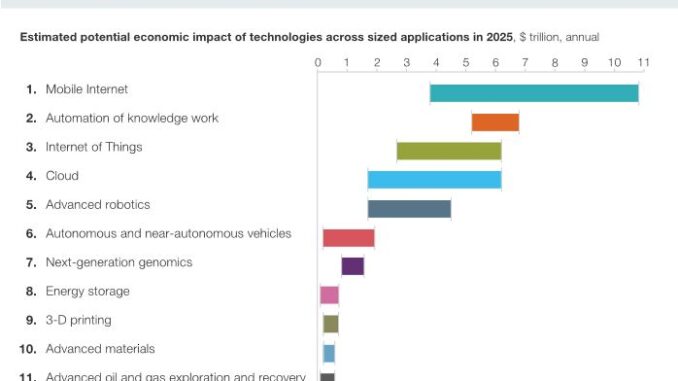
McKinsey identifies renewable energy and energy storage as disruptive technologies

McKinsey Global Institute (MGI) has identified 12 technologies that could cause large-scale economic disruptions in the future.  MGI estimates that the 12 technologies combined could have a potential economic impact between $14 trillion and $33 trillion a year in 2025.

1 Mobile Internet $3.7 – 10.8 trillion
Wieless, small devices, advanced displays and batteries

2 Automation of knowledge work $5.2-6.7 trillion
Artificial intelligence, big data, natural user interfaces

3 Internet of things $2.7-6.2 trillion
low-cost sensors, wireless and near-field comms devices like RFID

4 Cloud $1.7-6.2 trillion
Virtualization, metering, data-center h/w, high-speed networks, SaaS

5 Advanced robotics $1.7-4.5 trillion
Computer vision, sensors, advanced robotic dexterity, sensors

6 Autonomous/near-autonomous vehicles $0.2-1.0 trillion
Artifical intelligence, computer vision, advanced sensors (radar, LiDAR, GPS), m2m comms

7 Next-generation genomics $0.7-1.6 trillion
Advanced DNA sequencing, DNA-synthesis, big data and analytics

8 Energy storage $0.1-0.6 trillion
Battery technologies, pumped hydro/compressed air, advanced materials/nanomaterials

9 3-D printing $0.2-0.6 trillion
Selective laser sintering, fused deposition modeling, stereolithography, direct metal laser sintering

10 Advanced materials $0.2-0.5 trillion
Graphene, carbon nanontubes, nanoparticles, smart materials (piezoelectric materials, memory metals, self-healing materials)

11 Advanced oil and gas exploration and recovery $0.1-0.5 trillion
horizontal drilling, fracking, microseismic monitoring

12 Renewable energy $0.2-0.3 trillion
SolarPV, wind turbines, concentrated solar, hydroelectric and ocean-wave power, geothermal

Geoff Zeiss

Geoff Zeiss

Geoff Zeiss has more than 20 years experience in the geospatial software industry and 15 years experience developing enterprise geospatial solutions for the utilities, communications, and public works industries. His particular interests include the convergence of BIM, CAD, geospatial, and 3D. In recognition of his efforts to evangelize geospatial in vertical industries such as utilities and construction, Geoff received the Geospatial Ambassador Award at Geospatial World Forum 2014. Currently Geoff is Principal at Between the Poles, a thought leadership consulting firm. From 2001 to 2012 Geoff was Director of Utility Industry Program at Autodesk Inc, where he was responsible for thought leadership for the utility industry program. From 1999 to 2001 he was Director of Enterprise Software Development at Autodesk. He received one of ten annual global technology awards in 2004 from Oracle Corporation for technical innovation and leadership in the use of Oracle. Prior to Autodesk Geoff was Director of Product Development at VISION* Solutions. VISION* Solutions is credited with pioneering relational spatial data management, CAD/GIS integration, and long transactions (data versioning) in the utility, communications, and public works industries. Geoff is a frequent speaker at geospatial and utility events around the world including Geospatial World Forum, Where 2.0, MundoGeo Connect (Brazil), Middle East Spatial Geospatial Forum, India Geospatial Forum, Location Intelligence, Asia Geospatial Forum, and GITA events in US, Japan and Australia. Geoff received Speaker Excellence Awards at GITA 2007-2009.

View article by Geoff Zeiss

Be the first to comment

Leave a Reply

Your email address will not be published.


*