
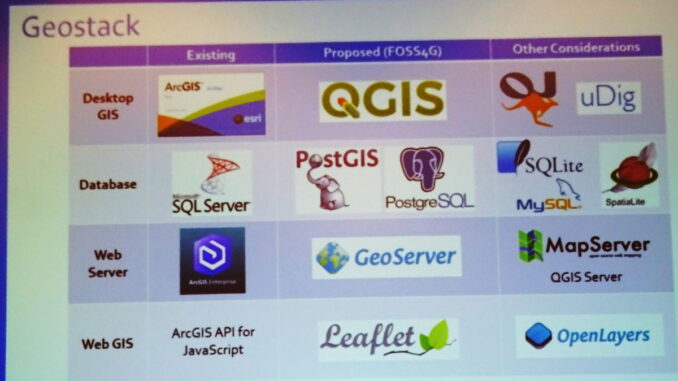
Samuel Song is responsible for the National Cemetery GIS implementation within Veterans Affairs and like many in government increased use of GIS means a greater sensitivity to cost. Samuel decided to investigate migrating to an open source geospatial from a commercial stack and found it surprisingly easy though there were some challenges. Samuel outlined his experience at this year’s GIS in the Rockies conference in Denver.
Currently he is using ArcGIS Desktop as his desktop GIS, SQL Server as a database, ArcGIS Enterprise as a web server, and ArcGIS API for Javascript for his web GIS. Samuel’s main costs are ArcGIS Desktop which costs him $7200/annum. To look at ways to lower his costs Samuel decided to experiment with open source geospatial software; QGIS for his desktop GIS, PostgreSQL/PostGIS for his database, GeoServer for his web server, and Leaflet or OpenLayers for his web GIS (all part of the OSGEO open source geospatial stack). Some of the things he found in his proof of concept are surprising, others perhaps not so to folks who have been working with open source geospatial software for years. His most important findings from his perspective is that QGIS is a very stable, very powerful alternative to ArcMap. He also found that PostgreSQL/PostGIS is a stable alternative to SQL Server. He found that migrating data from an ESRI Geodatabase is much easier than he expected. He had some problems with Leaflet and WMS attributes, and preferred the greater functionality of OpenLayers.
He is recommending as a first step migrating off ArcGIS Desktop to QGIS. That alone will save him $7200/annum. In the future he is looking at PostgreSQL/PostGIS replacing SQL Server, using OpenLayers for his Web GIS and testing QField mobile data collector to replace Collector for ArcGIS.
His overall conclusion is that although some GIS professionals fear a transition to an open source stack due to its perceived complexity and many moving parts, he found that it is possible to move to a fully open source platform from an existing ArcGIS implementation and that some parts of the migration are much simpler than he expected.

Be the first to comment