
In the view of many the utility industry is in the initial phase of adoption of a new generation of IT characterized by real-time, big data and analytics. I blogged previously about a new application framework implemented to support Burlington Hydro’s smart grid deployment. Here is another, but quite different, example of the new generation of IT.
In a very appropriately titled session Taking Society’s Pulse in Real-time at the Creating the Policy and Legal Framework for a Location-enabled Society conference in Boston, there were demonstration that showed mining information from tweets and other socal media traffic. One demonstration showed how a person sailing in the Caribbean could be tracked geographically as they tweeted from their boat.
As a more practical example, last week Michael Jander of AGSI gave a riveting webinar on a new, innovative location-aware approach for mining social media message traffic in real-time from Twitter, Flickr, Facebook and other social media streams. MIke’s background is public safety and security so his demonstration tended to focus on this area. However, this technology is equally applicable to other sectors including utilities.
The tool that Mike demonstrated monitors social media message streams in real time including the senders’ locations. In the webinar, Mike demonstrated monitoring Twitter message streams. A typical scenario involves an event, for example, a fire. The operator identifies the location of the event on a map and draws a polygon around it to define an area of interest. At this point all of the tweets emanating from a location within the polygon become visible to the operator, who can see and filter the contents of the tweets based on their contents. For example he/she may be interested in tweets that mention “fire”. In addition it is possible to view historical tweets back as far as 30 days prior to the event. Since the tweets have geolocation, either from on onboard GPS or via triangulation, it is also possible to track persons of interest by following their tweets.
People can be notified over the social network if they are in danger. They can be asked if they saw an incident. If the incident is still occurring, they can be asked for additional information such as what they can see, hear or smell. For example, if they report smelling smoke that can alert first responders to the risk of a fire. Mike related that during one incident, 1500 people were tweeting what they were seeing. During a major disaster such as Katrina this provides much better coverage over a broader area than would be possible if the only source of information is public officers.
Mike has had a lot of experience in the area of public security and safety and was able to describe real world scenarios where having access to this type of real-time information would be invaluable. He mentioned the annual Santa Claus Parade in Toronto where this capability can help find lost children. Define an area where the child was last reported and then tweet to everyone in that area a description and ask them to send a message if they see the child. Or monitor tweets in that area looking for mention of a “lost child.”
 The tool allows the operator to search most social media traffic, filter the traffic geographically and by date and time, identify specific social media users, and track users from their tweets or other social media. In addition geofencing can be used generate alerts when a specific social media user enters a zone, or when a key word such as “fire” is used within a specific area, and send social media messages to specific social media users (which don’t have to be followers.)
Application to utilities
 This approach can also assist electric utilities to search, review, and plot social media traffic when it relates to a customer concern, power outage or other types of incidents. It also enables the utility’s corporate communications staff to interact with all social media users, whether they are following the utility or not. It enables the utility to communicate important messages to specific users, for example, in a defined geographical area or region. Energy conservation programs, notification of planned outages, updates on major outages and other types of information that are important to consumers can be communicated in this way. Social media messages can be mapped and shared with other employees, for example, showing the location and photos of downed lines during a power outage. The benefit of the is approach is that it provides utilities the ability to utilize social media for interacting with the public and optimizing customers’ experience with the utility.
The graphics show
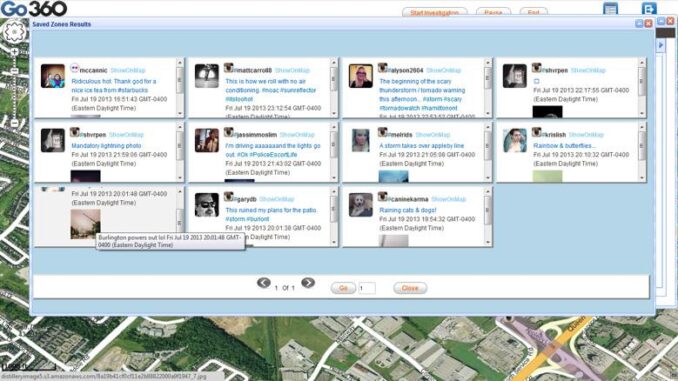
- Quilt view of social media tweets during a storm event filtered by geospatial buffer around a electrical distribution feeder.
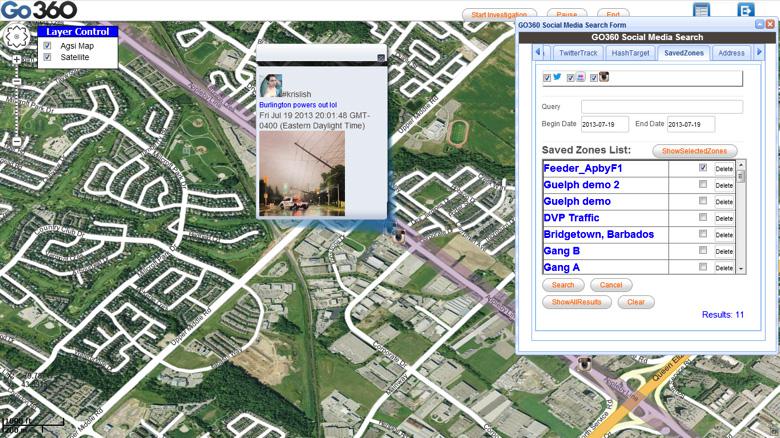
- Selection and sharing of applicable social media tweets during a storm event again using a buffer linked to an electrical distribution feeder.
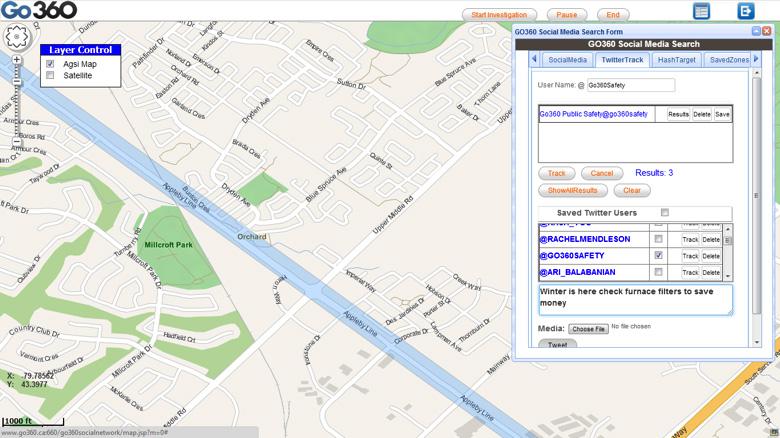
- Selection of users within a defined geographical area for communicating an important notifcation. Note that the users are not required to be followers.

Be the first to comment