
According to the Federal Highway Administration National Bridge Inventory there are 604,474 bridges in the U.S., including those that are part of the National Highway System (NHS) and non-NHS bridges. Of these 69,223 (11.5%) are classified as “Structurally Deficient” (SD) and 77,410 (12.8%)) as “Functionally Obsolete” (FO). These terms are defined in terms of technical engineering assessments of the condition of the deck, superstructures, substructures, culverts and retaining walls. SD means that the bridge requires more frequent monitoring and critical, near-term maintenance, rehabilitation or replacement. The average age of an American bridge is 42 years (not that far off from the average age of a transformer in a U.S. substation.)
Transportation for America conducted an analysis of the National Bridge Inventory and found that structurally deficient bridges in metropolitan areas carry three-quarters of all traffic crossing a deficient bridge each day. 210 million trips are taken daily across deficient bridges in these metro regions. The worst metropolitan area for structurally deficient bridges is Pittsburgh with 30 percent of its bridges rated deficient. California has the busiest deficient bridges led by Los Angeles.
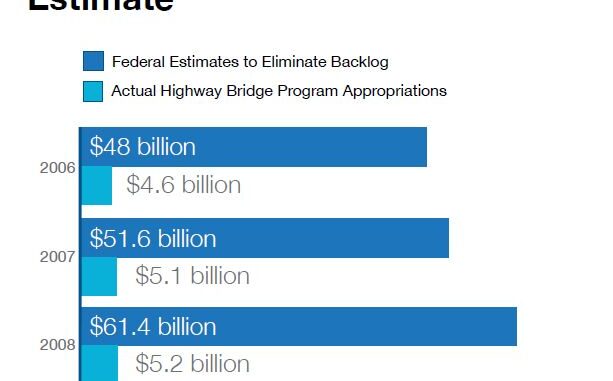
According to the FHWA’s 2009 statistics, $70.9 billion is needed to upgrade America’s deficient bridges. The actual funds allocated in 2009 was a little over 7% of what was required.
Transportation for America recommends that a fundamental shift in policy is required to ensure that existing infrastructure is maintained at an adequate level. One of the problems is coordination between different levels of government. According to federal law, federal funds for bridge repair are allocated to the states and decisions concerning the use of federal funding reside with the states. But while many major bridges are owned by state departments of transportation (DoTs), some are owned by city or county governments. Transporation for America suggests that better coordination between different levels of government is necessary to ensure that additional funding is prioritized for the most critical repairs, upgrades and replacements.

Be the first to comment