
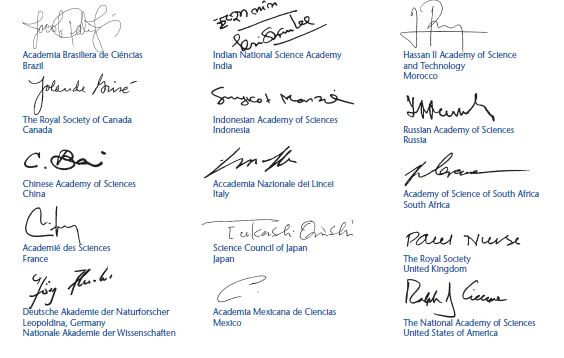
G-Science statements addressed to the world’s G8 leaders have been signed by the leaders of National Science Academies from Brazil, Canada, China, France, Germany, India, Indonesia, Italy, Japan, Mexico, Morocco, Russia, South Africa, the United Kingdom, and the United States. The statements ask for more involvement of science in addressing
- how to simultaneously meet water and energy needs
- how to build resilience to natural and technological disasters
- how to more accurately gauge greenhouse gas emissions on a country-level basis to verify progress toward national goals or international commitments
On February 27-28, 2012, the National Academy of Sciences of the U.S. convened a meeting of fifteen science academies to discuss three major issues facing the global community. The National Science Academies issued joint “G-Science” statements calling on world leaders at the upcoming G8 Summit and the Rio+20 UN Conference on Sustainable Development to give greater consideration to the vital role science and technology could play in addressing some of the planet’s most pressing challenges.
Energy and Water Linkage: Challenge to a Sustainable Future
 Needs for affordable and clean energy, for water in adequate quantity and quality, and for food security will increasingly be the central challenges for humanity: these needs are strongly linked. In some regions, the increasing demands for water in support of energy development and use pose challenges to its availability for food and other human needs and for important ecological systems. It is critically important that planning and investment in energy and water infrastructure and associated policies take into account the deep interaction between water and energy.
Improving Knowledge of Emissions and Sinks of Greenhouse Gases
 Most countries have made commitments to limit human-caused emissions of greenhouse gases. To determine the success of these efforts, we need to use standardized methods that accurately estimate natural and human caused sources and sinks of greenhouse gases—including carbon dioxide (CO2), methane (CH4), and nitrous oxide (N2O)—at a national level. Such estimates are needed to verify an international climate treaty as well as to detect changes in natural greenhouse gas emissions (such as, large-scale release from methane hydrates) or sinks.
Building Resilience to Disasters of Natural and Technological Origin
 Disasters impose huge social and economic costs on societies. By reducing exposure and adopting new strategies to increase resilience, these costs can be reduced. While experience from recent disasters provides useful lessons, a more effective guide to building resilience can be based on systematic scientific risk surveillance and ranking. Since a strategy built on this basis is common to a range of disasters, regardless of their cause, implementing these strategies can be an important investment. It is urgent that national governments build resilience strategies into national, as well as international cooperation and development assistance plans.
Be the first to comment