
I just returned from Malaysia, where I participated in the National Conference on Geospatial and Mapping Solutions conference, held for the second year on Pangkor Island. The focus was infrastructure including highways and roads, municipal infrastructure, power grids, and cadastres.
First a little about Malaysia. Next year 2007 is the 50th anniversary of the independence of Malaya. In 1963, Malaya was joined by Sabah, Sarawak, and Singapore to form Malaysia and in 1965 Singapore became an independent country. The population is close to Canada’s, nearly 30 million, but its land mass is about half of Saskatchewan’s or a bit larger than New Mexico. It’s ethnically diverse, primarily Malay 50.8% and Chinese 23.8%. It’s diverse with respect to languages; Malay, Cantonese, Hokkien, Mandarin Chinese, English, Tamil, indigenous) and religions; Islam (60.4%), Buddhism (19.2%), Christianity (9.1%), Hinduism (6.3%), and others.
in 2006 Malaysia is embarking on the 9th Malaysian plan, which covers the next five years. A total of RM3.5million (about US$1.2 billion) has been allocated to develop Malaysian infrastructure. I arrived at Kuala Lumpur International Airport. The shuttle to Lumut, which is where you get the ferry to Pangkor Island, takes about three and half hours on a major Malaysian highway, the North-South Highway, and secondary roads. I had an opportunity to see some Malaysian infrastructure first hand and I must say that the roads and highways compared favourably to North America. The roads I saw were in better condition than comparable roads in North America. (Of course in Canada the extremes of temperature, for example in Ottawa +35C in summer and -35C in winter, means that roads and highways are more costly to maintain.)
Based on what I heard, the things that were upper most in people’s minds at the conference were education and training in geospatial technology, especially in the newer model-based design tools, web mapping, open source geospatial, mobile, and 3D building models and geospatial integration.
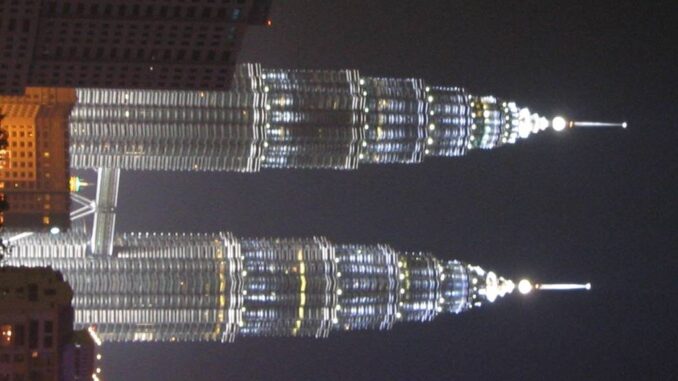
The discussion relating to 3D structures was especially interesting because we were lucky to have Professor Alias Abdul Rahman from the Universiti Teknologi Malaysia, who talked about 3D cadastres, which are more important in Asia, where dense population means many more multi-story structures. For six years Petronas Towers in Kuala Lumpur was the world’s tallest
building at 452 m. Taiwan 101 at 509 m is currently the world’s tallest building. (Canada’s CN Tower at 553m is higher, but the CN Tower is technically a tower.) Professsor Rahman outlined three approaches to 3D cadastres
1) Administrative tag model – Basically integrates 2D spatial with tagged information for strata.
2) Hybrid model – Integrates a 2D cadastre with topological information about 3D structures.
3) Full 3D model- Requires a complete overhaul to incorporate three dimensions.
Professor Rahman’s approach is based on the hybrid model and represents a pragmatic solution. For example, it supports topological queries such as what is above, below, or next to a three dimensional object. What is especially interesting about Professor Rahman’s approach is that it utilizes commercial off-the-shelf products, Oracle Spatial and Autodesk Map.
Be the first to comment