
I blogged previously about a new datum or geospatial reference system which will become the official U.S. datum in 2022. The new reference system will result in elevations changing by up to a meter and horizontal locations by up to 1.5 meters. As part of the transition from the North American Datum of 1983 (NAD 83) to the 2022 Terrestrial Reference Frames, an update of the State Plane Coordinate System is required . The National Geodetic Survey (NGS) has created a draft policy and procedures for SPCS 2022 and is asking for public feedback.
The State Plane Coordinate System (SPCS) is a system of conformal map projections created by the National Geodetic Survey (NGS). SPCS was established to support surveying, engineering, and mapping activities in the United States and its territories. The current version, SPCS 83, is referenced to the North American Datum of 1983 (NAD 83) and consists of 125 zones based on the Lambert Conformal Conic, Transverse Mercator, and Oblique Mercator projections. The State Plane Coordinate System of 2022 (SPCS2022) will replace SPCS 83.
Most people in the geospatial sector in the U.S. are aware of the datums NAD27 and NAD83 which have been the reference points for all surveys performed in the U.S. NAD83 was defined primarily using terrestrial surveying techniques. NAD83 has been updated several times since being introduced in 1983, but is based on an elipsoid that is non-geocentric and is tilted slightly. The new datum or North American Terrestrial Reference Frame of 2022 (NATRF2022) is based on gravity which means that “sea level” is now represented by an equipotential gravity surface rather than the Earth’s elipsoid. The new reference frames will rely primarily on Global Navigation Satellite Systems (GNSS) such as the Global Positioning System (GPS) as well as an updated and time-tracked geoid model. Importantly, the new datum means that Mexico, Canada, and the U.S. will share a common datum. The gravity-based vertical datum will be accurate at the 2 cm level for much of the U.S. Gravity data is being captured across the U.S. and its territories as part of the Grav-D project.
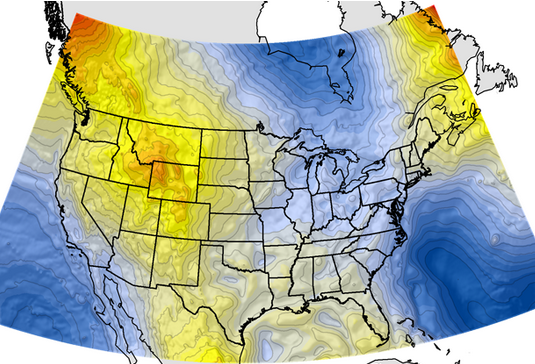
Practically, this means that elevations may change by up to a meter and horizontal location by up to 1.5 meters. The actual corrections to elevations and horizontal locations will depend on where you are in North America. The greatest changes are in the Pacific Northwest and the least in the southeastern U.S. All federal civilian agencies with geographic data will be required to use the new reference frames. Some states may require a change in law to utilize the new reference frames.
The NGS is asking for public feedback on the draft SPCS2022 by August 31, 2018.

Be the first to comment