
Since 2002 there has been a standard, ASCE 38, for investigating and documenting existing underground utility infrastructure. Now in the US a new standard ASCE 75 is imminent that will define a standard way to record and exchange information about newly installed infrastructure. This means that in the future all underground infrastructure can be assigned a quality level, either under ASCE 38 or ASCE 75.
Developed by the ASCE Construction Institute (CI) and Utility Engineering and Survey Institute (UESI) the new “as-installed” standard is currently available for public comment through January 6, 2022. It has already been adopted in Montana and Colorado as the “as-constructed” standard for new infrastructure in state right of ways. Recently UESI and the Centre for Advancement of Trenchless Technologies sponsored a talk by Phil Meis, one of the authors of the ASCE 75 standard.
ASCE 75 is applicable to newly installed, repaired, relocated and exposed infrastructure, both below and above ground. The standard specifies the minimum spatial, 3D geometry, and feature attribute data to be captured for newly installed utilities. 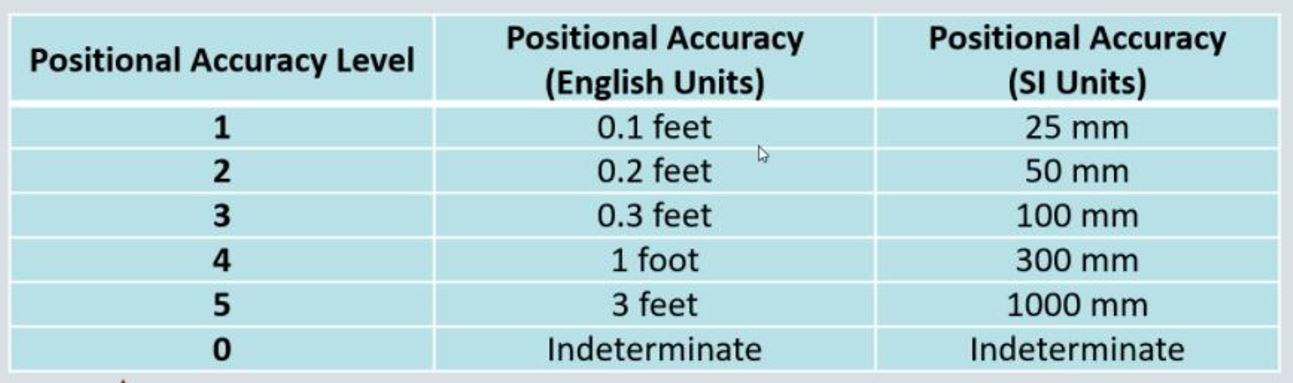 Unlike ASCE 38-02 it defines quantitative levels of positional accuracy – for both horizontal and vertical dimensions. It defines a basic set of data that provides a foundation for utility engineering and coordination, network asset management, and the exchange of utility facility information among stakeholders.
Most importantly ASCE 75 is a digital standard, which means that it is consistent with and supports digital construction design standards and delivery practices such as building information modeling (BIM) and virtual design and construction (VDC).
What does it mean for the public right of way owner ?
It makes it possible for the public right of way owner, typically a state Department of Transportation and their designers and contractors, to require advanced 3D digital technologies such as BIM, conflict detection, and reality capture for improved utility coordination with 3rd parties including utility owners. The major benefit is reduced construction risk, time, and costs, and more on-time project completions.
What does it mean for the utility owner ?
For utility owners the benefits of the new standard dwarf the incremental cost. Standardized recording and retrieval of utility infrastructure data and the ability to exchange information about underground and above-ground utilities among stakeholders provides for enhanced damage prevention and reduced risk to existing utility infrastructure As a digital standard It enables for more focused and effective utility investigations and conflict assessments. In general it will provide a foundation for more effective utility asset management and more resilient and sustainable infrastructure.

Be the first to comment