
New federal regulations in the U.S. will likely more than double the areas where higher levels of pipeline integrity maintenance standards are mandated by federal legislation. Identifying these areas is more complex creating opportunities for geospatial professionals to apply new technologies including machine learning.
On June 10, 1999, a gasoline pipeline operated by Olympic Pipeline Company exploded in Bellingham, Washington. Three people died in the accident. On August 19, 2000 a natural gas pipeline owned by the El Paso Corporation exploded near Carlsbad, New Mexico killing 12 people. After these incidents the government moved quickly to improve the quality of geospatial and other data about underground pipeline assets. The result was within about two years federal regulation from the Pipeline and Hazardous Materials Safety Administration (PHMSA) which required companies operating pipelines carrying hazardous materials to identify high consequence areas (HCAs) where there were 20 or more structures intended for human occupancy within a radius (potential impact radius or PIR) defined by the diameter and pressure of the pipe. Within the HCAs utility companies were required to maintain facilities data at a higher level of integrity. The cost to identify HCAs for a relatively small utility in Pennsylvania that I was familiar with at the time cost $2 million over two years. This represented a significant opportunity for experienced geospatial professionals.
The Pipeline Safety, Regulatory Certainty, and Job Creation Act of 2011 mandated telephonic or electronic reporting of accidents and incidents including the amount of product released, number of fatalities and injuries, but not an accurate location, within 48 hours of occurrence. The act also required the Secretary of Transportation to maintain a map of high-consequence areas in which pipelines are required to meet integrity management program regulations. At this time the locational accuracy requirement for pipelines was ± 500 feet.
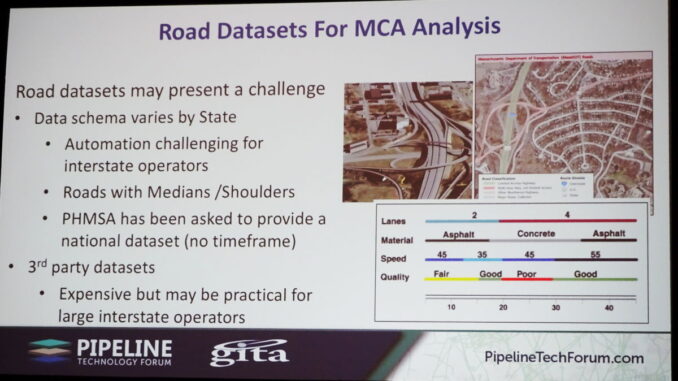
At the GITA Pipeline Forum in Houston, Darrel Donaho of G2 Integrated Solutions presented an overview of the latest regulations from PHMSA. Referred to as the Gas Mega Rule the new regulation extends the higher standards of pipeline maintenance to moderate consequence areas (MCAs). Pipeline operators are now required to identify areas where 1) the number of occupied structures within the PIR is five or greater and less than 20 or 2) where any portion of the pipeline PIR intersects the paved area of interstate highways, freeways and expressways and other principal four-lane arterial roads. They are also required to report longitude/latitude to five decimal places for all incidents.
Whereas in the past identifying HCAs involved hand drawing building footprints from imagery, machine learning can now be used to automate the process of identifying building footprints prior to using a buffer analysis to identify areas qualifying as MCAs. The analysis is aided by the current accuracy requirement for locating pipelines of ± 50 feet. Identifying MCAs where highways intersect pipeline PIRs is more complex because automating the identification of transportation corridors is more difficult. There are alternative, but more expensive ways to find this information.
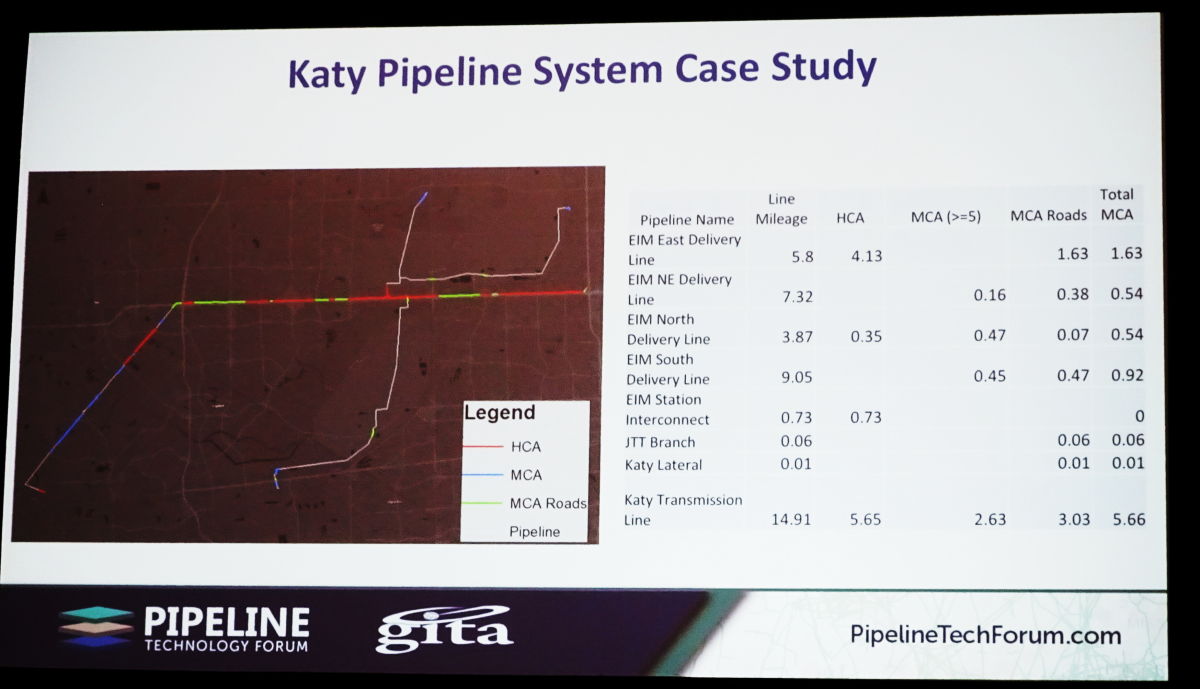 An analysis of a 14.91 mi transmission line suggests that the impact of the new regulation will be significant, more than doubling the areas where higher integrity maintenance applies. This creates a significant opportunity for geospatial professionals to apply new technologies including machine learning.
| HCA | MCA (>=5) | MCA roads | Total MCA |
| 5.65 mi | 2.63 mi | 3.03 mi | 5.66 mi |

Be the first to comment