
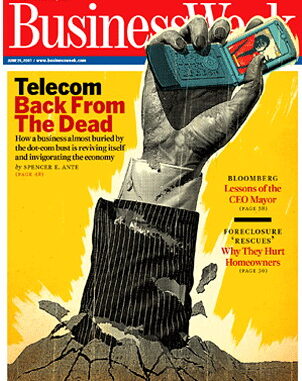

I had the opportunity to drop by the NXTcomm conference in Chicago on my way to Washington from San Francisco and it was worth it. I have not seen so much energy around telecom since before the telecom meltdown in 2000 when the telecom industry lost something like $2 trillion in market capitalization. What is driving this is deregulation, innovation in communications, and Web 2.0.
US Communications Market
I picked up some interesting statistics. The US communications market is $1 trillion annually. For comparison the US construction market is $1.2 trillion annually. It is expected that there will be $70 billion investment in broadband infrastructure in 2007 in the US.
The US has the largest broadband population on earth at 58 million (out of 285 million worldwide), but the US, having just achieved 50% of households with broadband, is 15th in broadband penetration in the OECD. Of the 58 million, 28.9 million are residential cable subscribers.
Broadband and Web 2.0
Internet traffic is doubling every year. South Korea leads the world in broadband penetration. Canada continues to lead the G7 group of industrialized countries in broadband penetration. Japan leads the OECD in fibre connections directly to the home with 7.9 million fibre-to-the-home subscribers in December 2006. To me it is absolutely amazing that 10 % of internet traffic is due to YouTube. John Chambers, CISCO CEO, predicted that Web 2.0 collaboration is the most important phenomenon determining how people will use the internet in the future. Consumers are driving telecom convergence meaning triple play, voice + entertainment + internet, or quadruple play, meaning voice + entertainment + internet + wireless. Reportedly cable rates have doubled over the last decade and the FCC is interested in fostering competition in this area. Convergence is the priority for all the major telecoms, AT&T, Qwest, Verizon, and BT with a major presence at NXTcomm. A scenario that will be possible in the future, is to watch the same program on different devices. For example, begin watching a hockey game on your television, switch to watching the game on your wireless phone, and then watch it on your computer.
Broadband wireless
Arguably, the US has the most competitive communications environment
in the world and as a result there is a lot of innovation in the US, but the US has
some important barriers to universal access. Wired broadband access in the US has just reached 50% and the US is 15th in terms of broadband penetration worldwide. Wireless penetration in the US is better, having just achieved 75 %, but still lags Japan and Western Europe. Wireless penetration in Japan surpassed 100% in the 15-64 age bracket and figures from the International Telecommunications Union indicate rates of nearly 103 % of the population in Britain, more than 109 % in Italy and 119.4 % in Luxembourg.. Internationally
WIMAX has become the most important broadband technology.
45% of American households
don’t have a computer which inhibits further growth of wired broadband penetration. As a result broadband wireless is going to be increasingly important in the US in the future. Whereas 50% of Americans now have access to wired broadband, 75% have a mobile phone. But wireless broadband (3G) penetration in the US is still low. Japan became the first nation to have more than 50% of its subscribers using 3G. DoCoMo and KDDI have 60% of their subscriber base using 3G devices. Korea is a close second approaching 50% 3G penetration. AT&T, now a wireless-centric company according to Randall Stephenson, announced a video sharing service for
wireless phones at NXTcomm and the FCC chairman Kevin Martin said that the upcoming 700 MHz spectrum auction in the US was a critical step in enabling broadband wireless.
Universal access
The biggest challenge in the US appears to be universal broadband access. Traditionally the US has been a leader in providing broad based access to new technologies, but in wireless and broadband the US has not been a leader. Another important factor is that AMPS (analog) networks will be shut down in the US beginning in Feb 2008. The people most seriously affected by this will be in rural areas. To help address the challenge of broadband access in rural areas, the FCC is considering converting its voice subsidy program, which primarily benefited rural areas to broadband.
In Australia, rural access has been a key issue as well This week the Australian Government announced a $1B subsidy
to get the bush connected to broadband and the winner is a
consortium known as OPEL – Optus with Elders which excludes Telstra.
Canada is 27th in wireless penetration in the OECD. According to Statistics Canada there were 47
wireless subscribers for every 100 people. The most recent U.S. figure available
indicates that at the end of last year, there were 61.7 wireless subscribers for
every 100 people. One reason is that wireless access is expensive in Canada. A recent study found that the average wireless customer in Canada pays 60 per cent more than they would under a U.S. plan.

Be the first to comment