
One of the things that is required to make the vast quantity of satellite imagery easily searchable is a common way to query satellite data. The SpatioTemporal Asset Catalog, known as STAC, is an open specification that came about when fourteen different organizations came together to increase the interoperability of searching for satellite imagery. At this year’s FOSS4GNA (Free and Open Source Software for Geospatial North America) get together in St Louis, Matt Hanson, of developmentSEED, gave a technical overview of the STAC standard and described one of the first implementations. The context for Matt’s STAC presentation was provided by Chris Holmes’ keynote in the morning.
Chris Holmes and others have been working on a standard for searching satellite imagery. Currently when a user wants to search for all the imagery in their area and time of interest they can’t make just one search — they have to use different tools and connect to API’s that are similar but all slightly different. The STAC specification aims to make that much easier, by providing common metadata and API mechanics to search and access geospatial data. This and other standards are essential for opening up satellite data to processing and visualization. This is one of a new breed of standards that are designed to be developer-friendly to encourage the open source community and others to get involved with the Open Geospatial Consortium (OGC) to further interoperability.
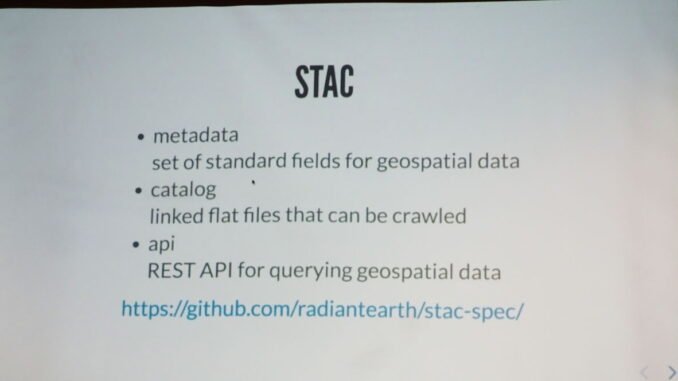
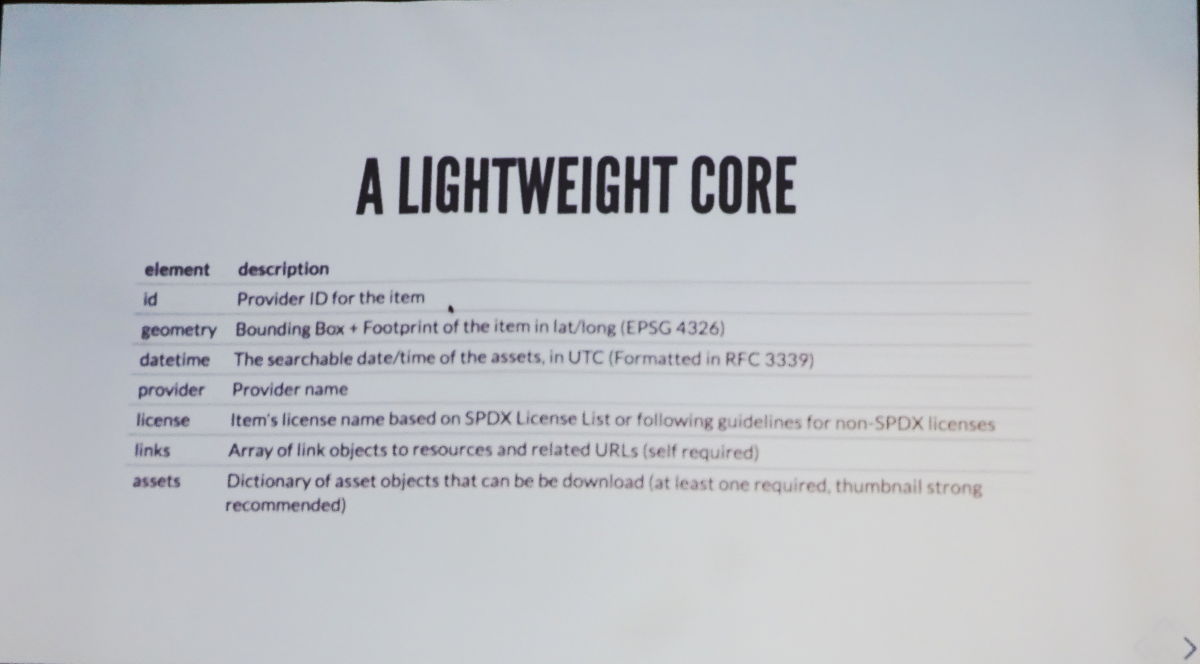 The STAC standard is minimalist, but balances that with extensibility. Basically it is comprised of metadata, catalog, and API. The core of STAC metadata is very simple, with only three mandatory fields; ID, geometry (for example, a bounding box in a defined projection), and date and time. The standard supports extensions, of which the earth observation standard “eo” has been defined at this time. Future extensions could include point cloud, mosaic and video extensions. The eo extension includes parameters such as camera viewing angle, resolution (dist between pixels), percent cloud cover, and band descriptions such as RGB, SWIR, band frequency and band accuracy.
The STAC standard and cloud optimized GeoTiff (COG) files makes it possible to search and stream imagery. COGs are GeoTiff files optimized for the cloud, for example, by streaming them from Amazon Web Services S3. Planet, Google Earth, and QGIS already support COGs and there are other open source tools such as COG-Explorer that support them as well.
https://sat-api.developmentseed.org/search/stac?datetime=2017&collection=landsat-8&eo:cloud_cover=0/20
Find all scenes from Dec 31, 2016 through Jan 1, 2018
https://sat-api.developmentseed.org/search/stac?datetime=2016-12-31/2018-01-01
The next developments that developmentSEED is planning for the STAC standard is to add more data CBERS and MODIS and to develop some applications based on the API.

Be the first to comment