
Last night in Crystal City the Open Geospatial Consortium (OGC) celebrated its first 20 years. To appreciate the OGC’s remarkable achievements it is valuable to look back to where geospatial was before the OGC was formed.
The Canada Land Inventory, which is considered the world’s first GIS, was designed in the late 1960’s and implemented between 1967 and 1977.
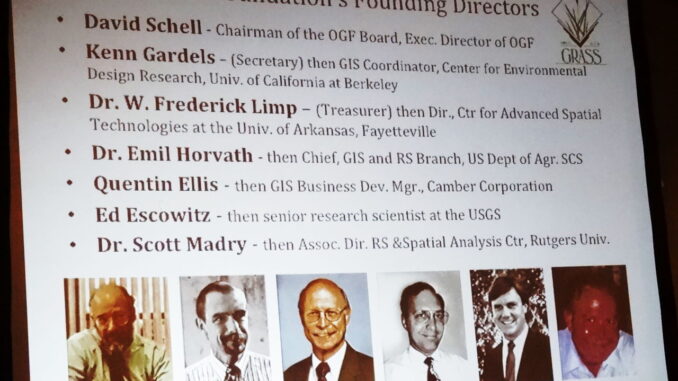
In the early 1980s, U. S. Army Corps of Engineers’ Construction Engineering Research Laboratory (CERL) developed GRASS (Geographic Resources Analysis Support System). Subsequently several U.S. government agencies including the Corps of Engineers, the Department of Agriculture Soil Conservation Service, and the National Park Service standardized on GRASS. Like Unix GRASS was freely available and universities around the world adopted it. In 1992, the GRASS user community formed a non-profit organization, the Open GRASS Foundation (OGF), intended to stimulate private sector support for GRASS and to create a consensus-based membership process for management of GRASS community affairs.
To put this in context Richard Stallman founded the Free Software Foundation in 1985. Development of the NCSA HTTP Server began in 1995. Subsequently a group of eight developers working on the NCSA HTTP Server came to be known as the Apache Group and the legal entity, the Apache Software Foundation (ASF), was founded in 1999. The Open Grass Foundation preceded the ASF by about seven years.
But GRASS did not provide a basis for comprehensive interoperability between different geosoftware packages. The OpenGIS Project envisioned diverse geoprocessing systems interoperating directly over networks by means of a set of open interfaces based on the “Open Geodata Interoperability Specification” (OGIS). To implement this vision, in 1994 the Open GIS Consortium (OGC) was founded with eight charter members Camber Corporation, University of Arkansas – CAST, Center for Environmental Design Research at the University of California – Berkeley, Intergraph Corporation, PCI Remote Sensing, QUBA, USACERL (US Army Corps of Engineers Construction Engineering Research Laboratory), and USDA Soil Conservation Service.
Today OGC standards comprise a platform for geospatial interoperability. They have been implemented in hundreds of commercial geoprocessing products, both proprietary and open source, and are being implemented by governments and non-government organizations around the world. An indication of their success is that other industries look to the geospatial sector and the OGC as a model for implementing interoperability.

Be the first to comment