

I was asked participate on a panel on open source geospatial organized by Eclipse LocationTech at the Location Intelligence in Washington DC. I decided to look at how software had changed since the early days of open source which I tend to tie to the formation of the Apache Software Foundation (ASF) in 1999. What I found was that the proprietary and open source software landscape has changed dramatically in the last 13 years. Here are some statistics that provide an indication of just how dramatic the change has been.
 Apache Software Foundation
Apache which started off supporting the Apache http server developed at the National Center for Supercomputing Applications (NCSA) now supports over 100 top level projects.
According to a Netcraft survey of 649,072,682 web sites in April 2013
- Over 51% run Apache http server
- Almost 20% run Microsoft IIS
Microsoft
In 1998 the infamous Halloween docs were leaked in which Microsoft identifed open source as a threat and discussed ways of combatting it.
April 2013 is the first anniversary of Microsoft Open Technologies, Microsoft’s own open source division. Microsoft also has another open source group, Outercurve, where more than 50% of the projects are run by non-Microsoft developers. Microsoft announced that Visual Studio now supports Github.
Browsers
Until several years ago, Internet Explorer was used by over 90% of users. The most recent statistics from W3Schools for April 2013 show marketshare for browsers is dominated by open source browsers, Chrome and Firefox. IE is a poor third now.
- Chrome 52.7 % (increasing)
- Firefox 27.9 % (decreasing)
- IE 12.7% mostly IE8 and IE9 (declining)
- Safari 4% (decreasing)
- Opera 1.7% (decreasing)
Operating systems on personal devices
 Until several years ago, PCs running MS Windows were used by over 90% of users. Now handheld devices such as smart phones lead PCs in annual sales. IDC 1Q2013 statistics for smartphone shipments show that in the last quarter, open source operating systems are dominant
- Android 75.0%
- iOS 17.3%
- Windows Phone 3.2%
- Blackberry OS 2.9%
- Linux 1.0%
- Symbian 0.6%
Software procurement
In many large organizations until recently the procurement playing field was tilted in favour of proprietary cmmercial and against open source software. In 2009 the Department of Defense (DOD), the world’s largest IT organization, issued a memorandum that leveled the playing field by stating that “OSS [open source software] meets the definition of commercial computer software”. The memorandum went on to identify some of the benefits of OSS for DOD.
- Fewer defects – many eyeballs means fewer defects
- Flexibility – easier to customize and adapt
- Multiple vendors instead of one – avoids vendor lock-in
- Unrestrictive license – simpler to deploy
- Cost advantage – when many copies are required
- Cost sharing – reduces DOD costs
- Prototyping and experimentation – OSS particularly suitable for this
Large IT systems
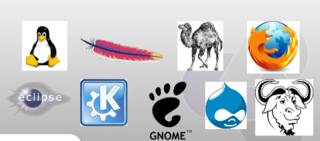 I blogged earlier about a study by Henrik Ingo that found that the world’s largest OSS projects including Linux, KDE, Apache, Eclipse, Perl+CPAN, Mozilla+Addons, Gnome, Drupal and GNU are collaborative community projects governed by non-profit foundations like Apache and Eclipse. These projects are10 times larger than the largest single-vendor projects. Ingo recommended that vendors seriously consider participating in a collaborative community run by a non-profit foundation because they could expect 10 time growth in the project and its addressable market.
Malware
Several years ago virtually all of the world’s malware exploits targeted MS Windows. Now according to F-Secure, exploits against mobile devices are exploding. In 1Q2013 the main target for mobile exploits is Android which is open source.
- 91.3% Android (49% increase over 4Q2012) *
- 8.7% Symbian
- Apple, Microsoft, and Blackberry – free of malware
In 1Q 2013 for the first time Android malware was identified by F-Secure as being distributed by email in addition to apps.
Geospatial open source
 The Open Source Geospatial Foundation was formed in 2006 supported by Autodesk. Prior to that geospatial software was dominated by proprietary vendors ESRI, Intergraph, Autodesk, Bentley, and others. Now there are many open source geospatial companies that provide alternatives to proprietary vendors. They primarily rely on OSGEO software such as PostGIS, OpenLayers, MapServer, GeoServer, and others. Earlier this year ESRI acquired GeoIQ and now offers both open source and proprietary software.
Open geospatial standards
 One of the key reasons for the rapid expansion in the deployment and use of open source geospatial software solutions is the open standards developed by the Open Geospatial Consortium notably the SQL Simple Feature Specification, KML, WMS, WFS, GML, and CSW. Open source and open standards are very different things, but open source gravitates to open standards. It is hard to imagine that geospatial open source would have progressed as rapidly and widely as it has without the OGC standards.

Be the first to comment