
At the Oracle Spatial and Graph User Meeting, the folks from Oracle outlined some of the things to expect in the next version of Oracle 12c. I was very impressed. All of the below is my interpretation of what will be in Oracle 12c.
Parametric curve support
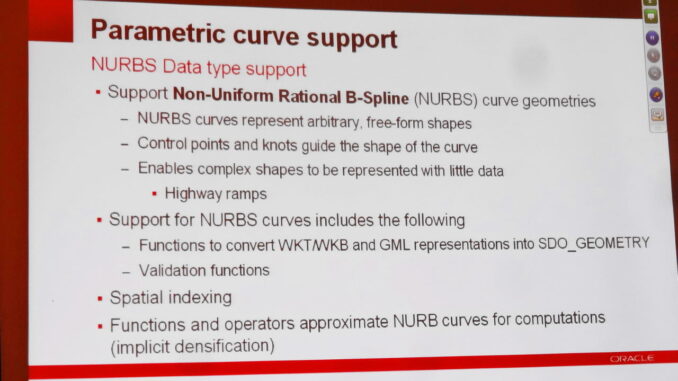
The really big news for the architecture, engineering and construction community (AEC) who use CAD and BIM applications is that Oracle 12c is expected to support NURBS (non-uniform rational basis spline) a type of parametric curve widely used in the design space. According the Siva Ravada the support will be very general and will be able to handle different ways of representing NURBS. Up to now the only parametric curve supported by Oracle was circular arcs.
To me it looks like Oracle is taking a major step toward being able to store natively and manipulate (in some cases by stroking) the parametrized curves used by CAD and BIM applications. There is a lot of CAD and BIM data out there and being able to store it and manipulate it in Oracle Spatial and Graph is going to be a game changer.
Orthorectification
Oracle is providing support for orthorectification embedded directly in the database. This will have important implications for the industry. Up to now, you had to pull the image out of where ever it was stored, transfer it over the network to someone’s application often from an image processing company to orthorectify it, and then transfer it back to store the image or stream it to the end user. With 12c you will be able to orthorectify images in the database. This is in line with Oracle’s objective of bringing processing to the data, rather than the data to processing.
Raster algebra
Oracle 12c will also have support for raster algebra, again in the database. For example, you will be able to average in the database12 months of national temperature data stored in monthly raster files.
GDAL and PDAL support
Oracle supports the open source GDAL raster libraries, the industry standard developed by Frank Warmerdam (now with Google) and used by just about everyone for accessing raster images including ESRI. PDAL is a similar type of open source library for point clouds developed by Howard Butler and Michael Gerlek.
3D
Oracle supports three types of 3D data. 3D vectors, point clouds and terrain (surfaces). Oracle 12c will provide full support for 3D geodetic data, lon lat and elevation in meters or feet.
Performance
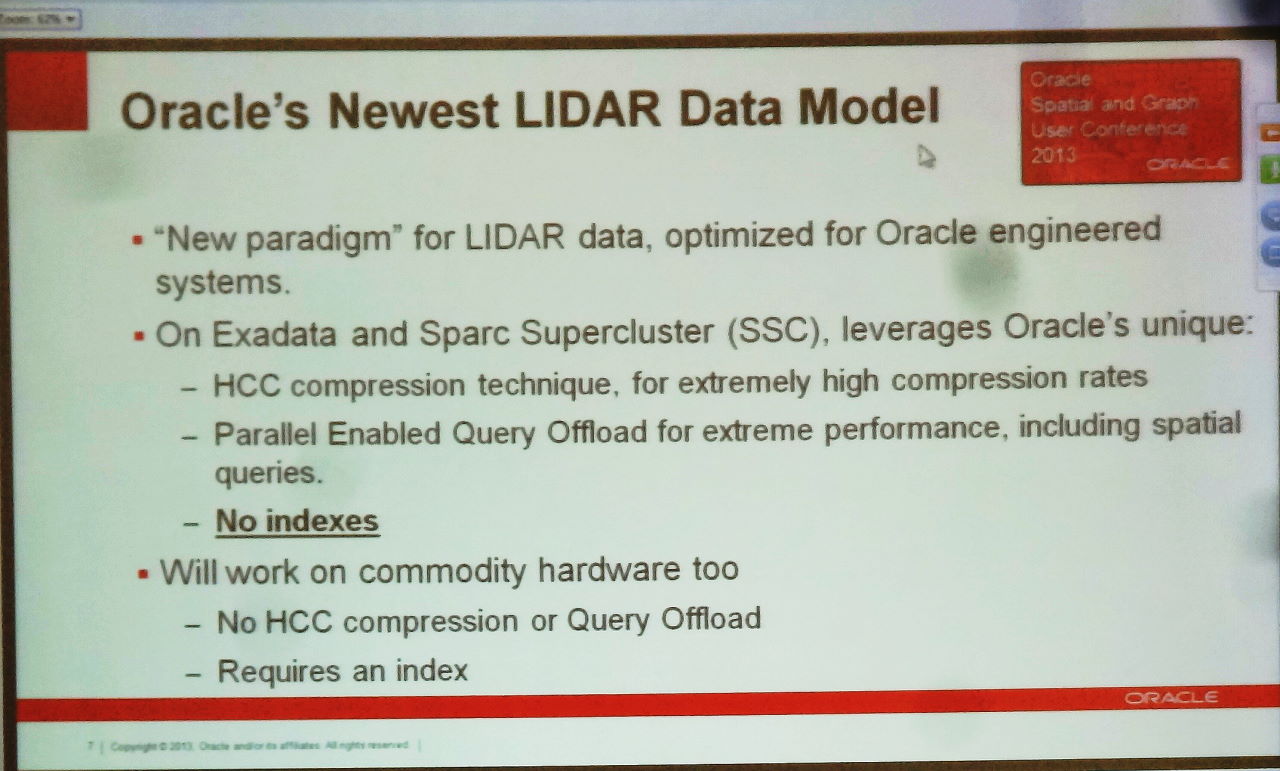 Oracle has developed a new engine for handling massive
point clouds. Dan Geringer showed impressive results for a 2.8 billion
point point cloud (286 gigabyte file).
Processing vector geospatial
data is reported to be 50 to 100 times faster in 12c than in 11g.
Raster
operations have been parallelized which can dramatically reduce the time it takes for these operations.
Engineered Database
Since acquiring Sun, Oracle has become a hardware and software company and is offering integrated hardware and software solutions that offer extremely good performance characteristics. For example, processing LiDAR data benefits from hardware acceleration on engineered machines such as Exadata boxes.
 Bundled data
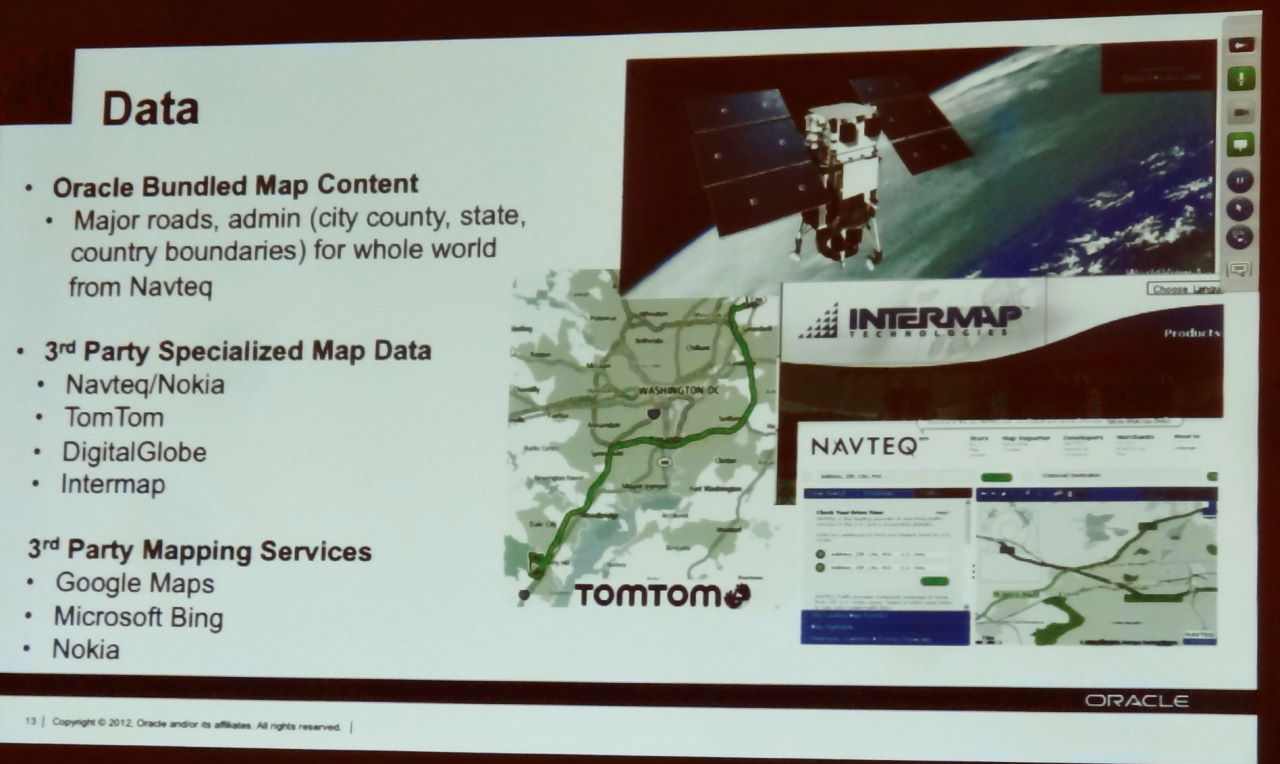
Oracle is planning to bundle vector data from Nokia (Navteq), TomTom and others.
Oracle Spatial and Graph
The name of the product is changing to Oracle Spatial and Graph partly because it has had graph capabilities (network and RDF semantic) already for several years. But probably more importantly because the demand for graph capabilities is accelerating, especially RDF semantic graphs for linked data, text mining, and for social media analytics, according to Xavier Lopez. Even Oracle’s NOSQL database (aka BerkeleyDB) is apparently getting graph capabilities.

Be the first to comment