
As I have blogged previously, cities are realizing that investment in maintenance and upgrading water, sanitary and stormwater infrastructure can no longer be deferred. They are being forced to find ways to fund these necessary improvements. Atlanta and Houston are examples of two cities who have found very different ways to fund water infrastructure rehabilitation.
Atlanta
 In 1998, the City of Atlanta signed a Federal consent decree to settle a lawsuit brought against the City by the US Environmental Protection Agency ( EPA), the Georgia Environmental Protection Division (EPD), the Upper Chattahoochee Riverkeeper and a citizen downstream. The consent decree committed the City to an accelerated program to improve water quality in metro Atlanta streams and the Chattahoochee and South Rivers. The consent decree specifically directed the city to end water quality violations resulting from combined sewer overflows (CSOs).
 In 1999 the consent decree was amended to include eliminating water quality violations from sanitary sewer overflows (SSOs). The consent decree specified a deadline for sanitary sewer improvements of 2014, though the city intends to complete these by 2012.
MOST and Municipal Borrowing
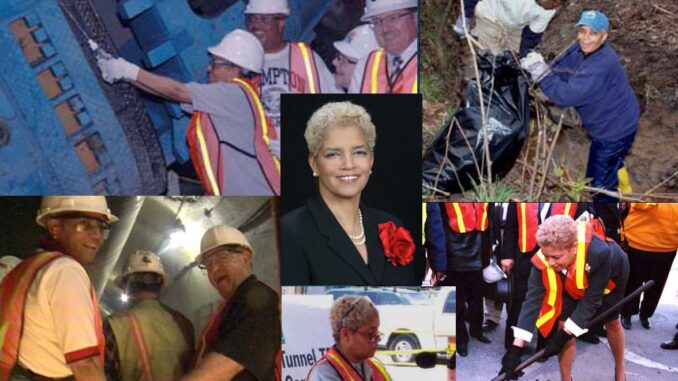
The estimated cost of the Clean Water Atlanta initiative, led by Shirley Franklin, the self-styled sewer mayor, to overhaul Atlanta’s sanitary and storm water system is $4.1 billion. The city used a number of approaches to fund the improvements including municipal option sales tax (MOST), expansion of low interest state revolving fund borrowing, federal grant funding, tax-exempt commercial paper (commercial loans) and current revenue financing. As part of the financing program the city started issuing tax exempt municipal bonds in September 2004. The MOST was responsible for a significant part of the revenue, and according to state law can be used to reduce water and wastewater rates.
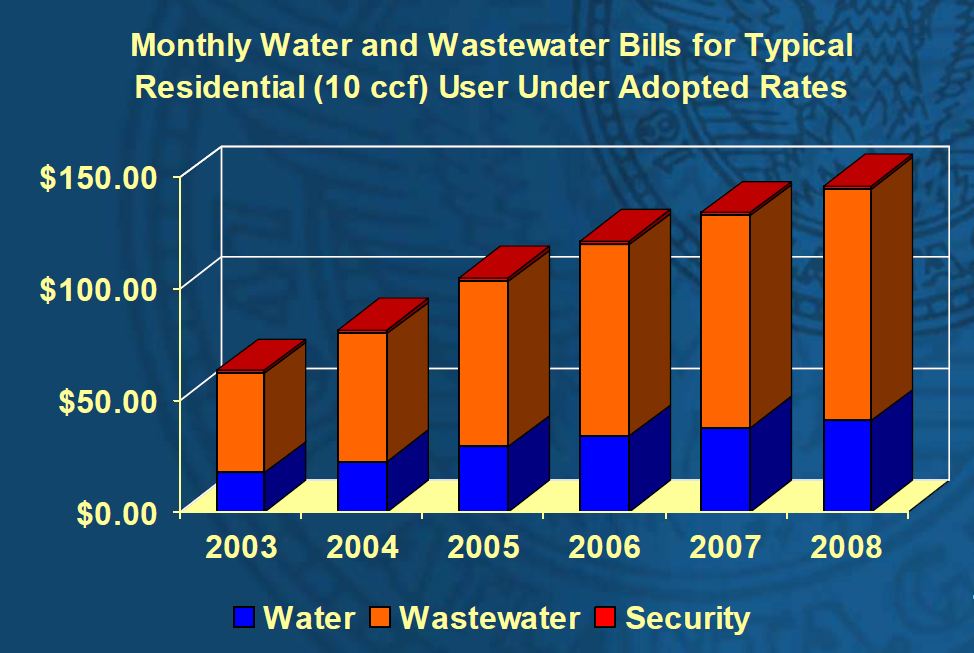
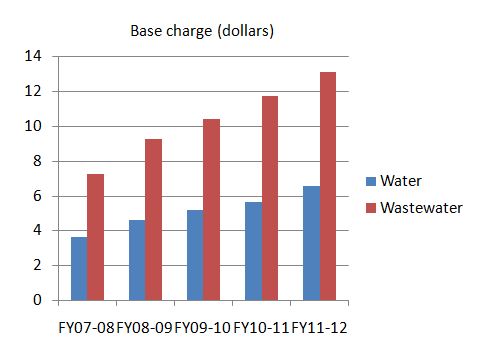
Water and wastewater rates increased 189% in the first five years. The approved rate increases for succeeding years are FY08/09 (27.5%), FY09/10(12.5%), FY10/11(12.5%), and FY11/12 (12.0%). I calculate that this amounts to more than a 5 fold increase in water and wastewater rates over about a decade. It is expected that the cost of borrowing will continue to be reflected in rates for the next 40 years.
Houston
 Last November, Proposition 1, a referendum on a proposal to improve drainage in Houston, was passed by a narrow margin. The proposal will spend $8 billion over 20 years on infrastructure projects targetted at alleviating flooding. To pay for the drainage program, the referendum proposed a drainage fee that would raise an estimated $125 million annually, in addition to developer fees and property taxes. Annise Parker, the Mayor of Houston, was a major supporter of the proposition because she believes that it is absolutely critical to invest in Houston’s crumbling infrastructure.

Drainage Fee
The city has proposed creating a dedicated infrastructure fund so that the city could avoid having to borrow money for infrastructure improvements. To finance the “Dedicated Drainage and Street Renewal Fund” citizens would pay a drainage fee based on the impervious surfaces on their property. Undeveloped land would not require a drainage fee, but an average homeowner with a 5,000 ft2 lot and a 1,900 ft2 house on a street with curbs and gutters would pay about $5 a month. The proposed drainage fee would apply to all residents and property owners, including churches, schools and other nonprofit groups. The only exemptions are those required by state law, which include higher education institutions and state properties.

Be the first to comment