
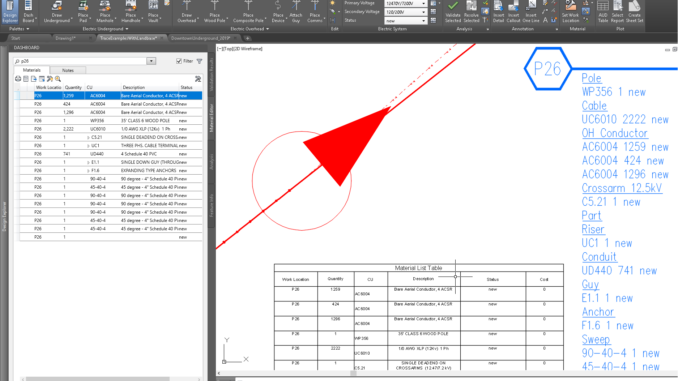
In the last few years strong business drivers for improving power distribution design productivity including an aging and shrinking workforce, an accelerating transition to the smart grid and a rapidly changing utility business model have emerged which are motivating utilities to transform their century old business practices. With new technologies utilities are finding that they can improve productivity by up to 60-70 % by integrating graphical design, engineering calculations such as flicker, voltage drop, guying, enforcement of engineering standards, and integration with enterprise systems to automate bill of materials generation and job estimating.
Distribution design in the power industry
Designing electric power distribution systems involves CAD drafting, engineering calculations such as sag, flicker, voltage drop, guying, wind loading, pulling tension and clearance and checking them against engineering standards to avoid under-engineering, using compatible units to compute jobs estimates, and comparing costs of different equipment to limit over-engineering. In many utilities distribution design remains a laborious error-prone process with redundant data entry, back of the envelope engineering calculations and manual lookups.
Furthermore once a design is completed it undergoes a typically paper-based workflow (especially for major jobs) that is inefficient and error-prone. The CAD design is printed for construction contractors to use in the field. After construction is completed the paper “as-built” comes back from the field to records possibly with red-lines that indicate what was actually constructed. The key metrics for this workflow are the as-built backlog and the accuracy of asset location in the utility GIS. These metrics are important for utilities because they directly affect key statistics such as average outage duration (SAIDI) reported by utilities to regulators. As examples: I remember a small utility in upstate New York where an engineer told me he spent two hours in the snow and darkness looking for a failed device and ultimately had to come back in the morning light to finally locate it. A large telecom I worked with could not locate some assets to within two city blocks which not only added to the time locating equipment that required maintenance but reduced the reliability of availability of services calculations. Fashioning AEC and geospatial data into an efficient data flow from planning through design and construction to operations and maintenance represents a challenge that remains a problem for utilities. The result of this broken workflow is an out-of-date, unreliable GIS that inhibits field workers from optimal productivity and complicates reporting of operational performance.
Business drivers for improving productivity
Utilities are facing business drivers that are motivating them to improve the productivity of their business processes and improving data quality including locational accuracy of assets to provide a near real-time digital twin of their assets. These drivers include an aging work force, the replacement of older workers by younger less experienced workers, a reliable near real-time GIS as the foundation for developing a smart grid, and a rapidly evolving utility business model that changes utility priorities.
With the new business models emerging in New York and other jurisdictions, utilities’ focus is shifting from selling energy to maintaining a reliable and resilient grid which makes reducing the frequency and duration of outages more critical.
Benefits of integrating engineering design, GIS and enterprise systems
In the last decade or so technology advances have provided a solution for low distribution design productivity and out-of-date and unreliable utility GIS. I have described the system developed by Southern California Edison (SCE) to integrate distribution and transmission graphical design (AutoCAD), utility GIS (Smallworld) and back office systems including ERP (SAP), customer service system, crew scheduling (Clicksoft), field operations (eMobile) and finance (SAP and PowerPlant). One of the workflows SCE focussed on was compatible units (CUs). CUs represent the cost of equipment together with the cost of labour to install the equipment. When combined with a bill of materials (BOM), CUs allow the designer to generate job estimates. The compatible unit workflow involves many systems including design, crew scheduling, materials ordering, and fixed asset accounting. As an example, at SCE designers were required to manually list the bill of materials on the design drawing and reenter it, again manually, in the materials ordering system. SCE’s integrated system was successful in improving productivity by bringing consistency and efficiency to distribution and transmission design, eliminating manual lookup, enforcing engineering standards to reduce the risk of under-engineering and avoiding the costs of over-engineering, and reducing or eliminating redundant data entry. The integrated system enables experienced workers to work faster with fewer errors and younger workers to become productive sooner. It sped up the design to GIS workflow and resulted in improved quality of the data in the utility GIS.
However, while the system implemented at SCE demonstrated the success of an integrated approach, it was a bespoke integration of design, enterprise GIS, ERP and other products and is beyond the reach of small and medium size utilities.
Benefits of a productized integrated solution
At Distributech 2019 I linked up with Dennis Beck of Spatial Business Systems (SBS), which took over responsibility for future development, support and licensing of AutoCAD Utility Design (AUD) software in 2016. He explained that SBS has transformed the architecture of the SCE integrated solution into off-the-shelf products that enable it to be cost-effectively implemented at any size utility. One of SBS’s customers has determined in detail the productivity benefits of an integrated architecture with SBS components for their engineering design workflow.
Nashville Electric Service (NES) is a publicly owned, nonprofit company that serves more than 355,000 customers in a large service area in Tennessee. As part of a major upgrade to their business processes NES benchmarked an integrated automated design, utility GIS and enterprise systems solution for two engineering design jobs using SBS components. NES performed the two jobs four different ways and assiduously recorded the time required for each step of the design process. This allowed them to estimate the quantitative benefits of different aspects of the integrated solution. The major components of the NES solution architecture were
-
Automated design – AUD is an AutoCAD-based desktop application that provides a model-based approach to design and bill of material generation along with a comprehensive set of engineering tools, including flicker, voltage drop, guying, and pulling tension and clearance checking. It supports both overhead and underground distribution design.
-
GIS integration – Integrating graphical engineering design with the utility GIS helps reduce as-built backlogs which are a major contributor to out-of-date utility GIS.
-
Enterprise integration – Integrating engineering design and utility GIS with the utility’s work order system, material management and financial systems makes it possible to automatically enforce engineering standards, generate construction work orders, layouts, bills of materials, design scenarios and estimated costs.
NES calculated the benefits of each level of improvement as applied to overhead and underground residential distribution design.
|
Overhead Time (mins) |
Overhead Time saved (%) |
Underground Time (mins) |
Underground Time saved (%) |
|
| AutoCAD | 173 | 81 | ||
| Automated design (AUD) | 145 | 16 % | 63 | 22 % |
| AUD with GIS integration | 132 | 8 % | 50 | 14 % |
| AUD with GIS and enterprise integration | 69 | 36 % | 23 | 34 % |
| Total savings | 104 | 60 % | 58 | 70 % |
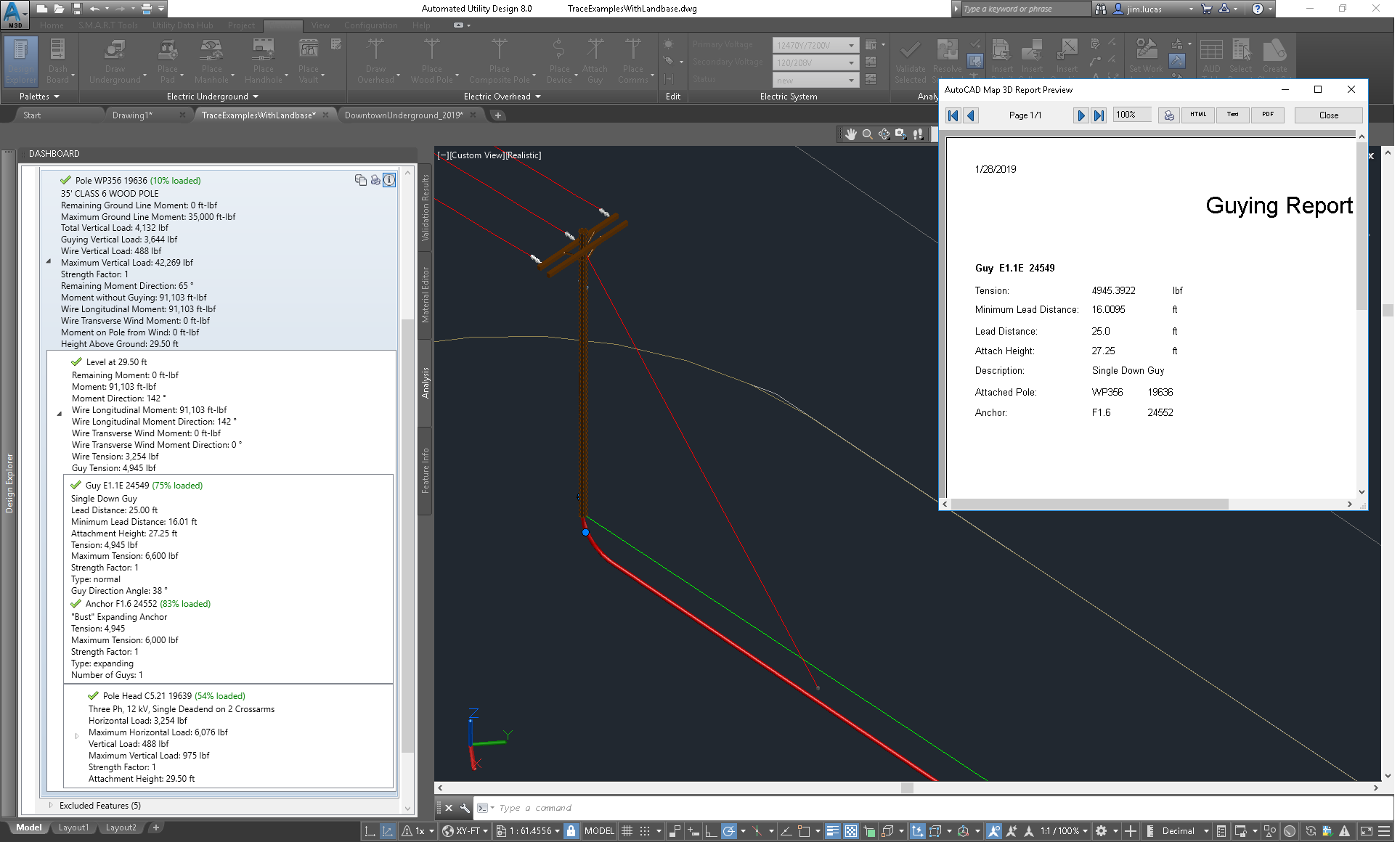 The analysis revealed important benefits from model- and rule-based approaches to engineering design. It enabled behind-the-scene calculation of physical things like wire sag, flicker and voltage drop. An important contributor to productivity improvement was to completely avoid the need to lookup or manually find engineering and drafting standards. The largest benefits from a productivity perspective were found by integration with enterprise systems especially compatible units which enabled automated bill of materials generation and job estimation.
NES further broke the overall workflow into subtasks including drafting, annotation, job estimating and enforcing engineering standards and analyzed the productivity improvements for each of these subtasks.
| Overhead residential design | AutoCAD | Automated design (AUD) | AUD with GIS integration | AUD with GIS and enterprise integration |
| Drafting | 60 mins | 95 mins | 82 mins | 61 mins |
| Annotation | 36 | 36 | 36 | 8 |
| Job estimating | 24 | 14 | 14 | 0 |
| Engineering standards | 53 | 0 | 0 | 0 |
| Underground residential design | AutoCAD | Automated design (AUD) | AUD with GIS integration | AUD with GIS and enterprise integration |
| Drafting | 25 mins | 31 mins | 18 mins | 18 mins |
| Annotation | 22 | 22 | 22 | 5 |
| Job estimating | 24 | 10 | 10 | 0 |
| Engineering standards | 10 | 0 | 0 | 0 |
The analysis revealed that while an integrated approach to design did not significantly change the time required for actual graphical drafting, it dramatically reduced the time required for annotation, applying engineering standards, and job estimating (including BOM generation). These improvements in productivity were derived primarily from eliminating redundant data entry and manual lookup. Another significant point is that these timings only represent the time savings to engineering design – they do not include savings on re-entry of data into the GIS from as-builts.
Other benefits that NES did not quantify include avoiding the risks associated with under-engineering, reducing the costs of over-engineering, increased quality of the utility GIS by recording engineering designs directly in the GIS rather than re-entering it from paper as-builts, and enabling less experienced workers to come up to speed faster without increasing the risk of errors or significantly reduced productivity.
Improving productivity of distribution design by up to 60-70% is a huge benefit. SBS is finding that other customers are reporting similar experiences, although they haven’t documented their productivity gains as meticulously as NES has done. For utilities that are facing a significant portion of their workforce retiring, this improvement in productivity can free up experienced engineers and others to accelerate the transition to the smart grid and to adapt to a rapidly changing utility business model.

Be the first to comment