
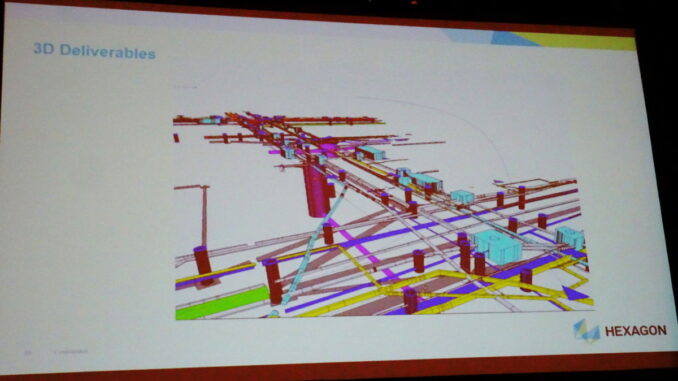
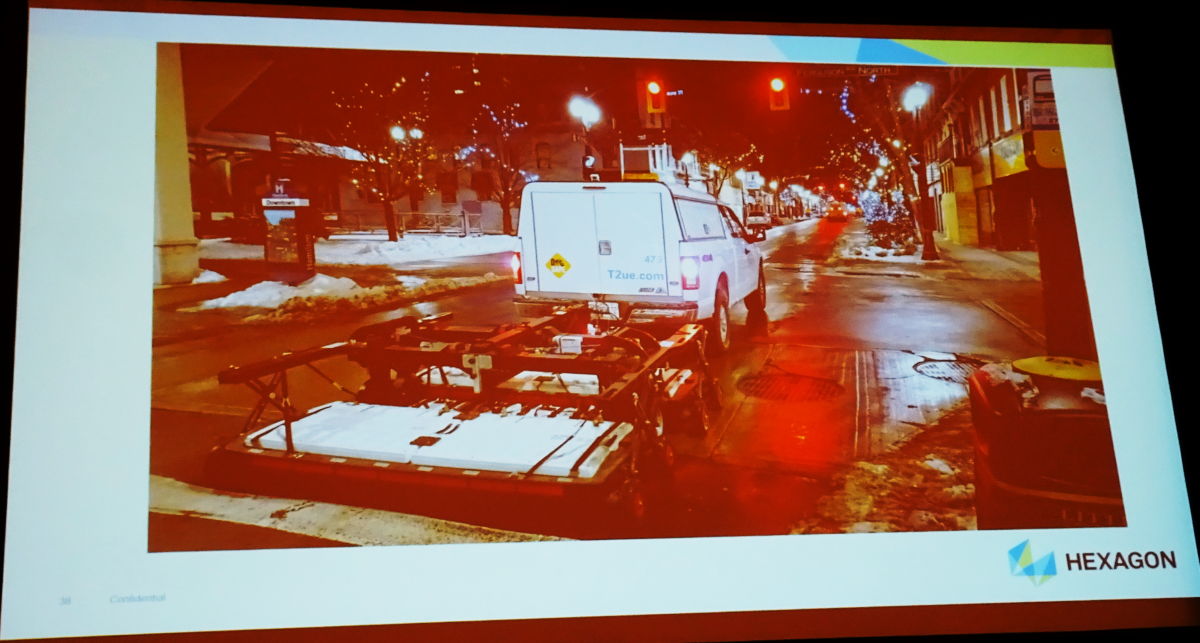
For the first time in my experience I have encountered a private company that is routinely using GPR and other underground remote sensing technologies to create accurate 3D models of underground infrastructure for their customers; municipalities, MoTs, engineering and construction companies and utilities. The data is captured by a towed Stream EM ground penetrating radar (GPR) array at 10 to 12 km/hour, which is fast enough not to hold-up traffic in most situations and does not require boots on the pavement making it a faster and much safer collection process.
 At HxGNLIve in Las Vegas this morning, Jamie Bradburn of T2 Utility Engineers, based in Whitby, Ontario, Canada gave a remarkable, game changing presentation in which he described how T2 used GPR, EMI, as-builts and whatever else thay can find to detect and identify underground utilities and other structures. For example, for a municipal customer planning on building a light rail, the GPR scan revealed basement encroachments under the road bed dating from the days when they were used as coal shutes. For another municipal customer they scanned with GPR and found a historic rail line even including rails in some places. In both cases if these hadn’t been detected before construction began, they would have held the projects up for months.
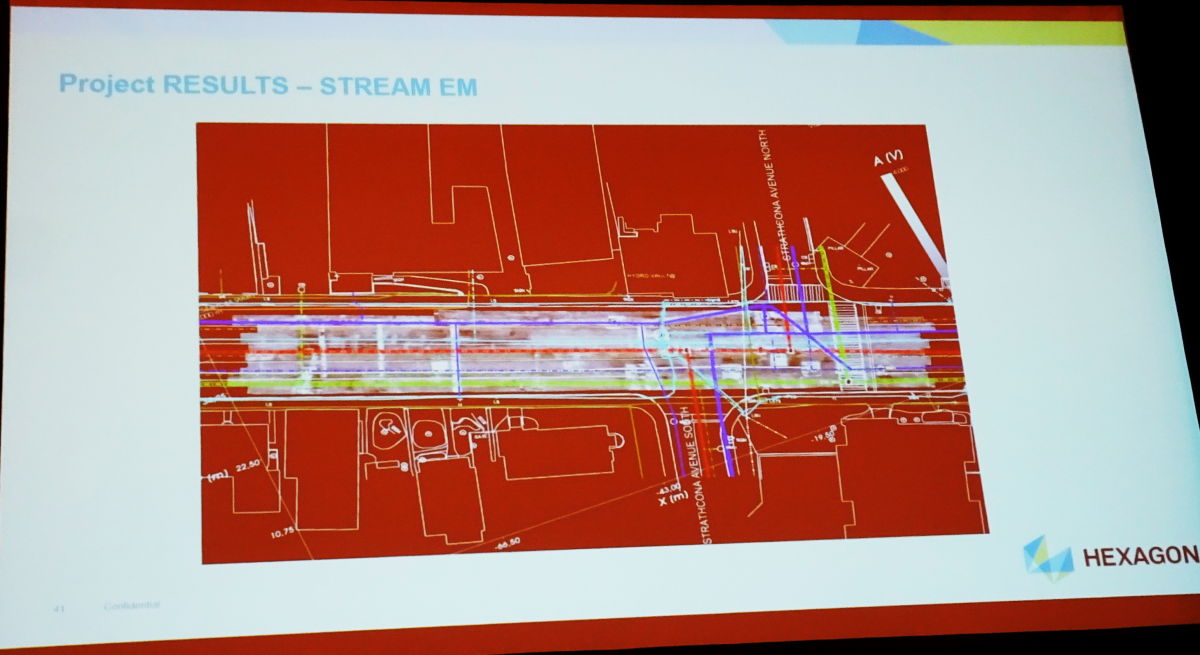 Jamie described how they routinely use GPR together with other data sources to create a 3D model. They first compile paper records, typically CAD as-builts, of the area of interest. In some cases they may do some EMI scanning to indentify meatallic objects such as older pipes and electric cables. Then they scan the roadbed using a GPR multi-channel array, a Stream EM from IDS GeoRadar (Hexagon), towed behind a truck travelling at 10-12 km per hour, optionally with a Pegasus 2 LiDAR to capture above ground context. Collecting the data does not require a skilled operator. Once the data is collected, it is post-processed back in the office to create a 3D model. This does require a skilled operator and can take up to two weeks per ten km section. Part of the process is taking cross sections of the GPR scans at different depths and superimposing the original CAD as-builts. The deliverable is a 3D model which T2 delivers using a variety of software including Bentley Subsurface Utility Engineering (SUE), AutoCAD, and others. I should add that the examples Jamie showed involved collecting GPR data in heavy clay which is not the best soil conditions for GPR.
Over the years I have heard many times a vision of remote scanning the subsurface and creating a 3D model, but this is the first time I have seem this done operationally. T2 Utility Engineers do many kinds of utility-related work and this is one of their profitable business lines.
This is truly ground breaking and I expect that this is the beginning of the practical, efficient, accurate and large scale mapping of underground infrastructure in 3D. Once municipalities, provinces and states and countries recognize the tremendous cost savings and avoidance of delays on major transportation and other projects that result from accurate subsurface 3D maps and that there is now a technology that can be applied efficiently and safely to capturing and interpreting the data required to create these 3D maps, I am confident the momentum for 3D mapping the subsurface will accelerate.

Be the first to comment