
In his inauguration speech, President Obama said
“The state of the economy calls for action, bold and swift, and we will act – not only to create new jobs but to lay a new foundation for growth. We will build the roads and bridges, the electric grids and digital lines that feed our commerce and bind us together. We will restore science to its rightful place, and wield technology’s wonders to raise healthcare’s quality and lower its costs. We will harness the sun and the winds and the soils to fuel our cars and run our factories. And we will transform our schools and colleges and universities to meet the demands of a new age. All this we can do. And all this we will do.“
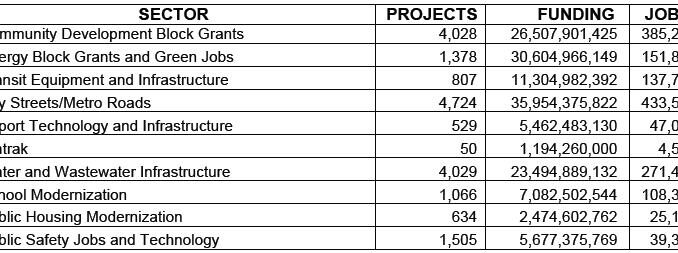
Practically what seems to be happening is that Congress intends to put a lot of money, the House of Representatives’ bill specifies $825 billion, into traditional infrastructure projects. To get some idea of how this money may be spent the US Conference of Mayors January 17 of this year produced an updated “ready to go” report
detailing 18,750 local infrastructure projects that are “ready to go”
in 779 cities. In total these projects represent an infrastructure
investment of $149 billion that would produce an estimated 1.6 million
jobs in 2009 and 2010. These projects fall into the areas of Community
Development, Energy and Green,
Transit Equipment and Infrastructure,
City Streets/Metro Roads, Airport Technology and Infrastructure,
Amtrak, Water and Wastewater Infrastructure, School Modernization,
Public Housing Modernization, and Public Safety Jobs and Technology. As an example, Las Vegas is proposing a number of project relating to rehabilitating downtown Las Vegas including park reconstruction, undergrounding aerial utility facilities, rehabiliataing the old Las Vegas Post Office, a new city hall and parking garage, and a performing arts center.
But to me the exciting thing is that the House bill also proposes putting a portion of this into high technology projects, $30 billion into computerizing medical records, $11 billion into smarter electrical distribution grids, and $6 billion to improve broadband access in rural and underserved communities. A report The Digital Road to Recovery: A Stimulus Plan to Create Jobs, Boost Productivity and Revitalize America by the Information and Technology Foundation predicts that these investments in America’s
digital infrastructure will lead to significant job creation in the short
run. The ITIF estimated that an “additional investment of $30 billion in America’s IT
network infrastructure in 2009 will create approximately 949,000 U.S.
jobs.” The investment in new technologies is seen as laying a foundation for productivity gains and innovation, and is what Obama was referring to when he referred to “lay[ing] a new foundation for growth.”

Be the first to comment