
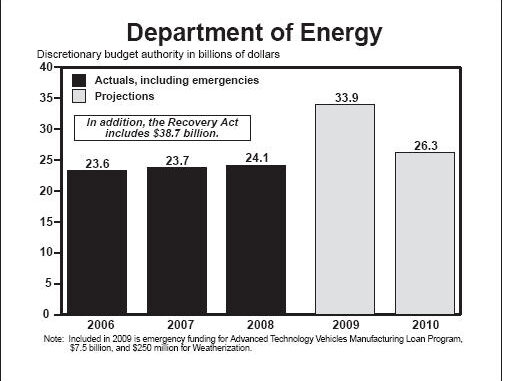
I have taken a quick glance at the Obama administration’s proposed budget for 2009 and it looks to be heavily focussed on sustainability and technology. Here’s a list of highlights I identified.
Virtually every measure is focussed on clean energy, the smart grid, and alternative energy.
- Begins to build a new economy that is powered by clean and secure energy through funding provided in the 2010 Budget and the $39 billion provided for energy programs in the American Recovery and Reinvestment Act of 2009.
- Provides significant increases in funding for basic research and world-leading scientific user facilities to support transformational discoveries and accelerate solutions to our Nation’s most pressing problems – including the development of clean energy.
- Supports economic investment and positions the United States as the world leader in climate change technology.
- Accelerates the transition to a low-carbon economy through increased support of the development and deployment of clean energy technologies such as solar, biomass, geothermal, wind, and low-carbon emission coal power.
- Builds on the $11 billion provided in the Recovery Act for smart grid technologies, transmission system expansion and upgrades, and other investments to modernize and enhance the electric transmission infrastructure to improve energy efficiency and reliability.
- Supports and encourages the early commercial deployment of innovative, clean energy technologies through loan guarantees.
- Reduces security risks through the detection, elimination, and securing of nuclear material and radiological sources worldwide while maintaining the safety, security, and reliability of the nuclear weapons stockpile.
- Continues the Nation’s efforts to reduce environmental risks and safely manage nuclear materials.
- Provides over $20 billion in loans and grants to support and expand rural development activities, including small businesses, renewable energy, and telecommunications.
- Develops Rural Broadband Services. Modern technology is critical to the expansion of business, education, and health care opportunities in rural areas and the competitiveness of the Nation’s small towns and rural communities. The Budget provides $1.3 billion in loans and grants to increase broadband capacity and improve telecommunication service and education and health opportunities in rural areas.
- Promotes Rural America’s Leadership in Developing Renewable Energy. America’s farmers have been on the forefront of the renewable fuels movement. The President has been a strong proponent for increasing the national supply of home-grown American renewable fuels. This Budget ensures that the Nation’s rural areas continue their leadership in this arena by supporting an additional $250 million in loans and grants. Rural America is poised to produce and refine more American biofuels; provide morewind power than ever before; and create millions of new jobs across the country.
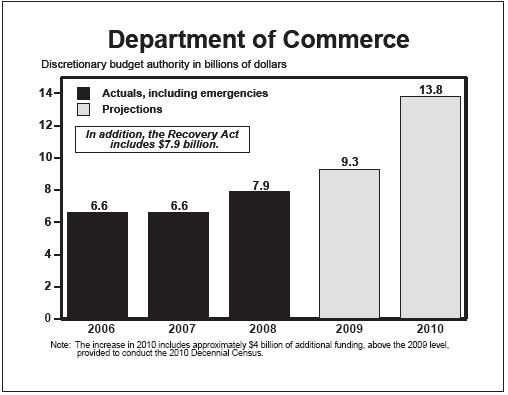
- Improves Weather forecasting, Climate Monitoring, fisheries Management and Ocean Programs. The Budget helps ensure continuity of National Oceanic and Atmospheric Administration (NOAA) satellite coverage needed for weather forecasting and climate data records by providing over $1.3 billion to fund the development and acquisition of vital weather satellites and climate sensors. Funding is also provided to advance climate and ocean research, including efforts to understand and monitor ocean acidification. In addition, the Budget fully supports implementation of the Magnuson-Stevens Act and its requirement to
eliminate overfishing by 2011. All of these activities build upon the recently enacted recovery Act, which provides $600 million for the construction and maintenance of NOAA research facilities, vessels, and satellites, as well as $230 million for habitat restoration, hydrographic services, research, and management operations. - Invests in America’s Competitiveness. The Budget supports the Nation’s technology infrastructure by funding advanced measurement and standards development at the National Institute of Standards and Technology (NIST).These activities will build upon the recovery Act, which includes $240 million for NIST’s scientific research activities and lab equipment and $180 million for construction of NIST facilities. The 2010 Budget also provides $70 million for the Technology Innovation Program, which invests in high-impact research that will address critical national needs and advance innovation. The Hollings Manufacturing Extension Partnership will receive $125 million to enhance the competitiveness of the Nation’s manufacturers by facilitating the adoption of more efficient manufacturing processes. In addition, Commerce’s National Telecommunications and Information Administration will be focused on administering the $4.7 billion provided by the recovery Act for programs to expand broadband deployment, adoption, and data collection.
Department of Housing and Urban Development
- Creates a New Energy innovation fund. The Budget includes funds for HUD to drive the creation of an energy-efficient housing market— including “retrofitting” of older, inefficient housing—and catalyze private sector lending for this purpose in the residential sector. Partnering with the Department of Energy on this initiative, HUD will contribute to the Administration’s broader effort to combat global warming, jumpstart the creation of a green economy, and reduce utility bills.
- Assists State and Federal land management agencies with over $130 million in additional funding
to monitor, adaptively manage and assess the impacts of climate change on the Nation’s lands,
fish and wildlife. - Invests over $50 million to promote renewable energy projects on Federal lands and waters. invests in a Clean Energy future. DOI will play a central role in achieving the President’s vision for a clean energy future advancing our national security, environmental security, and
economic opportunity. The Department will help lead the way when it comes to enhancing the Nation’s
domestic energy supply and moving toward a clean energy economy. Our public lands, and the offshore resources that we control already provide close to one-third of our entire domestic supply of oil and gas resources. The Budget includes over $50 million in increases to conduct the environmental
evaluations and technical studies needed to spur development of renewable energy projects,
assess available alternative resources, and mitigate the impacts of development.
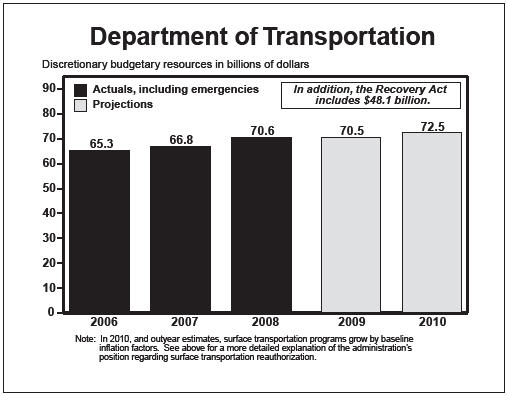
- Increases funding for public transit to support commuters, improve air quality, and reduce greenhouse gases.
- Supports development of high speed rail networks across the country to link regional population centers.
- Commits to developing Sustainable Solutions for Surface Transportation Programs
and to improving Program Performance. Surface transportation programs are at a crossroads.
The current framework for financing and allocating surface transportation investments is not financially sustainable; nor does it effectively allocate resources to meet our critical national needs. The Administration intends to work with the Congress to reform surface transportation programs both to put the system on a sustainable financing path and to make investments in a more sustainable future, enhancing transit options and making our economy more productive and our communities more livable. Further, the Nation’s surface transportation system must generate the best investments to reduce congestion and improve safety. To do so, the Administration will emphasize the use of economic analysis and performance measurement in transportation planning. This will ensure that taxpayer dollars are better targeted and spent. - Initiates a New federal Commitment to high Speed Rail. To provide Americans a 21st Century transportation system, the Administration proposes a five-year $5 billion high-speed rail State grant program. Building on the $8 billion down payment in the American recovery and reinvestment Act of 2009, the President’s proposal marks a new Federal commitment to give the traveling public a practical and environmentally sustainable alternative to flying or driving. Directed by the States, this investment will lead to the creation of several high-speed rail corridors across the country linking regional population centers.
- Focuses Construction on high-Return investments. The construction program supports high-return investments in the three main mission areas of the Corps: 1) facilitating commercial navigation; 2) reducing the risk of damage from floods and storms; and 3) restoring significant aquatic ecosystems.
Environmental Protection Agency
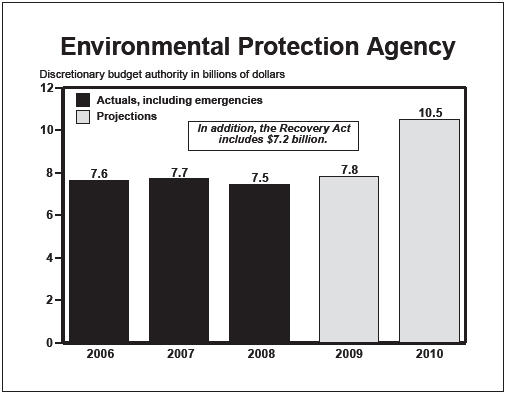
- Provides $10.5 billion in total for the Environmental Protection Agency, a 34-percent increase over the 2009 likely enacted level.
- Provides $3.9 billion for the Clean Water and Drinking Water State Revolving Funds, an unprecedented Federal commitment to water infrastructure investment in the United States.
- Provides $475 million for a new Environmental Protection Agency-led, interagency Great Lakes restoration initiative, which will target the most significant problems in the region, including invasive aquatic species, non-point source pollution, and contaminated sediment.
- Funds the Agency’s operating budget, which comprises its core regulatory, research, and enforcement activities, at $3.9 billion, the highest level ever.
- Provides over $1.1 billion in grants for States and Tribes to administer environmental programs.
- Begins a Comprehensive Approach to Transform Our Energy Supply and Slow Global Warming. The Administration is developing a comprehensive energy and climate change plan to invest in clean energy, end our addiction to oil, address the global climate crisis, and create new American jobs that cannot be outsourced. After enactment of the Budget, the Administration will work expeditiously with key stakeholders and Congress to develop an economy-wide emissions reduction program to reduce greenhouse gas emissions approximately 14 percent below 2005 levels by 2020, and approximately 83 percent below 2005 levels by 2050. This program will be implemented through a cap-and-trade system, a policy approach that dramatically reduced acid rain at much lower costs than the traditional Government regulations and mandates of the past. Through a 100 percent auction to ensure that the biggest polluters do not enjoy windfall profits, this program will fund vital investments in a clean energy future totaling $150 billion over 10 years, starting in fiscal year 2012. The balance of the auction revenues will be returned to
the people, especially vulnerable families, communities, and businesses to help the transition to a clean energy economy. The Budget includes a $19 million increase for EPA work on a Greenhouse Gas (GHG) emission inventory and to work with affected industry sectors to report high-quality GHG emission data. This will also allow for work on the necessary steps toward implementing a comprehensive climate bill.
National Aeronautics and Space Administration
- Provides $18.7 billion for the National Aeronautics and Space Administration. Combined with the $1 billion provided to the agency in the American Recovery and Reinvestment Act of 2009, this represents a total increase of more than $2.4 billion over the 2008 level.
- Funds a program of space-based research that supports the Administration’s commitment to deploy a global climate change research and monitoring system.
- Funds a robust program of space exploration involving humans and robots. The National Aeronautics and Space Administration will return humans to the Moon while also supporting a vigorous program of robotic exploration of the solar system and universe.
- Funds the safe flight of the Space Shuttle through the vehicle’s retirement at the end of 2010. An additional flight will be conducted if it can be completed safely before the end of 2010.
- Funds the development of new space flight systems for carrying American crews and supplies to space.
- Funds continued use of the International Space Station to support the agency and other Federal, commercial, and academic research and technology testing needs.
- Funds aeronautics research to address aviation safety, air traffic control, noise and emissions reduction, and fuel efficiency.
- Advances Global Climate Change Research and Monitoring. The National Aeronautics and Space Administration’s (NASA’s) investment in Earth science research satellites, airborne sensors, computer models, and analysis has revolutionized scientific knowledge and prediction of climate change and its effects. Using the National research Council’s recommended priorities for space-based Earth science research as its guide, NASA will develop new space-based research sensors in support of the Administration’s goal to deploy a global climate research and monitoring system. NASA will work to
deploy these new sensors expeditiously while coordinating with other Federal agencies to ensure continuity of measurements that have long-term research and applications benefits. - Renews NASA’s Commitment to Aeronautics Research. A strong national program of aeronautics research and technology contributes to the economic well-being and quality of life of American citizens. NASA will renew its commitment to cutting-edge, fundamental research in traditional and emerging disciplines to help transform the Nation’s air transportation system and to support future aircraft. NASA research will increase airspace capacity and mobility, enhance aviation safety, and improve aircraft performance while reducing noise, emissions, and fuel consumption.
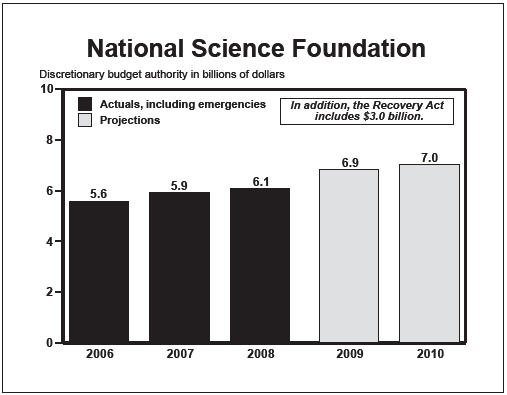
- Provides $7 billion for the National Science Foundation, a 16-percent increase over the 2008 level, as part of the President’s Plan for Science and Innovation.
- Increases support for graduate research fellowships and for early-career researchers.
- Increases support for the education of technicians in the high-technology fields that drive the Nation’s economy.
- Encourages more novel high-risk, high-reward research proposals.
- Increases support for critical research priorities in global climate change.
- Makes Climate Change Research and Education a Priority. The Budget supports research to improve our ability to predict future environmental conditions and to develop strategies for responding to global environmental change. The Budget establishes a climate change education program to help develop the next generation of environmentally engaged scientists and engineers.

Be the first to comment