

I blogged some time ago about the Federally-initiated Green Button initiative. Aneesh Chopra, then CTO of the US, in his keynote at the Gridweek conference in Washington DC, challenged the electric utility industry to do what the Federal government initiated at
Veterans’ Affairs and what was taken up by the private health industry –
“blue button” access to personal health records. For electirc power utility customers with smart meters he challenged the electric utility industry to implement a “Green Button”
program, so that every consumer with a “click of a green button” can
access and download personal electric usage data. And not only that, but give permission for thrid parties to see their data anonymously as well. To date, utilities in seventeen states including Arkansas, California, Illinois, Indiana, Kentucky, Louisiana, Maryland, Massachusetts, Michigan, North Carolina, Ohio, Oklahoma, Pennsylvania, Tennessee, Texas, Virginia, West Virginia, and Washington, D.C. have implemented Green Button programs.
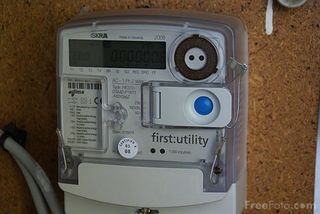 Green Button web sites were launched at Pacific Gas and Electric and San Diego Gas and Electric. Southern California Edison offers a Green Button program to certain of its customers
who have smart meters. By clicking on the green button, customers can
view online or download their historical electricity usage data in a
standard form that allows them to view their data on their own desktop
computer. You can see simple examples at the Green Button web site.
People are also being encouraged to share their energy usage data with
third party companies who would like access to consumer data because it
helps them target their products to real consumer needs. With the Green
Button system, a consumer can download previous electric power usage
information from their utility and then make it available to an energy
company (using a process designed to protect consumer privacy).
California Public Utilities Commission Rulemaking to Protect Consumer Privacy
What I wasn’t aware of, and just came across on the Center for Spatial Law and Policy site (an incredible trove of information about legal and policy issues related to spatial data) is the rulemaking by the California Public Utilities Commision, which regulates electric power in California, that defines the rules for providing access to and protecting the privacy of consumer electric power usage data collected by smart meters. Some extracts;
“This decision adopts rules to protect the privacy and security of customer data generated by Smart Meters concerning the usage of electricity that are deployed by Pacific Gas and Electric Company (PG&E), Southern California Edison Company (SCE), and San Diego Gas & Electric Company (SDG&E). The rules adopted implement the protections ordered by Senate Bill (SB) 1476 (Chapter 497, Statutes of 2010)….
“the decision adopts policies to govern access to customer usage data by customers and by authorized third parties. PG&E and SCE must continue to provide and SDG&E must provide access to customer usage data. Each utility must provide pricing, usage and cost data to customers in the customer-friendly manners discussed below..
“PG&E, SCE, and SDG&E must … make price, usage and cost information available to its customers online and updated at least on a daily basis. Each day’s usage data, along with applicable price and cost details, and with hourly or 15-minute granularity (matching the time
granularity programmed into the customer’s smart meter), must be available by
the next day…
“PG&E, SCE and SDG&E must … provide third parties access to a customer’s usage data via the utility’s backhaul when authorized by the customer. The three utilities should propose a common data format to the extent possible and be consistent with ongoing national standards
efforts…
“Customer Authorization.
(1) Authorization. Separate authorization by each customer must be obtained for all disclosures of covered information…
(2) Revocation. Customers have the right to revoke, at any time, any previously granted authorization.”
In other words the date belongs to the consumer, not the utility, and the consumer decides who has access to it, not the utility.

Be the first to comment