
The European construction market amounts to € 1.2 trillion annually or 9.9% of total EU GDP. There are 3.1 million organizations in the European construction industry of which more than 95% are SMEs. As in many jurisdictions over a third of construction projects are overbudget or overschedule.
In January 15, 2014 the European Parliament passed the European Union Public Procurement Directive (EUPPD) which among other things recommended the use of building information modelling (BIM) for public works contracts to enable more efficient construction and building projects in Europe. Passage of the bill allowed member states to encourage, specify or mandate the use of BIM for publicly funded construction and building projects in the EU by 2016.
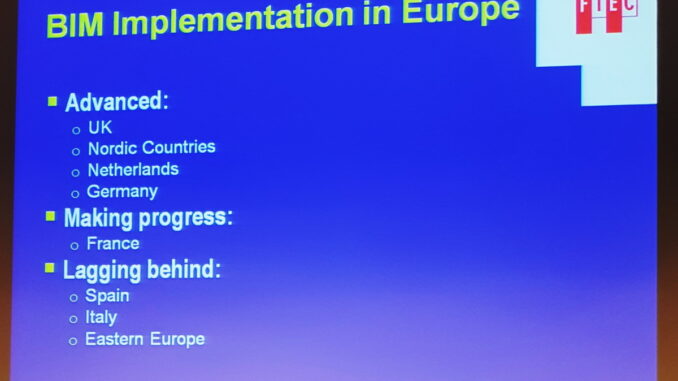
Prior to that some EU governments had already mandated or had concrete plans to mandate BIM for publicly funded projects. Finland, the UK, the Netherlands, Denmark, and Norway led BIM adoption in Europe. At the recent GeoBIM Building and Infrastructure conference in Amsterdam, Kjetil Tonning, Vice President of the European Construction Industry Federation (FIEC), gave an overview of the status of BIM for infrastructure in the EU with the objective of determining whether BIM for infrastructure (horizontal BIM) is lagging behind BIM for buildings (vertical BIM) in Europe. His assessment of various countries’ progress with respect to BIM for infrastructure reveals that some countries are making rapid progress while others are lagging.
Germany
Last year Alexander Dobrindt, Bundesminister für Verkehr und digitale Infrastruktur (BMVI), announced a step-by-step plan for the introduction of BIM. It requires three steps: a preparatory phase up to 2017, a pilot phase by 2020, and mandatory BIM is to be used from 2020 on all newly planned projects of the BMVI. Dobrindt’s goal is to make digital planning and building nationwide a standard. To achieve this the public sector has to act as a major builder in order to drive cultural change. The German government has set up a committee for reforming large construction project. It has formulated the principle: “Erst digital, dann real bauen” (Build digitally first, then real). Four pilot projects have been launched to obtain real world experience with BIM. BMVI has developed a timetable for the planning and building of the future, which will make BIM a new standard for transport infrastructure projects by 2020.
Sweden
In Sweden a project BSAB to develop a classification system for buildings and civil engineering works has culminated in the development of a classification standard CoClass, which is based on international standards for classification and ISO standards for data transfer (ISO 12006-2). BSAB is owned by the Swedish Building Centre, a company that is owned by 32 Swedish construction and FM organizations.
CoClass is the result of an extensive industry-wide development effort called BSAB 2.0 which ran for over a year and a half. Unlike other classification systems the classification is BIM-based and is intended to cover the entire built environment through the full life cycle including operations and maintenance. The project has been supported by the the Swedish Building Centre, BIM Alliance Sweden, Swedish Transport Administration (Trafikverket), Cooperation Forum for state property developers and managers, PEAB, BEAst, Swedavia, Swedish Association of Local Authorities and Regions (SKL) and the Stockholm County Council (SCC) traffic management. Trafikverket and others are now implementing CoClass.
Spain
The Spanish government’s BIM roadmap foresees mandatory BIM for public infrastructure projects occurring after mandatory BIM for buildings. But the Government’s strategy has been delayed and at this time the timetable remains unclear.
BIM for Infrastructure in Europe
Kjetil Tonning concluded that BIM for infrastructure is lagging behind BIM for buildings in Europe. EU policy could help correct this. He mentioned climate change, circular economy, strategy on the urban environment, prevention of natural and man-made disasters, and the digital agenda as areas where EU policy initiatives would help accelerate the adoption of BIM for infrastructure by EU member states.

Be the first to comment